Industry Insights · Industry
What Power and Energy Operations Demand of XR Hardware. A Requirements Read for Plant and Grid Training Leads.
By QWR Engineering
Power and energy work has two properties that make immersive training attractive. The procedures that matter most are the ones that cannot be practised for real: switching sequences on live equipment, isolation of high-voltage circuits, emergency response in a generating station. And the people who need training are spread across many sites, from thermal and hydro plants to substations in remote districts.
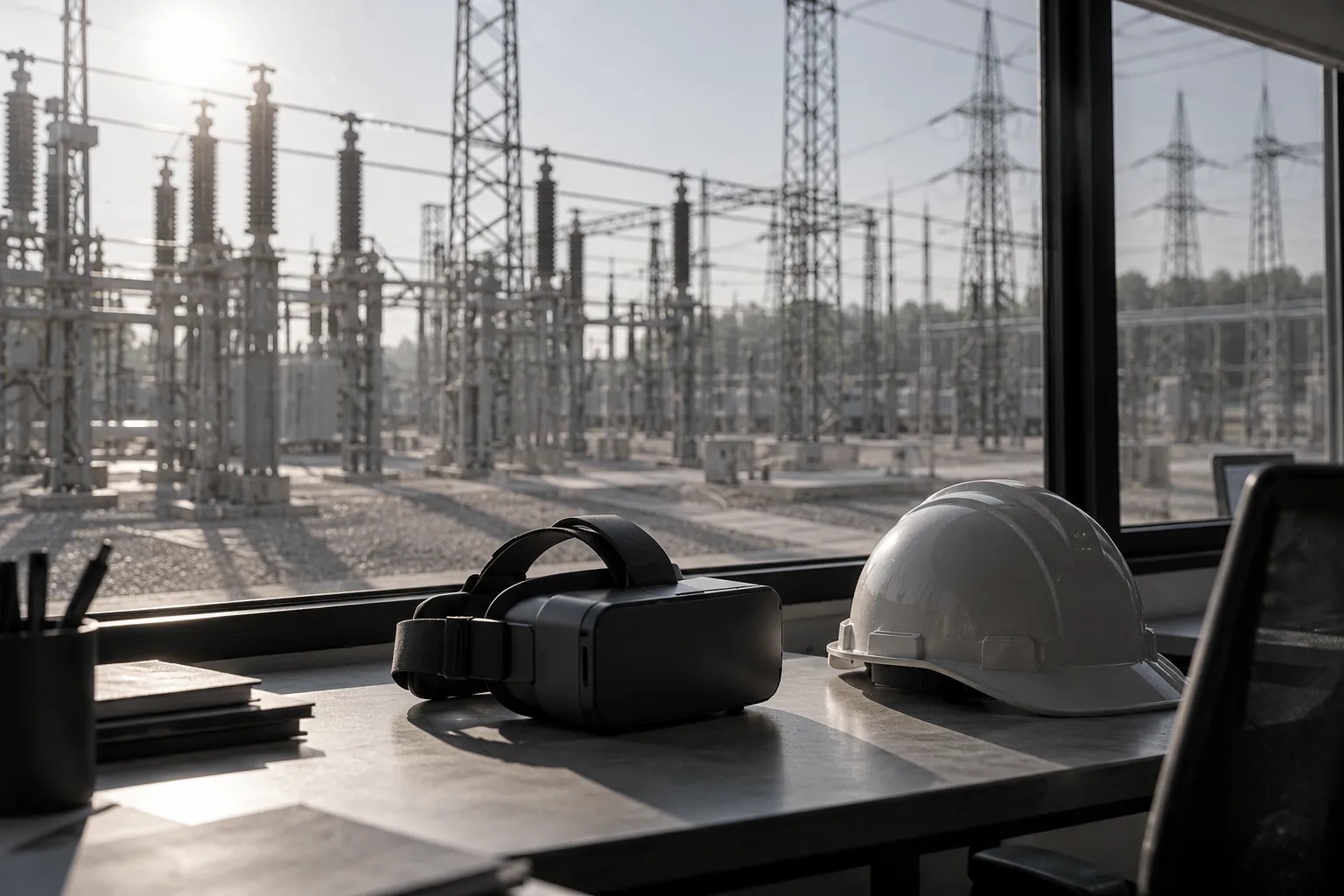
Illustrative image. These are not what our headsets look like.
Virtual reality lets a lineman or substation operator rehearse a switching sequence without energising anything. Augmented reality lets a field engineer see a single-line diagram or an isolation checklist while standing in front of the equipment. Both promise a great deal. Both also run into conditions that most XR hardware was not designed for: bright sun, rain, dust, wide outdoor spaces, and procurement rules that differ from the private sector.
This paper sets out what power and energy operations ask of XR hardware, for training leads at utilities, generating companies and their contractors.
Two different use cases, two different devices
It helps to separate power and energy XR into two settings, because they place opposite demands on hardware.
Training, usually indoors. VR modules for switching sequences, high-voltage safety, permit-to-work procedures, plant familiarisation and emergency drills. These usually run in a training centre or a control building, away from live equipment. The trainee is fully immersed and the outside world is blocked out.
Field operations, often outdoors. AR glasses that show procedures, diagrams, checklists or a remote expert's guidance while the engineer works on real equipment. These are used in substation yards, on transmission structures and inside plant buildings. The engineer must see the real world clearly at all times.
A single fleet rarely serves both well. Many utilities will need VR headsets for the training centre and AR or voice-first glasses for the field. Deciding which programme comes first avoids buying the wrong device for both.
Training: what high-voltage and switching modules ask of a headset
Positional tracking and space
Switching and isolation procedures involve moving along a switchboard, between panels, or around a yard. Modules that rehearse these need positional tracking, so the device knows where the trainee is, not only where they are looking. QWR's paper on 3DoF vs 6DoF explains the distinction.
Substation yards are large. A module that simulates walking a yard either needs a large cleared training space or uses some form of virtual movement. Ask the content provider which, and what physical area the module assumes.
Hand input for operating equipment
Rehearsing a switching sequence means operating breakers, isolators and earth switches in the correct order, and applying locks and tags. The value of the training lies in building the sequence into muscle memory. Hand tracking, or controllers mapped sensibly to each action, both work; what matters is that the module registers each step distinctly. The companion paper Which Safety Modules Need Which Headset covers lockout tagout requirements in detail.
Multi-user drills
Some energy procedures involve coordination: a control room operator and a field operator confirming each step of a switching programme over the radio. Multi-user modules let both roles train together.
What to ask. Does the module support more than one trainee in the same scenario? Can trainees in different locations join? What network does that require?
Training records
Utilities often need evidence of competence for authorisation to work on particular equipment. The companion paper Getting Training Records Off the Headset covers what the device must support so records reach the learning management system.
Outdoor sunlight, glare and weather exposure
This section is specific to energy field work, where much of the equipment is outdoors.
Direct sunlight and VR headsets
VR headsets should not be used or left outdoors in direct sunlight. Their lenses are designed to focus light from the internal displays onto the eye; pointed at the sun, they can focus sunlight onto the displays and damage them. This is a known limitation of the category, widely noted in manufacturer guidance, and it is one reason VR training belongs indoors.
If a utility wants to run VR training at remote substations, plan for an indoor space, such as the control building, rather than the yard.
Display visibility in daylight for AR glasses
AR glasses for field use face the opposite problem. Their displays must remain readable against a bright sky or a sunlit concrete yard. A display that looks clear indoors can wash out completely outdoors.
What to ask. - What is the display brightness, and has the device been tested in direct sunlight? - Does it support tinted or photochromic lenses, or a clip-on shade, to improve contrast? - How does the display behave when the user looks from a bright yard into a dark relay room?
QWR's papers on light engine selection for see-through AR and choosing a waveguide architecture explain how display technology affects outdoor brightness and transparency.
Voice-first as an alternative
For many field tasks, the engineer does not need to see anything: they need to hear the next step and confirm it aloud. Voice-first glasses without a display avoid the sunlight problem entirely. QWR's paper on when a field task needs a display and when voice is enough sets out how to decide.
Rain, dust and temperature
Outdoor substations expose devices to rain, dust and wide temperature ranges.
What to ask. - What ingress protection rating does the device carry, and what does each digit mean for your conditions? QWR's paper on IP ratings across AI glasses explains how to read them. - What is the operating temperature range, and how does the device behave at the edges of it? - How does heat affect battery life and display performance on a summer afternoon?
Wearability with protective equipment
Field engineers wear hard hats, safety glasses and, for some tasks, arc-rated face shields and hoods. Glasses that cannot be worn with the required protective equipment will not be used.
What to ask. Can the device be worn with the hard hat and safety eyewear the utility specifies? Is it compatible with arc flash protection, or should it be removed for tasks that require it? This last question should go to the utility's own safety team as well as the vendor.
Electrical environments
Substations and switchrooms contain strong electromagnetic fields. Electronic devices can be affected by them, and some sites restrict which devices may be carried into certain areas.
What to ask. Has the device been tested for electromagnetic compatibility in conditions similar to a substation? Does the site have rules on wireless devices near protection relays or control equipment? These are questions for the utility's engineering standards team as well as the vendor. This paper makes no claim about any device's performance in such fields.
Fleet and connectivity at remote sites
Energy sites are dispersed. A utility may have hundreds of substations, many with limited connectivity.
Offline operation. Training modules and field procedures should run without a connection, with records and logs synchronised later.
Fleet management. Devices across many sites need remote management, updates and the ability to wipe a lost unit. QWR's paper on kiosk mode, secure boot and remote MDM covers the mechanisms.
Charging. At a remote substation, charging may happen only in the control building. Plan battery capacity against a full field shift.
Procurement filters for public sector utilities
In India, much of the power sector is owned or operated by central and state public sector undertakings. Their procurement follows public procurement rules, which can include domestic content preferences and specific bidding processes.
QWR's papers on what a domestic-content clause actually excludes and the Make in India advantage for XR buyers cover how these filters apply to XR hardware. A utility training lead should confirm with the procurement team which preferences apply before shortlisting devices.
Typical pattern: sequencing a utility programme
Typical pattern. A utility starts with VR in its central training institute, where conditions are controlled. Switching sequences and high-voltage safety modules are licensed, and the headsets are chosen for positional tracking and hand input. After a year, the field engineering team asks for AR support during maintenance. A separate evaluation follows, this time focused on daylight display visibility, protective equipment compatibility and offline operation, and it leads to voice-first glasses for most tasks and display glasses for a smaller group who work from diagrams.
Running these as two evaluations, rather than one, is what keeps each device suited to its job.
Where to go next
To compare headsets for training with glasses for field use, start with the Platform Finder. For enterprise fleet requirements, see Enterprise XR.
Sources
- Meta Quest help, "Avoid sunlight damage with your Meta Quest headset" (cited as a manufacturer safety reference).
FAQ
Frequently asked questions
Can VR headsets be used outdoors at a substation?+
They should not be used or left in direct sunlight, because their lenses can focus sunlight onto the displays and damage them. Plan VR training for an indoor space, such as a control building.
What matters most for AR glasses used outdoors?+
Display brightness and contrast in daylight, ingress protection for rain and dust, operating temperature range, and compatibility with the protective equipment field engineers wear.
Does switching sequence training need specific tracking?+
Usually positional tracking, because trainees move between panels or around equipment, and reliable hand input, because the training builds the order of physical actions.
Can one device serve both training and field work?+
Rarely well. VR training benefits from immersion and indoor use; field work needs clear see-through vision and outdoor durability. Many utilities use separate devices for each.
Do public sector procurement rules affect XR device choice?+
They can. Confirm with the procurement team which domestic content preferences and bidding processes apply before shortlisting.
Request a Technical Briefing
Our team provides direct support for procurement officers, institutional buyers, and enterprise technology leads.