Industry Insights · Technology · Hardware
When a Field Task Needs a Display, and When Voice Is Enough. One Rule, Applied Across Three Verticals.
By QWR Engineering
Buyers of hands-free wearables tend to start from the hardware: display or no display. A better start is the task. Ask what kind of mistake the worker can make, and whether the fix can be spoken.
Start Here: A Decision Rule, Not a Product Comparison
The two QWR hardware tiers, their weights and sensors are compared in Choosing Between QAI-06 and QAR-06. This paper takes the other direction: begin with the task, apply one rule, and let the tier follow.
"If the correction can be said, say it. If it has to be pointed at, it needs a display."
The Rule
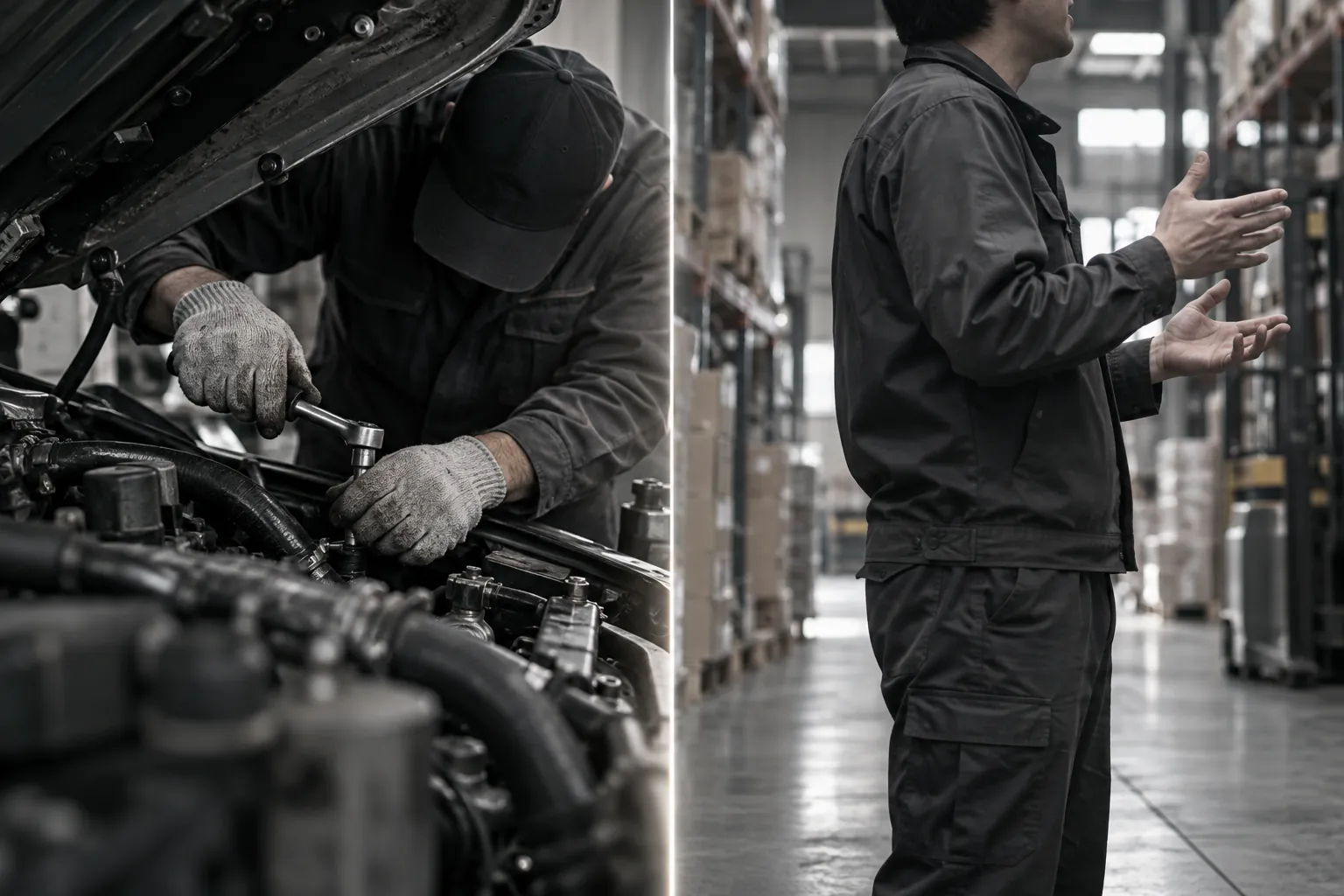
If the likely error is a wrong step, and the right step can be described in words, voice is enough. If the likely error is a wrong place, wrong part or wrong position, the correction has to appear registered on the physical object, and that needs a display. The rule is about where the error lives, not how advanced the task is.
Manufacturing and Logistics: Mostly Voice
QWR's HUMBL page assigns real-time barcode verification and hands-free inventory management to the display-free QAI-06 tier. The error there is "wrong item" or "wrong count", and the correction is a spoken confirmation or rejection. Where the manufacturing use case moves to step-by-step assembly instructions with predictive-maintenance overlays on the line, the page assigns it to QAR-06: the worker needs to see which fastener, on which part.
Aerospace MRO: Both Tiers, Different Jobs
The same aircraft needs both. The page puts step-by-step maintenance guides and remote expert guidance, without dropping your tools, on the QAI-06 tier: sequence and advice, delivered by voice. The aerospace vertical's headline claim, up to 30% less aircraft-on-ground time, is attributed to AR overlays that identify part placement and fastener torque. That is a wrong-place error, and it is a display job. Treating "aerospace MRO" as one tier decision is the mistake; split it by task.
Construction and AEC: Display Only
Walking 1:1 BIM models on site and overlaying clash detection on the build is on QAR-06's list. A clash is a spatial relationship between two things that exist in space. There is no way to say it that the worker can act on without seeing where.
The Table
| Task | Where the error lives | Correction | Tier |
|---|---|---|---|
| Barcode and inventory checks | Wrong item or count | Spoken confirm/reject | QAI-06 |
| Maintenance sequence and expert advice | Wrong step | Spoken guidance | QAI-06 |
| Part placement and fastener torque | Wrong place or value | Overlay on the part | QAR-06 |
| Assembly line work instructions | Wrong part or position | Overlay on the work | QAR-06 |
| BIM clash detection on site | Wrong position in space | Overlay on the build | QAR-06 |
Where the Rule Strains
Some tasks have both error types, and the cost of the heavier tier is real: QAR-06 is 76g against QAI-06 at under 49g, and the display stack is weight and complexity a voice task never uses. If most of a role's errors are wrong-step and a few are wrong-place, consider whether the exceptions justify the tier, or whether a second device for the exceptions does.
The Checklist
For each role you plan to equip: name the three most likely errors; mark each as wrong-step or wrong-place; if every one is wrong-step, price QAI-06 first; if any is wrong-place and frequent, the display is not optional; and confirm the camera and microphone spec of the specific tier, since QWR publishes a 12MP camera and 3-mic array for QAR-06, and a 13 MP camera but no microphone figures for QAI-06.
The Conclusion
Choose the tier by the failure you are trying to prevent. Voice is enough when the fix can be said. When it has to be pointed at, no amount of audio will substitute for seeing it on the object.
Request a Technical Briefing
Our engineering team provides direct support for procurement officers, institutional buyers, and enterprise technology leads.