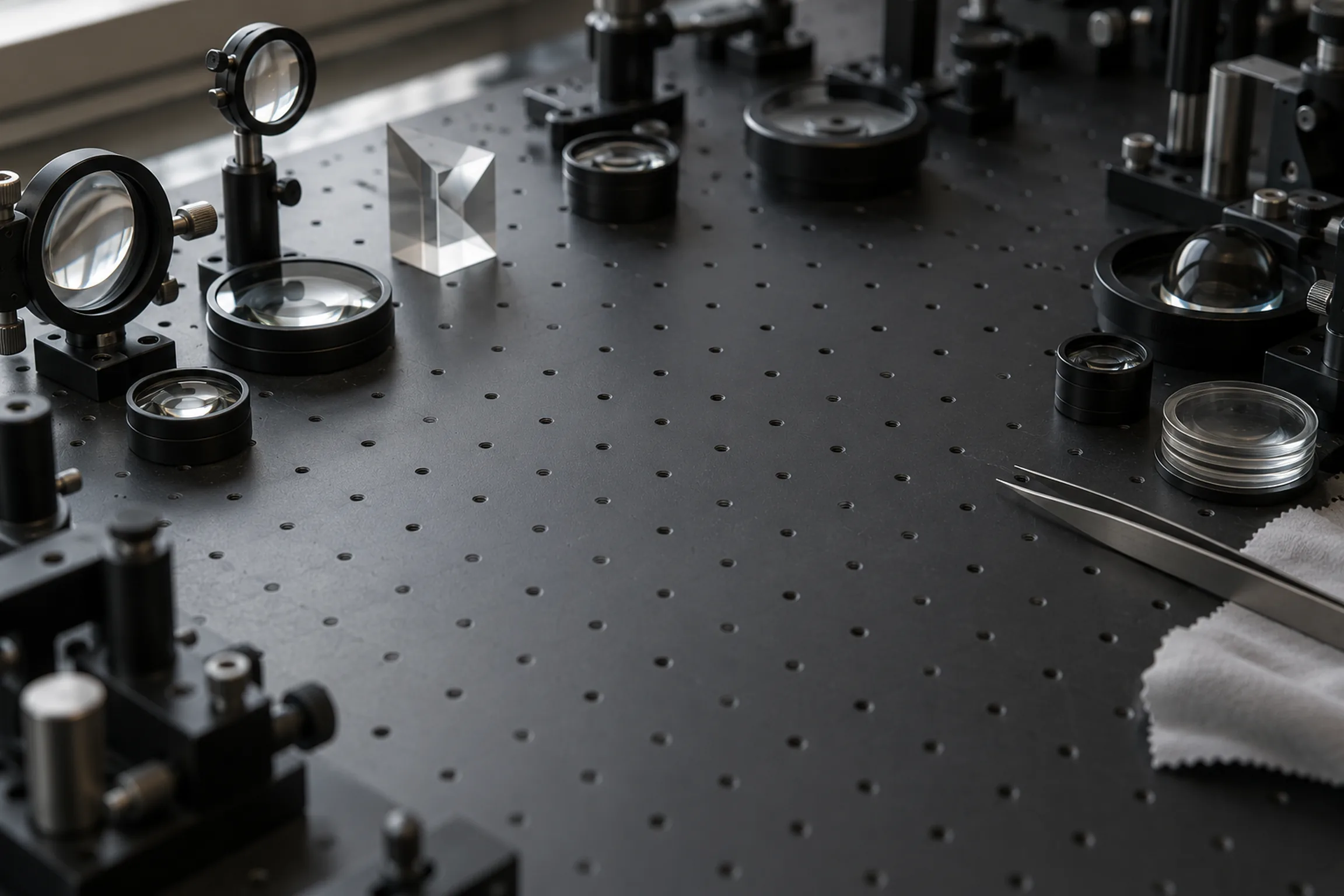
QWR Optics Lab · Interactive optics explorer · seven experiments
Your eyes are focusing on something that isn't there.
A headset puts a screen a few centimetres from your face, yet you see a picture floating far away. Every head-worn display is a lens problem. Seven live experiments cover pancake lenses, pixels per degree, AR waveguides, VR eye strain, lens fit and foveated rendering, then put 50+ headsets on one chart. Drag the scenes, move the sliders, watch the light.
01 · The floating screen
A magnifying glass, aimed at your eye.
Your eye can't focus closer than about 10 cm, so the display sits just inside the focal length of the lens. The light leaves the lens spreading as if it came from a much bigger screen far away, and your eye relaxes onto that virtual image.
Move the display a fraction of a millimetre and the image moves by metres. That is why lens-to-display alignment is set in microns on the line.
- You focus at
- 76 cm
- Magnification
- 20.0×
- Focal length
- 40 mm
02 · Folding the light
Why new headsets got thinner.
A plain lens needs the full distance between screen and lens. A pancake lens folds it: a half mirror and a reflective polariser bounce the light back and forth, so it crosses the same gap three times.
The cost is brightness. Each meeting with the half mirror loses half the light, so at most a quarter reaches your eye.
- Optics depth
- 20–25 mm
- Light to eye
- ≤ 25%
- Passes
- 3
03 · Pixels per degree calculator
Resolution means nothing without the angle.
Your eye judges pixels per degree: how many pixels sit inside each degree of your view. Normal 20/20 vision resolves about 60. Most headsets sit well below that: see every headset on one chart.
The display shows our calibration chart, rendered at the sharpness you choose. In macro view each colour pixel is drawn as its red, green and blue subpixels, the way a close-up photo through a headset lens shows them. In mono green, each pixel is a single green emitter.
- Pixels / degree
- 18.3
- Like vision of
- 20/66
- 20/20 vision
- 60 PPD
04 · Light trapped in glass
Why AR glasses show a small window.
AR glasses pipe the picture in from the temple. Light enters a thin sheet of glass and stays trapped by total internal reflection, bouncing along until a grating releases it toward your eye.
The glass stays the same size. What changes is how wide a picture it can carry: the floating window is how big the AR screen looks to you. Higher-index glass traps a wider range of angles, so the window grows.
Switch the light to mono green and the window jumps. One grating bends each colour by a different angle, so full colour has to share the same range of angles. That is why colour AR glasses stack two or three plates, and why green HUD glasses can be thinner, brighter and wider. To compare the main waveguide types, read Choosing a Waveguide Architecture; for the physics in depth, What Is a Waveguide Display? Our optical design work covers custom waveguides and light engines, designed to a customer's spec.
- Widest view · one plate
- 26°
- Critical angle
- 41.8°
- Laptop at arm's length
- 28°
Simplified model: one axis, one diffractive plate, rays up to 75° from the surface normal, full colour taken as 450–630 nm. Real glasses also lose field to colour handling and eyebox size. Product figures are as each maker publishes them; most AR makers quote the diagonal, so treat the comparison as indicative.
05 · Two distances at once
Why your eyes get tired in VR.
In the real world your eyes do two things together. They turn inward to point at an object, and they refocus to its distance. Your brain has wired the two together since childhood.
A headset breaks that link. The 3D picture tells your eyes where to point, but the lens puts the screen at one fixed focus, usually somewhere around 1.3 to 2 metres. Bring an object close and your eyes point near while focusing far. That mismatch is a known cause of eye strain in VR.
- Eyes point at
- 50 cm
- Eyes focus at
- 1.50 m
- Mismatch · strain
- 1.33 D
Model: eyes 63 mm apart; in the headset the focus is fixed at 1.5 m. Mismatch is the difference between 1 ÷ pointing distance and 1 ÷ focus distance, in dioptres (D). The comfort bands are a rule of thumb drawn from vision-science studies, such as Shibata et al. (2011); people vary. The eyes in the scene are drawn further apart than life so that the angles are visible.
06 · Fit and the eyebox
Why a headset has to fit your eyes.
Each lens only works from a small zone behind it, the eyebox. With your pupil at its centre, you see the whole picture, sharp. Move off-centre and the edges soften and colours start to split. Leave the eyebox and the lens rim cuts into the picture.
Adults' eyes sit roughly 54 to 72 mm apart. A headset with fixed lenses is built for the middle, so people at either end look through the edge of every lens. Set your eye spacing, then drag the view to move your eye.
Lens spacing
- Eye off-centre
- 3.5 mm
- Eyebox · ≈10 mm
- Inside
- Picture visible
- 100%
Illustrative model: a 10 mm eyebox, a blur and colour split that grow with distance from the lens centre, and a lens rim that cuts in once the eye leaves the eyebox. Real eyeboxes differ by optic and are often oval. The adjustable option is shown as 56–72 mm and the three positions as 58, 63 and 68 mm; actual ranges differ by headset. Mono green shows no colour split, because there is only one colour to split.
07 · Foveated rendering
Draw it sharp only where you look.
Only a small patch at the centre of your vision, the fovea, sees fine detail. Everywhere else, your own eye blurs the picture. A headset can use that: full detail where you look, far fewer pixels everywhere else, and the graphics chip saves the work.
Try it. Keep your eyes on the pointer and the drop in quality is hard to spot. Look anywhere else and it jumps out. With eye tracking, the sharp zone follows your gaze, so you never catch it.
Foveation
Outer resolution
- Pixels drawn
- —
- Fewer pixels
- —
- Sharp zone
- 20° wide
Standalone headsets commonly use fixed foveation: the centre stays sharp and the edges are cheaper, with no extra hardware. Headsets with eye tracking, such as PlayStation VR2 and Apple Vision Pro, move the sharp zone with your gaze.
Simplified: 60° of view, three hard-edged zones (full detail within 10° of your gaze, half resolution to 20°, then your chosen outer resolution). Real systems blend the edges and make the sharp zone large enough to cover eye-tracking error. The wider the field of view, the bigger the saving.
08 · Every headset
The whole industry, on one chart.
Field of view against sharpness for 51 headsets and glasses, including our own products. Wide and sharp is the hard corner: every product trades one for the other.
Sharpness here is the average across the view: pixels across one eye divided by the horizontal field of view. Makers often quote the centre, which is higher (how to read an XR spec sheet). Hover a point for details.
| Sources | ||||||||||
|---|---|---|---|---|---|---|---|---|---|---|
| QWRQAR-01Waveguide AR Glasses 1920×1080 | AR | Waveguide | waveguide | 1920 × 1080 | 30° (axis not stated) | 73est. | — | 60 g | — | QWR master sheet |
| QWRQAR-02Waveguide AR Glasses 48MP | AR | Waveguide | waveguide | 1920 × 1080 | 30° (axis not stated) | 73est. | — | 185 g | — | QWR master sheet |
| Play For Dream MRPlay For Dream (formerly YVR) | MR | micro-OLED | pancake | 3840 × 3552 | 103° (axis not published) | 45est. | — | 650 g | 2024 | [1][2][3][4] |
| QWRQXR-06-07QXR-06-07 | MR | Micro-OLED | Pancake lens | 3552 × 3840 | 103° (axis not stated) | 43.9est. | — | 650 g | — | QWR master sheet |
| Rokid Max 2Rokid | Display glasses | micro-OLED | — | 1920 × 1080 | 50° (axis not published) | 43.4est. | — | 75 g | 2024 | [1][2][3] |
| QWRQXR-06-066DoF Headset | MR | Micro-OLED | Pancake Lens | 3552 × 3840 | 105° (axis not stated) | 42.8est. | — | 235 g | — | QWR master sheet |
| Viture Luma UltraViture | Display glasses | — | — | 1920 × 1200 | 52° (axis not published) | 42.7est. | — | 83 g | 2025 | [1][2] |
| Meta Ray-Ban DisplayMeta / EssilorLuxottica | AR | LCoS | reflective/geometric waveguide | 600 × 600 | 20° D | 42.2est. | 42 | 69 g | 2025 | [1][2][3][4] |
| Xreal Air 2 UltraXreal | Display glasses | micro-OLED | birdbath | 1920 × 1080 | 52° (axis not published) | 41.7est. | 42 | 83 g | 2024 | [1][2][3][4] |
| Viture BeastViture | Display glasses | micro-OLED | — | 1920 × 1200 | 58° (axis not published) | 38.1est. | — | 88 g | 2026 | [1][2][3][4] |
| Xreal One ProXreal | Display glasses | micro-OLED | flat prism ('X-Prism') | 1920 × 1080 | 57° (axis not published) | 37.9est. | — | 87 g | 2025 | [1][2][3][4] |
| QWRQXR-06-08Mini-LED XR Headset | MR | Mini-LED | Aspheric lenses | 3744 × 3840 | 120° (axis not stated) | 37.1est. | — | — | — | QWR master sheet |
| Pimax Dream AirPimax | VR | micro-OLED | pancake | 3840 × 3552 | 110° H | 34.9 | — | — | 2026 | [1][2][3][4] |
| Samsung Galaxy XRSamsung | MR | micro-OLED | pancake | 3552 × 3840 | 109° H | 32.6 | — | 545 g | 2025 | [1][2][3][4] |
| Magic Leap 2Magic Leap | AR | LCoS | waveguide (one per color) | 1440 × 1760 | 44.6° H · 70° D | 32.3 | — | 260 g | 2022 | [1][2][3][4] |
| Varjo XR-4Varjo | MR | mini-LED (LCD) | aspheric | 3840 × 3744 | 120° H | 32 | 51 | 1021 g | 2023 | [1][2][3][4] |
| QWRQAR-03RGB Waveguide AR Glasses | AR | Waveguide | waveguide | 640 × 400 | 26° (axis not stated) | 28.9est. | — | 100 g | — | QWR master sheet |
| QWRQXR-06-04XR Headset XR2+ Gen 2 | MR | Fast LCD | Pancake Lens | 2210 × 2160 | 100° (axis not stated) | 27.3est. | — | 540 g | — | QWR master sheet |
| QWRQAR-04Waveguide AR Glasses | AR | Waveguide | waveguide | 640 × 200 | 25° (axis not stated) | 26.8est. | — | 36 g | — | QWR master sheet |
| QWRQXR-06-05Standalone Headset 4620×2160 | MR | Fast LCD | Pancake Lens | 2310 × 2160 | 105° (axis not stated) | 26.5est. | — | 450 g | — | QWR master sheet |
| RayNeo X3 ProRayNeo (TCL) | AR | microLED | waveguide | 640 × 480 | 30° (axis not published) | 26.4est. | — | 76 g | 2025 | [1][2][3][4] |
| Vuzix Z100Vuzix | AR | microLED (monochrome green) | waveguide | 640 × 480 | 30° (axis not published) | 26.4est. | — | — | 2024 | [1][2][3] |
| Even Realities G2Even Realities | AR | microLED (monochrome green) | waveguide | 640 × 350 | 27.5° (axis not published) | 26.4est. | — | 36 g | 2025 | [1][2][3] |
| QWRQAR-06RGB Waveguide AR Glasses | AR | Waveguide | waveguide | 640 × 480 | 30° (axis not stated) | 26.4est. | — | 76 g | — | QWR master sheet |
| Pico 4 UltraPico (ByteDance) | MR | — | pancake | 2160 × 2160 | 105° (axis not published) | 25.3est. | 20.6 | 580 g | 2024 | [1][2][3][4] |
| QWRQXR-06-03XR Headset 3K Passthrough | MR | Fast LCD | Pancake Lens | 2320 × 2160 | 110° (axis not stated) | 25.1est. | — | 500 g | — | QWR master sheet |
| QWRQVR-03-01A4K Classroom VR Headset | VR | Fast LCD | Fresnel lenses | 1920 × 2160 | 100° (axis not stated) | 25est. | — | 350 g | — | QWR master sheet |
| QWRQVR-03-01C4K VR Headset | VR | Fast LCD | Fresnel lenses | 1920 × 2160 | 100° (axis not stated) | 25est. | — | 350 g | — | QWR master sheet |
| QWRQVR-03-01BVR Headset with Passthrough | VR | Fast LCD | Fresnel lenses | 1920 × 2160 | 100° (axis not stated) | 25est. | — | 350 g | — | QWR master sheet |
| QWRQVR-06-016DoF VR Headset | VR | Fast LCD | Fresnel lenses | 1832 × 1920 | 96° (axis not stated) | 24.4est. | — | 490 g | — | QWR master sheet |
| QWRQXR-06-016DoF XR Headset | MR | Fast LCD | Fresnel Lens | 1832 × 1920 | 96° (axis not stated) | 24.4est. | — | 490 g | — | QWR master sheet |
| Bigscreen Beyond 2 / 2eBigscreen | VR | micro-OLED | pancake | 2560 × 2560 | 108° H · 116° D | 23.7 | — | 107 g | 2025 | [1][2][3] |
| QWRQVR-03-02VR Headset with Swappable Battery | VR | Fast LCD | Fresnel lenses | 1832 × 1920 | 100° (axis not stated) | 23.2est. | — | 690 g | — | QWR master sheet |
| QWRQVR-03-02AVR Headset with Eye Tracking | VR | Fast LCD | Fresnel lenses | 1832 × 1920 | 100° (axis not stated) | 23.2est. | — | 690 g | — | QWR master sheet |
| QWRQVR-03-03QVR-03-03 | VR | Fast LCD | Fresnel lenses | 1832 × 1920 | 100° (axis not stated) | 23.2est. | — | 350 g | — | QWR master sheet |
| QWRQVR-03-04VR Headset | VR | Fast LCD | Fresnel lenses | 1832 × 1920 | 100° (axis not stated) | 23.2est. | — | 407 g | — | QWR master sheet |
| QWRQXR-06-02XR Headset 1600×1600 Passthrough | MR | Fast LCD | Fresnel Lens | 1600 × 1600 | 90° (axis not stated) | 22.7est. | — | 500 g | — | QWR master sheet |
| Sony PlayStation VR2Sony | VR | OLED | Fresnel | 2000 × 2040 | 110° (axis not published) | 22.2est. | — | 560 g | 2023 | [1][2][3][4] |
| HTC Vive XR EliteHTC | MR | LCD | pancake | 1920 × 1920 | 110° D | 21.2est. | — | 625 g | 2023 | [1][2][3] |
| QWRQVR-03-05PC-Tethered VR Headset | VR | Fast LCD | Fresnel Lens | 1832 × 1920 | 110° (axis not stated) | 20.5est. | — | 313 g | — | QWR master sheet |
| HTC Vive Focus VisionHTC | MR | LCD | Fresnel | 2448 × 2448 | 120° H | 20.4 | — | 785 g | 2024 | [1][2][3][4] |
| Valve Steam FrameValve | VR | LCD | pancake | 2160 × 2160 | 110° H | 19.6 | — | 440 g | 2026 | [1][2][3][4] |
| QWRQXR-06-10QXR-06-10 | MR | Fast LCD | Fresnel lenses | 1832 × 1920 | 115° (axis not stated) | 19.4est. | — | 430 g | — | QWR master sheet |
| Meta Quest 3SMeta | MR | LCD | Fresnel | 1832 × 1920 | 96° H | 19.1 | — | 514 g | 2024 | [1][2][3][4] |
| QWRQVR-06-02PC-Tethered VR Headset | VR | Fast LCD | Fresnel Lens | 1832 × 1920 | 116° (axis not stated) | 19.1est. | — | 450 g | — | QWR master sheet |
| QWRQVR-06-03QVR-06-03 | VR | Fast LCD | Fresnel Lens | 1832 × 1920 | 116° (axis not stated) | 19.1est. | — | 285 g | — | QWR master sheet |
| Meta Quest 3Meta | MR | LCD | pancake | 2064 × 2208 | 110° H | 18.8 | 25 | 515 g | 2023 | [1][2][3][4] |
| QWRQVR-06-04QVR-06-04 | VR | Fast LCD | Pancake Lens | 1600 × 1600 | 105° (axis not stated) | 18.8est. | — | 350 g | — | QWR master sheet |
| Meta Quest ProMeta · discontinued | MR | LCD (Mini-LED backlight, quantum dot, local dimming) | pancake | 1800 × 1920 | 106° H | 17 | — | 722 g | 2022 | [1][2][3] |
| QWRQVR-03-01QVR-03-01 | VR | Fast LCD | Fresnel lenses | 1280 × 1440 | 100° (axis not stated) | 16.7est. | — | 350 g | — | QWR master sheet |
| Apple Vision Pro (M2)Apple · discontinued | MR | micro-OLED | catadioptric (pancake-class) | — | — | — | — | 600 g | 2024 | [1][2][3][4] |
| Apple Vision Pro (M5)Apple | MR | micro-OLED | catadioptric (pancake-class) | — | — | — | — | 750 g | 2025 | [1][2][3] |
| Pimax Crystal Super (57 PPD QLED engine)Pimax | VR | QLED LCD (mini-LED local dimming) | aspheric (glass) | 3840 × 3840 | — | — | 57 | 815 g | 2025 | [1][2][3][4] |
| Valve IndexValve | VR | LCD | — | 1440 × 1600 | — | — | — | 809 g | 2019 | [1][2][3][4] |
| Shiftall MeganeX superlight 8KShiftall | VR | micro-OLED | pancake | 3552 × 3840 | — | — | — | — | 2024 | [1][2][3][4] |
| Meta OrionMeta · prototype | AR | microLED | silicon carbide waveguide | — | 70° D | — | 13 | 98 g | 2024 | [1][2][3] |
| Microsoft HoloLens 2Microsoft · discontinued | AR | '2k 3:2 light engines' | waveguide | — | 43° H · 52° D | — | 47 | 566 g | 2019 | [1][2][3][4] |
| Snap Spectacles (5th gen, developer)Snap | AR | LCoS | waveguide | — | 46° D | — | 37 | 226 g | 2024 | [1][2][3] |
| Rokid GlassesRokid | AR | microLED (monochrome green) | diffractive waveguide | — | — | — | — | 49 g | — | [1][2][3] |
| Even Realities G1Even Realities · discontinued | AR | microLED (monochrome green, JBD) | — | 640 × 200 | — | — | — | — | 2024 | [1][2][3] |
Specs gathered from public maker pages, spec databases and reviews, October 2026; sources are linked per product and should be checked before quoting. "Est." means the maker gives a diagonal or does not say which axis, so the horizontal view is derived from the per-eye resolution. QWR figures come from our product master sheet; where it lists one resolution for both eyes, half the width is used per eye. Audio and camera-only glasses have no display and are left out. Apple does not publish per-eye resolution or field of view.
FAQ
Questions about headset optics.
What is pixels per degree (PPD)?+
Pixels per degree is how many pixels sit inside each degree of your view. Divide the pixels across one eye by the horizontal field of view to get the average. Normal 20/20 vision resolves about 60, and most headsets sit well below that, so a wider view usually costs sharpness. The calculator on this page lets you try your own numbers.
How do pancake lenses work?+
A pancake lens folds the light path. A half mirror and a reflective polariser bounce the light back and forth, so it crosses the same gap three times and the optics can sit closer to the screen. That is why newer headsets are thinner. The cost is brightness: each meeting with the half mirror loses half the light, so at most a quarter reaches your eye.
Why do AR glasses have a small field of view?+
AR glasses carry the picture inside a thin sheet of glass, where total internal reflection traps the light until a grating releases it toward your eye. The glass stays the same size, but how wide a picture it can carry depends on its refractive index: higher-index glass traps a wider range of angles, so the window grows. Full colour has to share one range of angles, which is why colour glasses stack two or three plates and green-only displays can be thinner, brighter and wider.
Why do VR headsets cause eye strain?+
In a headset your eyes point where the 3D picture says an object is, but the lens puts the screen at one fixed focus, usually around 1.3 to 2 metres. When the pointing distance and the focus distance differ, the mismatch is measured in dioptres, and it is a known cause of eye strain in VR. That is why menus and text usually sit 1 to 2 metres away.
What is the eyebox?+
The eyebox is the small zone behind each lens where your pupil sees the whole picture sharp. Move off-centre and the edges soften and colours start to split, and leave it and the lens rim cuts into the picture. Adults' eyes sit roughly 54 to 72 mm apart, so a headset with fixed lenses is built for the middle and people at either end look through the edge of every lens.
What is foveated rendering?+
Only a small patch at the centre of your vision, the fovea, sees fine detail. A headset can use that by drawing full detail where you look and far fewer pixels everywhere else, which saves graphics work. With eye tracking the sharp zone follows your gaze, so you never catch it. Without it, the sharp zone stays fixed at the centre.
Where do the headset numbers on the chart come from?+
Specs are gathered from public maker pages, spec databases and reviews, as of October 2026. Sources are linked per product and should be checked before quoting. A figure marked est. means the maker gives a diagonal or does not say which axis, so the horizontal view is derived from the per-eye resolution. Sharpness is the average across the view, while makers often quote the centre, which is higher.
Are the experiments exact?+
No. They are simplified models for illustration, not specifications of any product. For example, the waveguide model uses one axis and one diffractive plate, and real eyeboxes differ by optic and are often oval. Each experiment notes what it simplifies.
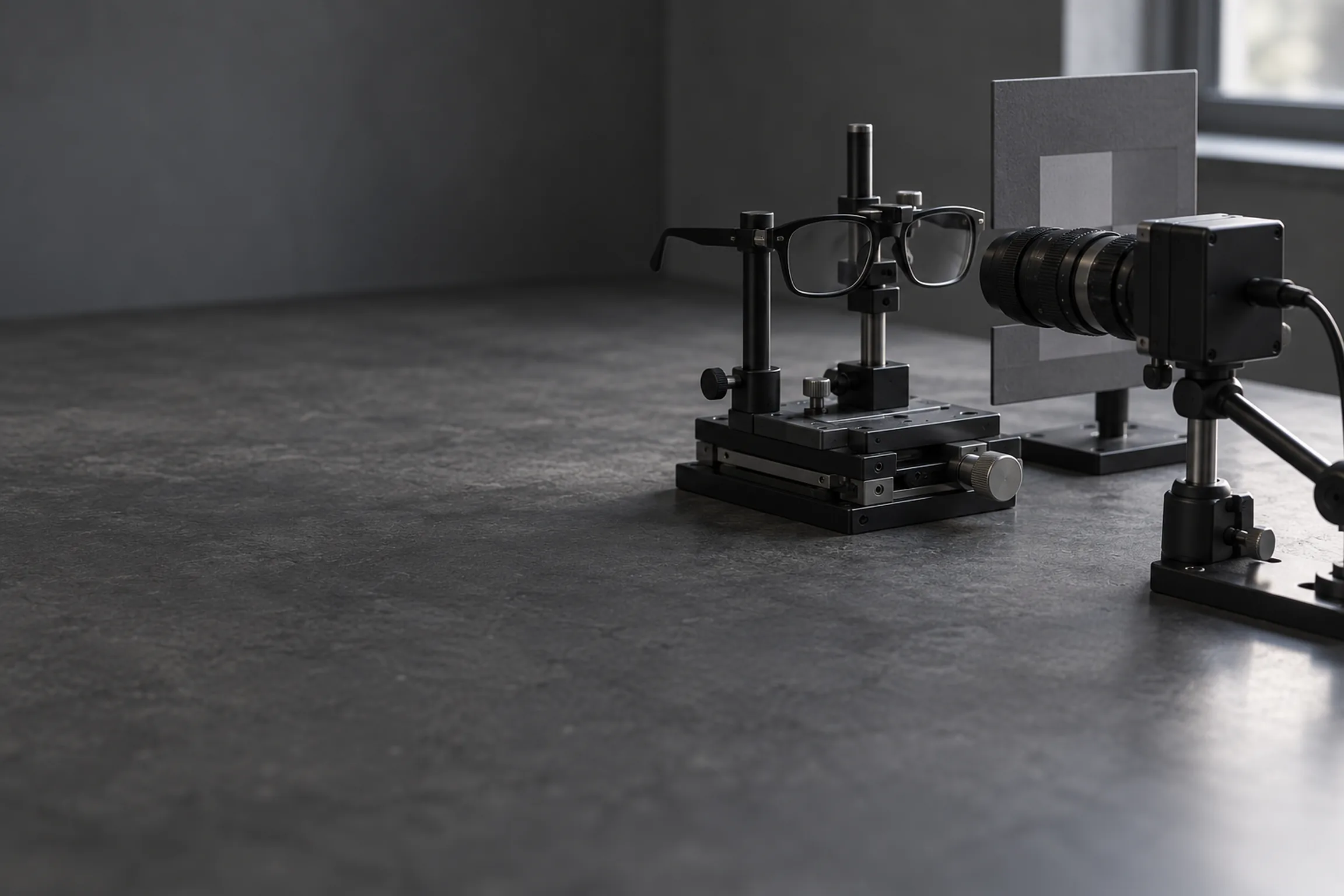
Designed in-house
Optical design and calibration, in house.
Lens stacks, waveguides and the display pipeline behind them. If you are building a head-worn device, talk to the team behind these optics. See how we work as an ODM and OEM partner and read about our waveguide and light-engine optics.
QWR · Question What's Real™ · Est. 2017
Figures are textbook approximations for illustration, not specifications of any product.