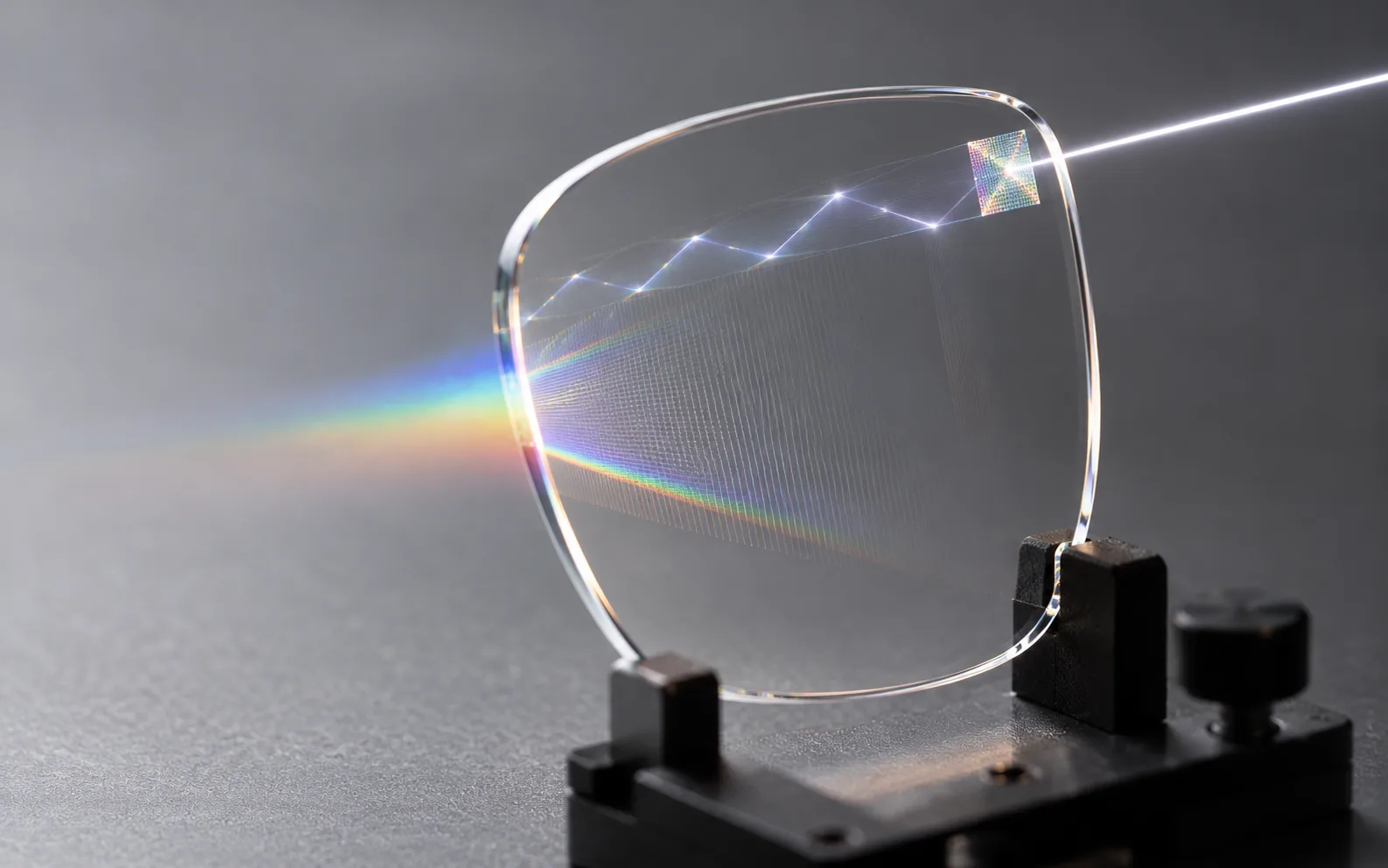
Waveguides & Light Engines
Custom Waveguides & Light Engines, Engineered to Your Spec.
QWR engineers custom waveguides and light engines, designed, integrated, and manufactured to your exact spec. From eyebox design to full optical-module integration, we're the in-house optics behind India's end-to-end ODM for enterprise AR glasses and AI smart glasses.
Waveguide architectures
Three waveguide architectures for see-through AR glasses.
Every QWR optical stack follows a structured Design for Manufacturing (DFM) pipeline to remove the certification risk and cost surprises typically found in hardware ODM projects. We help you select the architecture that fits your use case, then engineer it to your spec.
Want to see why the glass and the display colour set a waveguide's field of view? Slide the refractive index yourself. Open the Optics Explorer →
Option 01
Diffractive Waveguide · Surface Relief Grating
Nanoscale gratings etched onto glass redirect light into the eye. The production-validated approach for high-volume AR hardware deployments.
- Best colour uniformity across the eyebox
- Scalable mass production via nanoimprint lithography
- Moderate FOV: optimized for 30–50°
- Ideal for Enterprise AR / Field Ops
Option 02
Holographic Waveguide · Volume Grating
Interference patterns recorded in photopolymer film for partners requiring the thinnest possible form factor.
- Highest transparency (>85%) for all-day wearability
- Thinnest profile available
- Specialised single-colour or low-power displays
- Ideal for premium consumer / compact wearables
Option 03
Geometric Waveguide · Reflective / Birdbath
Utilising partial mirrors or prisms for a wide Field of View (FOV) at an accessible cost.
- Widest FOV: supports up to 52°
- Cost-effective at scale
- Rugged design for industrial and defence
- Ideal for all-day AI wearables
Light engines
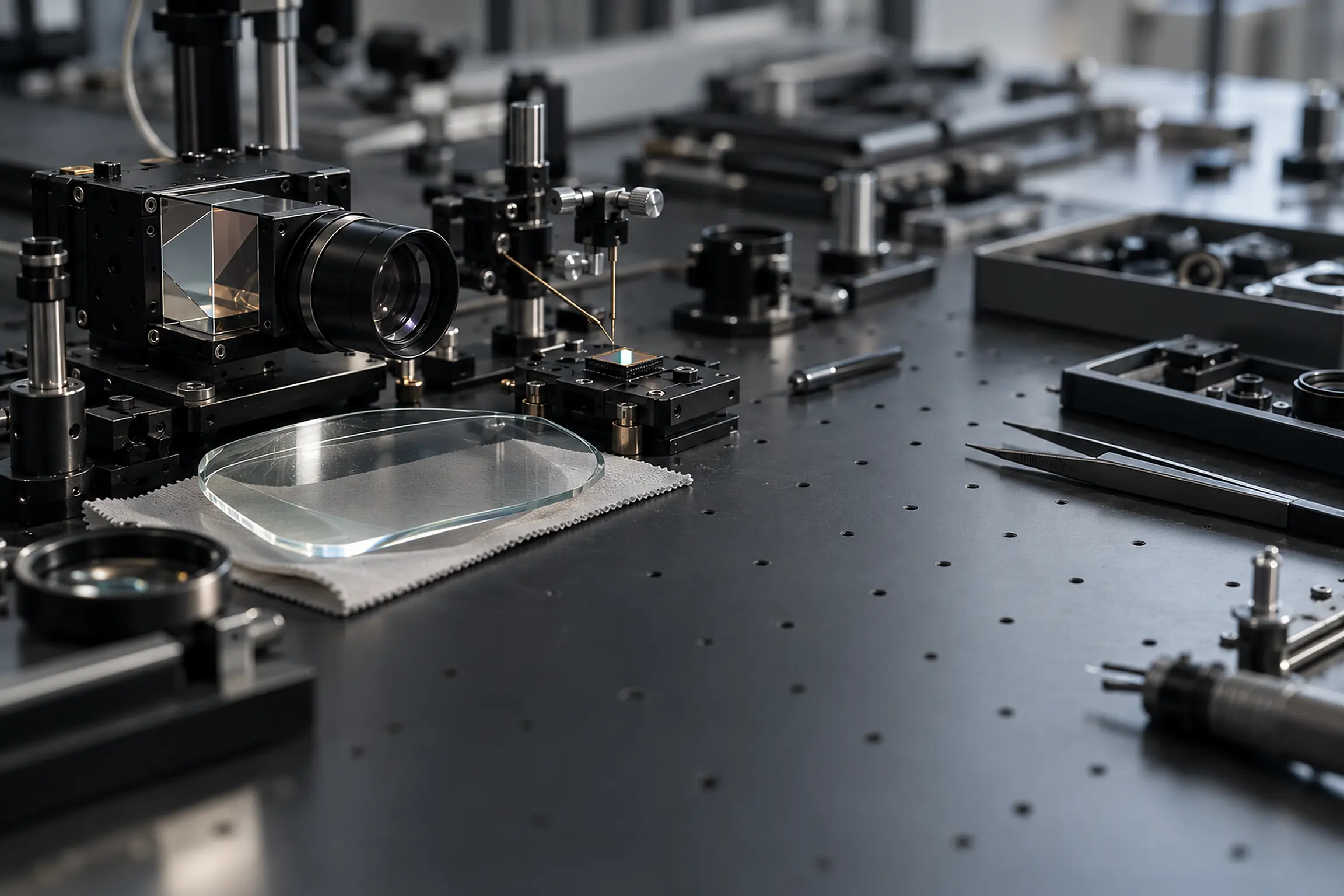
Light engines, the image source behind the display.
The light engine serves as the "retinal projector" for your spatial computing application. We offer three validated reference architectures, each configurable at the BOM level.
LCoS (Liquid Crystal on Silicon)
The workhorse of enterprise AR glasses ODM projects. Mature technology delivering up to 2,500 nits of high-output brightness. Ideal for outdoor use cases.
Micro-OLED
Self-emitting pixels on a silicon backplane. Delivers a 100,000:1 contrast ratio, deepest blacks, and high pixel density. Essential for surgical simulation and precision CAD review.
LBS (Laser Beam Scanning)
MEMS-based RGB laser scanning for infinite focus depth (retinal projection). The smallest possible module for ultra-low power, all-day wearables. Best for HUMBL-class AI glasses.
Technical comparison
Waveguide and light-engine trade-offs.
These parameters represent QWR's core internal reference designs, each validated, certified, and production-ready.
| Parameter | Diffractive + LCoS | Holographic + Micro-OLED | Geometric + LBS |
|---|---|---|---|
| Field of View | 30–50° | 25–40° | 35–52° |
| Brightness | 1500–2500 nits | 500–1500 nits | 300–800 nits |
| Optics Weight | 8–14g | 5–9g | 6–12g |
| Transmittance | 70–80% | 85–92% | 65–75% |
| Ideal Use Case | Enterprise AR / Field Ops | Premium Consumer / Compact | All-day AI Wearables |
Full-stack integration
Beyond optics, full-stack optical module integration.

A unique branded device must be certifiably manufacturable. QWR integrates the entire optical chain while providing full DFM support for your industrial design.
Optical Engineering
Custom waveguide selection and light engine pairing to meet your product brief.
Module Packaging
Integrating the optical stack with the PCB, battery, and sensors within your custom shell geometry.
Mechanical Constraints
We hold the hard points (lens spacing and waveguide mount points) to ensure optical calibration is non-negotiable.
Production & Calibration
Precision assembly in ISO cleanrooms at our Pune facility with 100,000+ unit annual capacity.
Found your optical specification?
Every specification detailed above is configurable at BOM level for ODM partners. Tell us your use case and target cost, we'll deliver a DFM feasibility assessment within 5 business days.
Further reading
- Optics Explorer: See How Lenses and Waveguides Work
- Waveguide Optics ExplainedOptics & Display
- Local Waveguide ODMs for DefenceDefence · ODM
- Android Enterprise for XRPlatform · Enterprise
- How to Read an XR Spec SheetEngineering
- Choosing a Waveguide ArchitectureEngineering
- Choosing a Light Engine for See-Through AREngineering
- Choosing Between QAI-06 and QAR-06Engineering
- Secondary Sensors in an XR ODM PlatformEngineering
- Choosing Enclosure Materials for XR HardwareEngineering