Industry Insights · Technology · Hardware
Diffractive vs Holographic vs Geometric Waveguides. Which Optical Approach Fits Your Enterprise AR Deployment.
By QWR Engineering
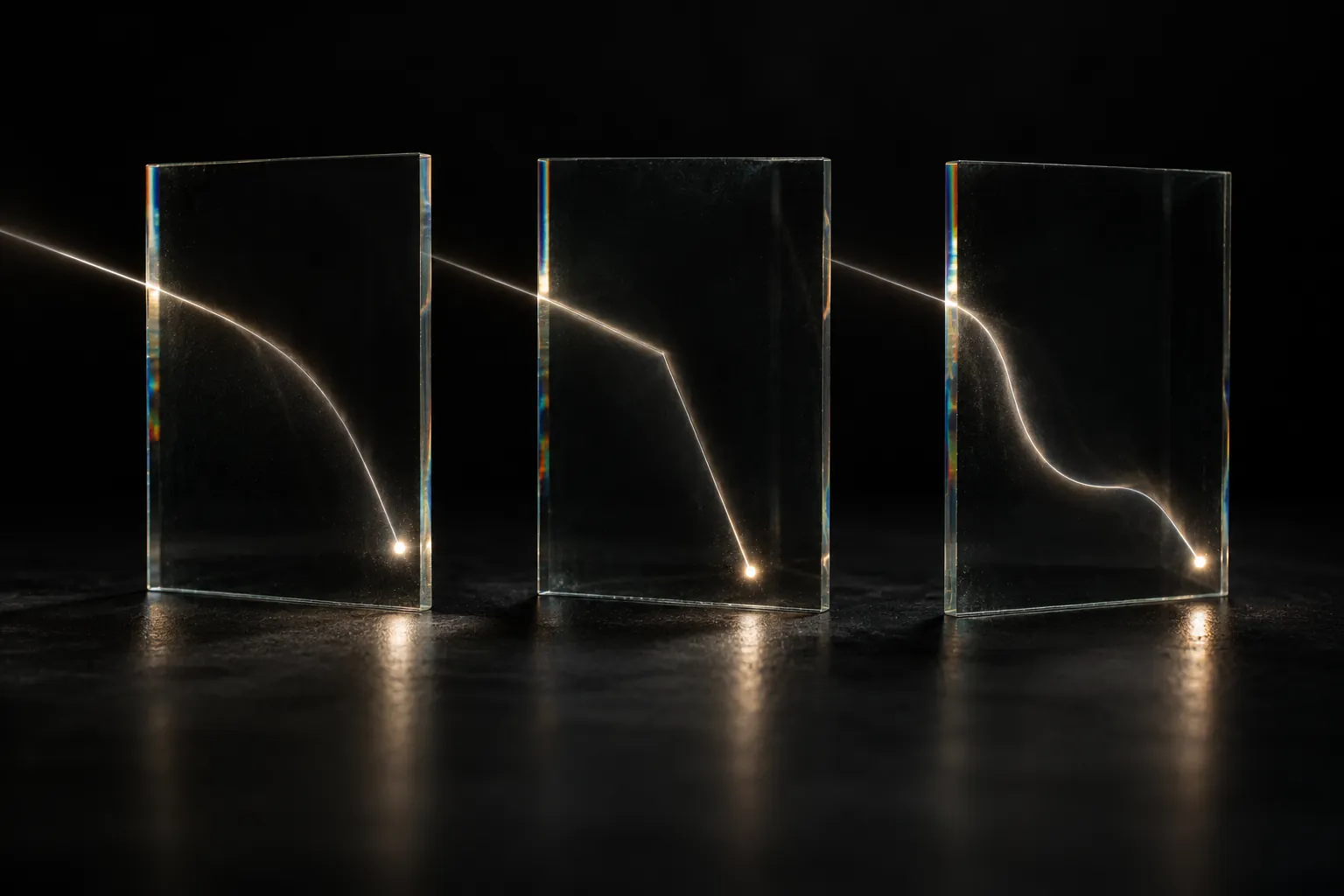
There is no best waveguide — only the right one for a given deployment. Diffractive, holographic, and geometric architectures each win on a different axis, and the choice is decided by where the device is worn and what it has to do there. This is the selection logic: not how the optics work, but which to pick, and why.
Start Here: This Is the Choice, Not the Physics
If you want the first-principles explanation — total internal reflection, gratings, how light is coupled into the substrate — QWR's waveguide deep-dive already covers it, and the full parameter matrix lives on the technology page. This paper assumes you know roughly what a waveguide is and answers the question that actually appears in a procurement decision: given my deployment, which architecture, and which light engine paired with it? The specs below appear only as decision drivers, not as a catalogue.
"Every waveguide architecture is a set of trade-offs frozen into glass. Field of view, brightness, transparency, form factor, and cost cannot all win at once — so you pick the one whose winning axis is the one your deployment can't compromise."
The Trade-Off That Governs the Choice
- Four axes pull against each other: field of view, brightness, see-through transparency, and cost/manufacturability. An architecture that maximises one usually spends another. Naming which axis your deployment refuses to compromise is the whole decision — everything after is matching.
- The light engine is half the answer: the waveguide delivers the image, but the light engine generates it. Brightness, contrast, and power draw come from the engine (LCoS, Micro-OLED, or LBS), so the real unit of choice is a waveguide-plus-engine pairing, not a waveguide alone.
Deployment 1: Outdoor, Field Ops, and Bright Environments → Diffractive + LCoS
- When sunlight readability and colour uniformity decide it: For field service, inspection, and outdoor work, the overlay has to stay legible against ambient light and render colour evenly across the eyebox. QWR positions the diffractive (surface-relief grating) architecture explicitly for enterprise AR and field ops, citing best-in-class colour uniformity.
- Pair it with LCoS for brightness: An LCoS engine's high output — up to 2,500 nits — is what keeps the display visible in daylight, which is why this pairing is the field-ops default.
- It also scales: Diffractive waveguides are produced via nanoimprint lithography, making them the architecture built for high-volume manufacturing — the right call when the deployment is a large fleet, not a boutique run.
Deployment 2: All-Day Wear and Discreet, Premium Wearables → Holographic + Micro-OLED
- When transparency and form factor decide it: For a device worn all day, or one that must look like ordinary eyewear, see-through clarity and a thin profile outrank raw brightness. QWR's holographic (volume-grating) architecture leads on transparency (>85%) and offers the thinnest profile — built for the "invisible" premium aesthetic.
- Pair it with Micro-OLED where image quality is critical: Micro-OLED's very high contrast and pixel density suit compact, high-fidelity displays — the pairing for a premium or precision-leaning wearable rather than a bright outdoor one.
- Know the compromise you're accepting: the transparency-and-thinness win typically comes at some cost to peak brightness and field of view, so this is the wrong pick for a sunlit flightline and the right one for an all-day indoor or discreet role.
Deployment 3: Wide-FOV, Rugged, and Cost-Sensitive Volume → Geometric
- When field of view or budget decides it: Where a wide field of view or an accessible cost-at-scale matters more than the slimmest profile, the geometric (reflective/birdbath) architecture is the fit — it offers the widest FOV (up to 52°) and is cost-effective at scale.
- It suits rugged and all-day AI wearables: QWR positions geometric optics for rugged industrial and defence use and for all-day AI wearables, where a slightly larger frame profile is an acceptable trade for FOV and durability.
- The trade is transparency and sleekness: a geometric stack accepts a bulkier form and lower transmittance in exchange for FOV and cost — fine for a helmet-integrated or industrial device, less so for consumer eyewear.
The Manufacturability Question Most Buyers Skip
- Volume changes the calculus: For a pilot of a few hundred, manufacturability barely matters; for a fleet of 100,000, it dominates. Diffractive's nanoimprint-lithography process is the one explicitly built for high-volume yield, which is why fleet-scale enterprise programmes often land there even when another architecture edges it on a single spec.
- The pairing must be BOM-configurable: Because the real choice is waveguide-plus-engine, confirm both are configurable to your target at the bill-of-materials level rather than fixed — the customisation discipline covered across QWR's ODM stack.
A Short Decision Checklist
Answer these and the architecture usually selects itself: Is the device used outdoors or under bright light (→ brightness-first, diffractive + LCoS)? Must it be worn all day or look like normal glasses (→ transparency-and-form-first, holographic + Micro-OLED)? Is a wide field of view or cost-at-scale the priority, with form factor secondary (→ geometric)? And what is the production volume — because a boutique run and a 100,000-unit fleet can point to different answers even for the same use case.
The Engineering Conclusion: Choose the Axis, Then the Architecture
The waveguide decision is not a search for the most advanced optics — it is a disciplined match between one deployment's non-negotiable axis and the architecture that wins on it: diffractive-plus-LCoS for brightness and scale, holographic-plus-Micro-OLED for transparency and form, geometric for field of view and cost. Decide what your deployment cannot compromise, weigh the production volume, and the right pairing is the one left standing. For the physics behind each and the full parameter table, the waveguide deep-dive and the technology page carry the detail.
FAQ
Frequently asked questions
Which waveguide architecture is best for outdoor field use?+
Diffractive paired with an LCoS light engine, which delivers up to 2,500 nits of brightness for daylight visibility and best-in-class colour uniformity.
Which waveguide architecture suits an all-day, discreet wearable?+
Holographic paired with Micro-OLED, which leads on transparency, over 85 percent, and offers the thinnest profile, at some cost to peak brightness and field of view.
Which waveguide architecture offers the widest field of view?+
Geometric (reflective/birdbath), offering up to 52 degrees of field of view and cost-effectiveness at scale, trading off transparency and a bulkier form factor.
Request a Technical Briefing
Our engineering team provides direct support for procurement officers, institutional buyers, and enterprise technology leads.