Industry Insights · Training
Which Safety Modules Need Which Headset. Tracking, Hand Input and Play Space for LOTO, Confined Space and Work at Height.
By QWR Engineering
Safety training catalogues tend to be sold as a list: lockout tagout, confined space entry, work at height, fire extinguisher use, chemical handling, permit to work. Plant EHS teams buy them that way too, ticking the modules their audits require. What the list hides is that each module asks something different of the headset. A fleet chosen for one module can quietly fail another.
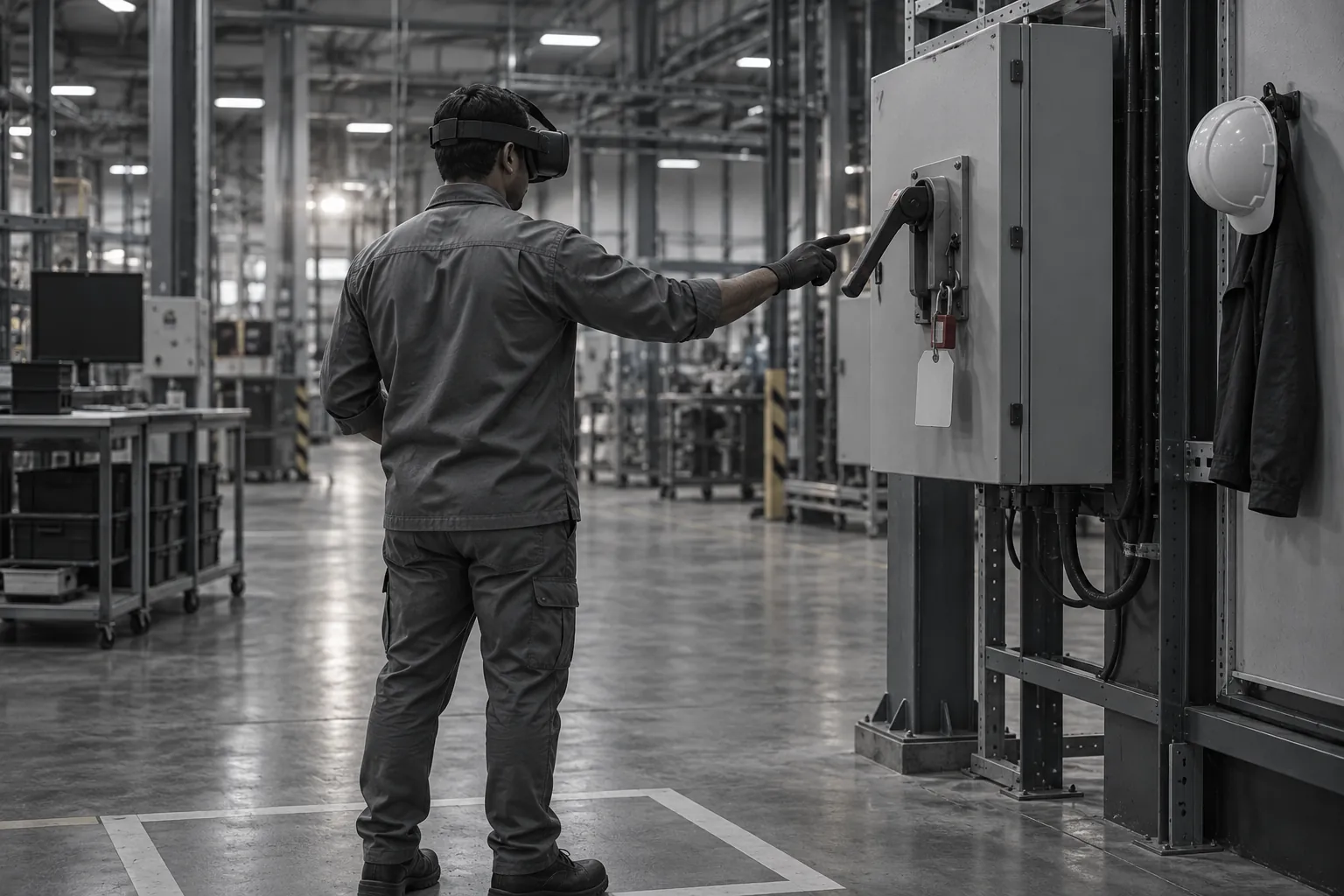
Illustrative image. These are not what our headsets look like.
This paper maps the most common industrial safety modules to the hardware they actually need, so that an EHS lead, a plant L&D head and an IT manager can agree on one fleet before content is licensed, not after.
Why the module defines the headset
Most safety training failures in VR are not content failures. The scenario is accurate, the narration is clear, the assessment is sound. What breaks is the fit between what the module expects the trainee to do and what the device can detect.
Typical pattern. A plant buys a set of headsets to run an induction module and a fire extinguisher module, both of which work well seated or standing still. Six months later the same plant licenses a lockout tagout module. The module assumes the trainee will reach for an isolation point, apply a lock and attach a tag. On the existing headsets the trainee points a controller at a valve and presses a button. The procedure is technically completed, but the motor sequence that the training was meant to build was never practised.
That gap is the subject of this paper. The question to ask of every module is: what physical action is this training trying to rehearse, and can the device register that action?
Three hardware variables that decide fit
Almost every safety module can be described by three variables.
Tracking. Does the module need the device to know where the trainee is in space (positional tracking, six degrees of freedom) or only which way they are looking (rotational tracking, three degrees of freedom)? QWR's paper on 3DoF vs 6DoF covers the distinction in detail. For safety training the rule is direct: if the procedure involves walking, crouching, reaching or leaning, it needs positional tracking.
Hand input. Does the module register actions through handheld controllers, through hand tracking (cameras on the headset recognising the trainee's hands), or through both? Controllers are robust and precise for pointing and triggering. Hand tracking is closer to the real motion of gripping, turning and placing, but depends on lighting, line of sight and the quality of the tracking system.
Play space. How much clear floor area does the module assume, and does it need the trainee to physically move through it? A seated module needs a chair. A walking module needs a cleared and bounded area, which in a working plant is often harder to find than the headsets themselves.
Module by module
The mapping below describes what each module typically rehearses and what that implies for the device. Individual module designs vary, so treat this as a starting point for questions to the content provider, not a substitute for them.
Lockout tagout
What it rehearses. Identifying energy sources, shutting down equipment in sequence, applying locks and tags to isolation points, and verifying zero energy before work begins.
What the device needs. Positional tracking, because the trainee moves between isolation points. Fine hand input, because the core skill is a sequence of physical actions: turning a valve, lowering a breaker, applying a lock, attaching a tag. Hand tracking gets closest to the real motion, but only if it reliably registers small actions at close range. Controllers work if the module maps actions sensibly to them.
What to ask. Does the module require hand tracking or merely support it? How does it behave when hand tracking loses the trainee's hands? Has it been tested on the device you plan to buy, under your training room's lighting?
Confined space entry
What it rehearses. Permit checks, atmospheric testing, ventilation set-up, entry and exit procedures, communication with an attendant, and emergency response.
What the device needs. Positional tracking for entry and movement inside the space. The physical space can be modest because the confined space itself is small, but the module may ask the trainee to crouch or kneel, which places demands on tracking near the floor. Hand input matters for operating gas monitors and ventilation equipment.
What to ask. Does the module expect the trainee to physically crouch or kneel, or does it simulate the posture? Does the device track reliably when the trainee's head is close to the floor or to a wall? Is there a mixed-reality option that lets an attendant see the trainee's surroundings?
Work at height
What it rehearses. Harness inspection, anchor point selection, ladder and scaffold safety, and movement on elevated platforms. Some modules include a simulated fall to build respect for fall arrest.
What the device needs. Positional tracking and clear floor space, because the trainee walks along a virtual edge or platform. Hand input for harness checks and clipping on. Comfort and fit matter more than in most modules, because a trainee who feels unbalanced will remove the headset.
What to ask. How much clear area does the module assume? Does it include a simulated fall, and if so, what supervision and physical safety measures does the provider recommend? How is the boundary of the physical play space communicated to the trainee?
Fire extinguisher use
What it rehearses. Identifying fire classes, choosing the right extinguisher, and the pull, aim, squeeze, sweep sequence.
What the device needs. Positional tracking helps but is not always required. Controllers often map well to the extinguisher action. Floor space is modest.
What to ask. Is the module designed for standing use or does it require walking towards the fire? Does it support controllers if hand tracking is unavailable?
Hazard identification and permit to work
What it rehearses. Spotting hazards in a realistic environment, recording observations, and following the authorisation steps for high-risk tasks.
What the device needs. Rotational tracking may be enough for hazard spotting if the module is designed for seated or stationary use. Positional tracking improves realism if the trainee walks through the environment. Input is mostly selection rather than manipulation.
What to ask. Can the module run seated? This often decides whether it can be delivered in a classroom without clearing floor space.
Summary matrix
| Module | Positional tracking | Hand input importance | Floor space |
|---|---|---|---|
| Lockout tagout | Required | High (fine manipulation) | Moderate |
| Confined space entry | Required | Moderate | Small, but low postures |
| Work at height | Required | Moderate | Largest of the set |
| Fire extinguisher | Helpful | Low to moderate | Small to moderate |
| Hazard identification | Optional | Low | Small if seated |
| Permit to work | Optional | Low | Small |
This table is qualitative by design. Exact floor dimensions and tracking tolerances depend on the specific module and device, and should come from the content provider and the hardware partner together.
Passthrough and mixed-reality moments
Some safety modules benefit from blending the virtual scenario with the real room. A trainer can see what the trainee sees on a separate screen, or the trainee can glimpse the physical surroundings at the edges of a scenario to avoid walking into furniture. Full-colour passthrough lets a module place a virtual hazard on a real workbench.
None of this is essential for every module. It becomes valuable in two cases: when the training room is not fully cleared, and when the plant wants trainees to practise on a physical prop (a real lock, a real tag) while the scenario plays around them. If either applies, passthrough quality belongs on the requirements list.
Fleet and operational questions for plant teams
Once modules and devices are matched, a separate set of questions decides whether the programme runs smoothly across shifts.
Battery and charging. A device that lasts one session but not a full training block forces a rotation of spare units. Plan charging capacity against the number of sessions per day, not the number of devices. QWR's paper on sealed vs swappable battery architecture covers the trade-off.
Shared use and hygiene. Safety training headsets pass between many workers. Face interfaces should be removable and cleanable, and the plant should decide on a cleaning routine before the first session.
Fleet management. IT will expect to manage the devices remotely, lock them to the training application, and wipe them if lost. QWR's paper on kiosk mode, secure boot and remote MDM covers what to require.
Training records. A safety module that does not produce an auditable record has limited value to an EHS team. The companion paper Getting Training Records Off the Headset covers what the device must support to get results into the learning management system.
Plant environment. If training happens near the line rather than in a dedicated room, consider dust, heat and noise. QWR's paper on what the factory floor demands of XR hardware addresses environmental hardening.
Typical pattern: standardising a single fleet
The most common decision a plant faces is whether one device can cover the whole catalogue. Usually it can, if the device is chosen for the most demanding module rather than the first one licensed.
Typical pattern. An EHS lead lists every module the plant expects to run in the next three years, including ones not yet licensed. The list includes lockout tagout and work at height. The team therefore specifies positional tracking, reliable hand tracking and enough floor space for the largest module. Simpler modules run on the same fleet without change. The plant avoids a second procurement cycle and the content provider tests against one device.
The alternative, buying for the first module and upgrading later, tends to produce a mixed fleet that IT has to manage twice.
Where to go next
For the broader picture of plant-floor hardware, see the manufacturing industry page. To match a module catalogue to a device class, start with the Platform Finder.
FAQ
Frequently asked questions
Does LOTO VR training need full positional tracking?+
In most designs, yes. Lockout tagout rehearses moving between isolation points and performing physical actions at each one. Rotational-only tracking can show the environment but cannot register the trainee moving through it.
Is hand tracking better than controllers for safety modules?+
For procedures built on fine manipulation, such as applying a lock or attaching a tag, hand tracking is closer to the real motion. It depends on lighting and line of sight, so confirm that the module degrades gracefully when tracking is lost, and test it in the room where training will happen.
How much physical space does a work-at-height module need?+
It depends on the module design. Ask the content provider for the minimum clear area and whether the module can be run in a reduced-space mode. Plan for the largest module in the catalogue when preparing the training room.
Can one headset cover lockout tagout, confined space and work at height?+
Usually, if it is chosen for the most demanding of the three. Specify positional tracking, reliable hand input and enough clear floor area for work at height, and the other modules will generally run on the same fleet.
Do safety training headsets need special hygiene arrangements?+
They are shared across many workers, so removable, cleanable face interfaces and a defined cleaning routine should be in place before the programme starts.
Request a Technical Briefing
Our team provides direct support for procurement officers, institutional buyers, and enterprise technology leads.