XR Knowledge Base
The XR Glossary. Every Term, Explained Simply.
Navigate the complexities of spatial computing with our comprehensive guide to head-worn computing terminology. From optical engineering to manufacturing frameworks, plain-English definitions for institutional and enterprise partners.
Core terminology
Spatial computing fundamentals.

3DoF (Three Degrees of Freedom)
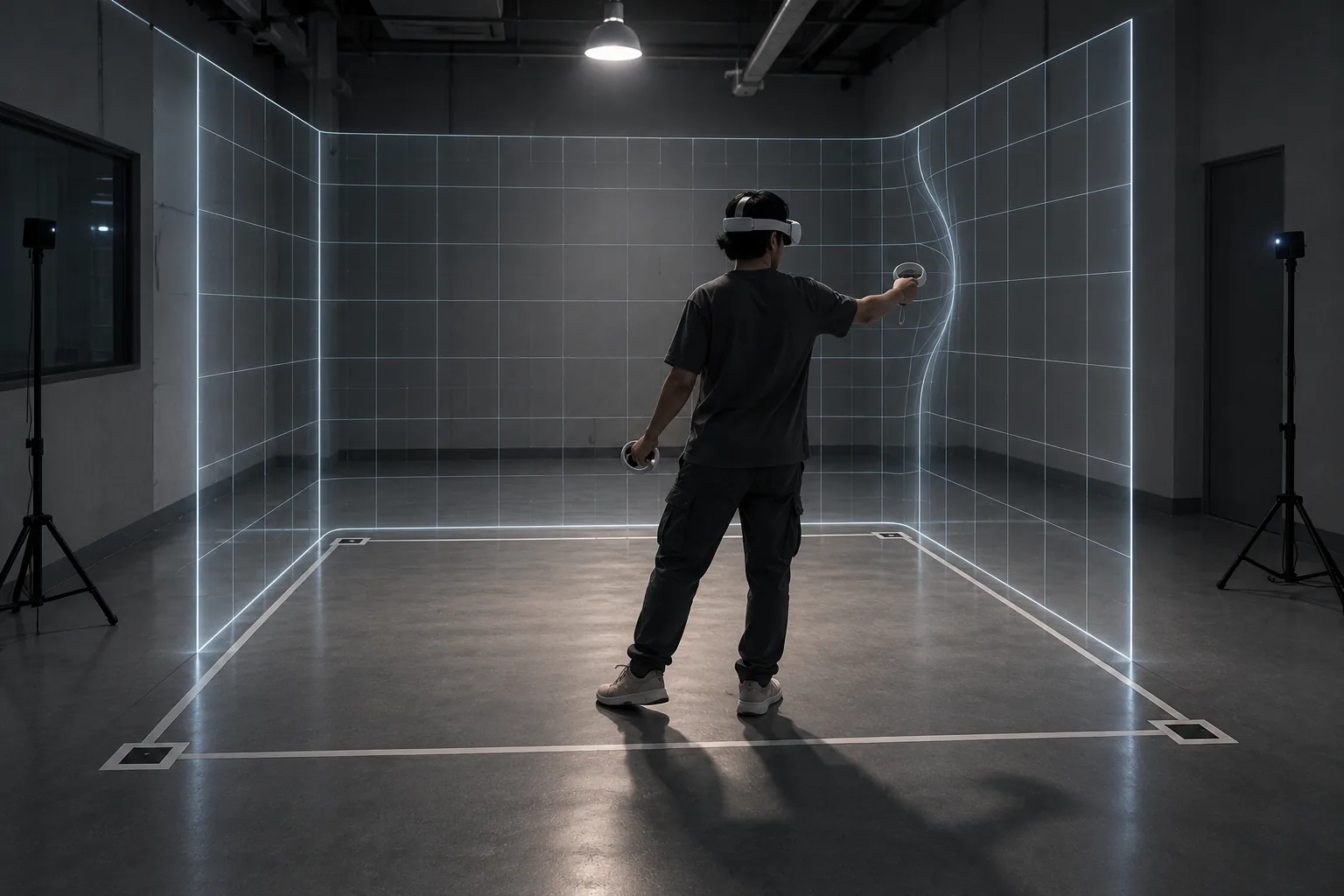
Rotational tracking only (yaw, pitch, roll). Used primarily in entry-level headsets where positional movement in 3D space is not required. QWR's QVR-03-01 is a 3DoF platform optimised for seated classroom experiences.
6DoF (Six Degrees of Freedom)
Full rotational and positional tracking, allowing users to physically walk within a virtual or mixed environment. Essential for room-scale simulation, industrial training, and surgical rehearsal. QWR's QVR-06-04 and QXR-06-07 are 6DoF platforms.
XR (Extended Reality)
An umbrella term covering Virtual Reality (VR), Augmented Reality (AR), and Mixed Reality (MR). XR is the overarching category of immersive technologies QWR designs hardware for.
Passthrough
A camera-based view of the real world displayed inside a headset. Advanced RGB passthrough (as featured on QXR-06-07) enables high-fidelity Mixed Reality on opaque headsets.
SLAM (Simultaneous Localisation and Mapping)
Algorithms that build a real-time 3D map of the environment while simultaneously tracking the device's position within it. The foundation of QWR's inside-out 6DoF tracking systems.
Inside-Out Tracking
6DoF tracking computed entirely by cameras and sensors on the headset, with no external base stations, far simpler to deploy at scale than outside-in systems. QWR's 6DoF platforms are inside-out.
Outside-In Tracking
Tracking that relies on external sensors or base stations placed around the room to locate the headset. Higher setup overhead; largely superseded by inside-out for institutional deployments.
Motion-to-Photon Latency
The delay between a head movement and the matching update on-screen. Below ~20ms it is imperceptible; above it, comfort drops and, in simulation, flawed muscle memory can form, the basis of QWR's "negative training" analysis.
Foveated Rendering
Rendering the centre of gaze at full resolution and the periphery at lower resolution, matching human vision, to cut GPU load without visible quality loss.
Digital Twin
A real-time virtual replica of a physical object, system, or environment, used for simulation, monitoring, and predictive maintenance. Central to QWR's MRO, manufacturing, and smart-city deployments.
Optics & display technology
How the display reaches your eyes.
Waveguide
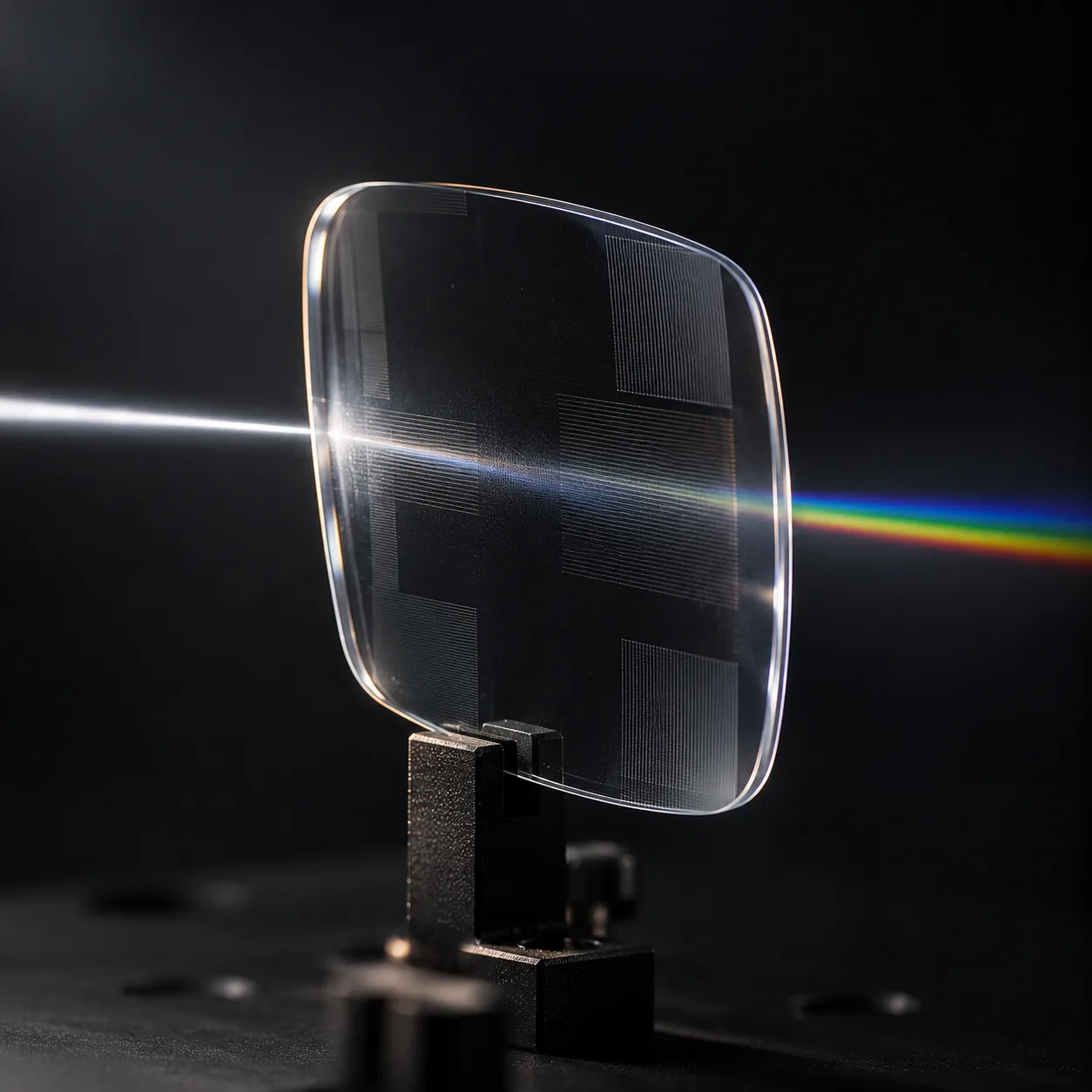
An optical component that channels light from a micro-display to the user's eye via total internal reflection, enabling transparent AR displays. The core optical technology in QWR's QAR-06.
Pancake Lens
A folded optics design that bounces light between polarizing layers, significantly reducing headset depth compared to traditional Fresnel lenses. Used in QWR's QVR-06-04 for a compact form factor.
Micro-OLED
A high-density display technology providing superior contrast ratios and pixels per inch (PPI). The QXR-06-07 features Micro-OLED, essential for medical visualization and high-fidelity engineering.
LCoS (Liquid Crystal on Silicon)
A micro-display technology used in AR light engines providing high-output brightness up to 2,500 nits. The production-validated approach for enterprise AR glasses manufacturing at high volumes.
FOV (Field of View)
The angular extent of the visible world through a headset, measured in degrees diagonal. A wider FOV increases user immersion. QWR's VR platforms range from 90–110°.
Diffractive Waveguide
A waveguide variant using surface-relief gratings (SRG) etched at nanometer scale to diffract light into the eye. Offers thinner, lighter form factors than reflective designs, the approach used in QAR-06 for all-day wearability.
Eye Box
The three-dimensional region in front of an AR display where the full image remains visible to the wearer. A larger eye box tolerates more variation in fit and inter-pupillary distance, critical for population-scale deployments across diverse facial geometries.
Total Internal Reflection (TIR)
The optical principle where light bounces along inside a medium without escaping, the mechanism that lets a waveguide carry an image across a transparent lens to the eye.
Geometric Waveguide
A waveguide using an array of partially-reflective mirrors to relay light to the eye, offering strong colour fidelity. One of the three waveguide architectures QWR produces, alongside diffractive and holographic.
Holographic Waveguide
A waveguide using volume holograms to diffract light into the eye, enabling compact, high-efficiency AR optics. The third of QWR's in-house waveguide architectures.
Light Engine
The micro-display-and-optics module that generates the image projected into an AR waveguide. QWR integrates multiple light-engine options across its AR platforms.
PPI (Pixels Per Inch)
A measure of display sharpness; higher PPI means finer detail and less visible "screen-door" effect.
Fresnel Lens
A lightweight lens with concentric ridges that focuses light in a thinner profile than a conventional lens, the older alternative to pancake optics, with a deeper headset form factor.
Sovereign trust & compliance
India-specific regulatory terms.
Make in India Class 1
A domestic content status that makes QWR a primary choice for institutional tenders and state-led ICT initiatives. Qualifies hardware for GeM procurement and Samagra Shiksha-aligned education deployments.
DAP (Defence Acquisition Procedure)
The primary framework for military procurement in India. QWR hardware meets "Buy Indian" (IDDM) categories under this procedure, making it eligible for Indian Army, Navy, and Air Force tenders.
DPDP Act (2023)
The Digital Personal Data Protection Act 2023. QWR uses secure boot and on-device processing to support Indian data-residency requirements, with in-region hosting for enterprise and healthcare deployments.
BIS Certification
The Bureau of Indian Standards. BIS certification validates that QWR electronics meet mandatory Indian safety and quality standards, required for all institutional and commercial deployments in India.
WPC Certification
Wireless Planning & Coordination, the Indian authority that licenses RF equipment. WPC approval is required for any device with Wi-Fi, Bluetooth, or other radios sold in India.
iDEX (Innovations for Defence Excellence)
The Ministry of Defence initiative that funds and procures innovation from Indian startups and MSMEs for the armed forces.
IDDM (Indigenously Designed, Developed and Manufactured)
The highest-priority "Buy Indian" category under DAP, for hardware designed, developed, and made in India.
GeM (Government e-Marketplace)
India's official online procurement portal for government buyers. A GeM listing is a prerequisite for most public-sector and education tenders.
Global Certifications (FCC, CE, RoHS)
International compliance marks for export and global OEM partners: FCC (US electromagnetic), CE (European conformity), and RoHS (restriction of hazardous substances). QWR's hardware carries these alongside its Indian certifications.
AI model training & safety
How on-device AI is trained & bounded.
Negative Training
A training methodology that explicitly teaches a model what not to output, using curated counter-examples and refusal patterns, rather than relying only on positive examples. Essential for regulated deployments where predictable refusal of out-of-scope requests matters more than raw capability.
RLHF (Reinforcement Learning from Human Feedback)
A post-training technique where human reviewers rank model outputs, and those rankings fine-tune the model toward preferred behaviour. Used to align HUMBL's on-device assistant with enterprise tone, safety boundaries, and task-specific answer formats.
Hallucination
A model output that is fluent and plausible but factually wrong or fabricated. Mitigated through retrieval-grounded generation, strict negative training, and, for QWR's regulated-sector deployments, hard guardrails on unverified numeric or citation output.
Guardrails
Deterministic filters wrapped around a model's input and output paths to block policy-violating prompts, PII leakage, or unsafe actions. Operate independently of the model itself, so safety properties hold even if the underlying weights are updated.
Fine-tuning
Continued training of a pre-trained base model on a smaller, domain-specific dataset to specialise its behaviour. QWR offers fine-tuning on partner-supplied corpora for vertical deployments, medical training content, defence doctrine, classroom curricula, with data staying within Indian jurisdiction.
On-Device AI
AI workloads that run locally on the device's own silicon (NPU/SoC) rather than in the cloud: wake-word detection, hand and eye tracking, sensor fusion, and object recognition. On QWR devices these run on-device for low latency and privacy. (The HUMBL assistant's language model is separate, see Model-Agnostic Orchestration.)
Model-Agnostic Orchestration
An architecture where the assistant layer is decoupled from any single AI model, routing each request to the most suitable external LLM. HUMBL is model-agnostic: its value is the orchestration, compounding memory, and wearable integration, not a proprietary model.
LLM (Large Language Model)
A model trained on large text corpora to understand and generate language. HUMBL's assistant routes to external LLMs rather than running one on the device.
RAG (Retrieval-Augmented Generation)
A method that grounds a model's answers in retrieved source documents rather than its training memory alone, used in QWR's regulated-sector deployments to keep responses verifiable.
Multimodal AI
Models that process multiple input types, voice, vision, and text, in one system. HUMBL is multimodal: it can see through the camera, hear via voice, and respond.
NPU (Neural Processing Unit)
A processor on the device's SoC dedicated to AI workloads, enabling on-device inference for tasks like vision and voice without a cloud round-trip.
Manufacturing & software
Engineering terminology.
ODM (Original Design Manufacturer)
A partner that designs and manufactures products for other companies to rebrand and sell. QWR is India's leading ODM for head-worn computing, offering 110+ reference architectures.
OEM (Original Equipment Manufacturer)
A partner that manufactures hardware to a client's exact design and technical specification. QWR's OEM service provides a 9–11 month development-to-production timeline.
BSP (Board Support Package)
The software layer including kernels and drivers that enables an OS to run on specific hardware. Every QWR ODM project includes a full BSP handoff to the partner engineering team.
AOSP (Android Open Source Project)
The foundational operating system for QWR devices. A "Clean AOSP" build ensures native compatibility with enterprise MDM tools like Microsoft Intune, and no foreign bloatware.
OTA (Over-The-Air Updates)
Wireless delivery of software or firmware to a device. Critical for managing large-scale classroom or enterprise fleets, OTA enables delta updates with staged rollout and automatic rollback.
JDM (Joint Development Manufacturer)
A model where vendor and client co-develop a product and share design responsibility, sitting between full ODM and pure OEM.
DFM (Design for Manufacturing)
Designing a product so it can be built reliably and at scale. QWR runs a structured, multi-phase DFM pipeline for ODM and OEM partners.
NRE (Non-Recurring Engineering)
The one-time engineering cost of designing and validating a new product before mass production. QWR invests in NRE and maintains a validated reference-architecture library to speed partner market entry.
EVT / DVT / PVT
Engineering, Design, and Production Validation Test: the three hardware validation phases between prototype and mass production, confirming function, manufacturability, and production readiness.
Hard Points & Soft Points
QWR's DFM framework. Hard points are the parameters QWR protects, optical performance, thermal behaviour, certification integrity, sensor accuracy. Soft points are what partners freely change, shell geometry, materials, and CMF.
CMF (Colour, Material, Finish)
The visible design layer of a product: its colours, materials, and surface finishes. A soft point QWR partners control to differentiate their brand.
Secure Boot
A firmware mechanism that verifies each stage of the boot process is cryptographically signed and untampered, blocking unauthorised code. Part of QWR's backdoor-free firmware claim.