Industry Insights · Defence
Specifying Rugged XR for Defence and Aerospace. A Requirements Framework Beyond "MIL-STD-810H."
By QWR Technical Marketing
"Rugged" on a datasheet is where the conversation starts, not where it ends. A device rugged enough for a soldier in a desert, a technician on a flightline, and an engineer in a satellite cleanroom are three different requirements. This is a framework for procurement engineers who have to write the ruggedisation spec — and know what to demand evidence for.
Start Here: Ruggedness Is Three Requirements, Not One Rating
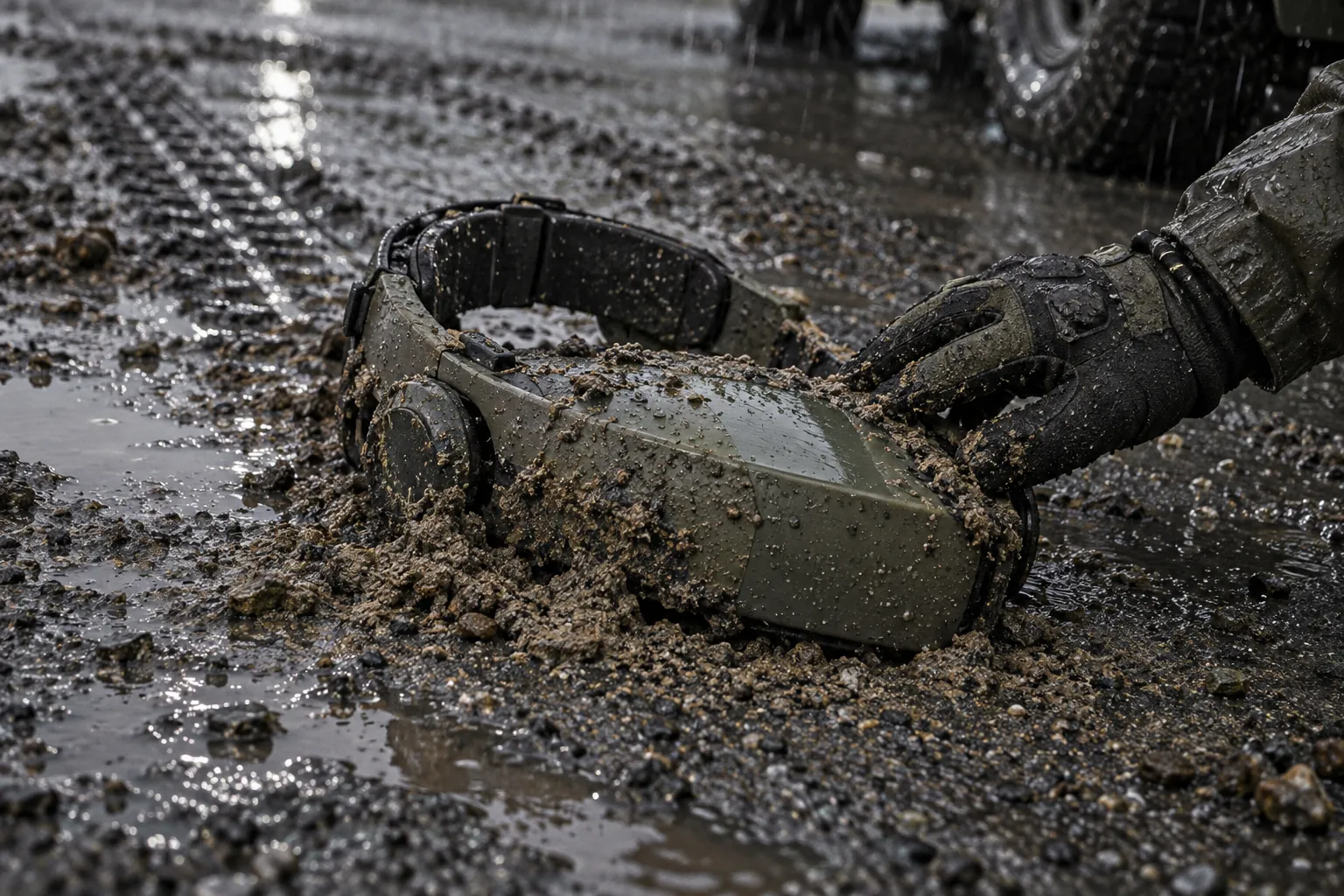
A single environmental rating tells you the device survives being dropped. It says nothing about whether it works while worn over night-vision goggles, or whether it functions when the network is jammed. For defence and aerospace, "rugged" resolves into three distinct requirement families — physical, integration, and operational — and a spec that names only the first will pass a lab test and fail a mission. (This paper stays on the hardware requirement; data-sovereignty is covered in Defence Waveguide ODMs, procurement policy in DAP 2020, and training ROI in the armed-forces and MRO papers.)
"The lab certifies that a device survives. The mission decides whether it works — over a helmet, under a jammer, in a cleanroom. Specify all three, or you have only specified the easy one."
1. Physical Hardening: What "Pre-Compliant" Should Mean
- MIL-STD-810H is the floor, and pre-compliance is the tell: QWR's defence platforms are described as MIL-STD-810H pre-compliant — meaning drop, shock, vibration, and thermal resilience are engineered in from the architecture, not retrofitted after a field failure. Insist the standard is designed-in, not a test the vendor hopes to pass later.
- Specify the environment, not just the standard: MIL-STD-810H is a family of methods; a desert deployment stresses thermal cycling and dust, a high-altitude one stresses pressure and cold. Name the methods that match your theatre, and pair them with an ingress rating (IP-class dust/water) appropriate to the environment.
- Physical hardening is a system trade-off: Hardening adds mass and constrains thermals — the engineering tension covered in the battery–weight–thermal trilemma. A rugged spec that ignores that trade produces a device too heavy or too hot to wear through a mission.
2. Integration Ruggedness: the Requirement Most Datasheets Omit
- A soldier's device is worn with other equipment, not alone: The ruggedness that decides field usability is whether the device coexists with existing kit. QWR's tactical AR optical stacks are designed to work with PVS-14 and PNV-10T night-vision devices — a compatibility requirement a generic "rugged" claim never addresses.
- Flush-fit is a hard requirement, not a comfort feature: The device must sit close enough to the face to be worn with ballistic helmets and gas masks without obstructing peripheral vision. Specify the co-worn equipment explicitly; a HUD that can't fit under a helmet is not deployable regardless of its drop rating.
- Weight is a mission-endurance spec: The tactical AR platform is engineered under 49g precisely because mass worn across a patrol becomes fatigue and lost situational awareness. For a wearable, "rugged" and "light enough to keep wearing" are the same requirement.
3. Operational Ruggedness: Working When the Network Doesn't
- Contested and disconnected operation is a ruggedness axis: A device that only works with a live connection is fragile in exactly the environments defence and aerospace care about. Air-gapped, offline-capable operation — the HUMBL platform is described as air-gap capable with no foreign server dependency — is a hardening requirement, not a networking preference.
- Secure connectivity is part of the spec: Where devices do network, encrypted mesh networking and blue-force-tracking / BMS integration determine whether the system is usable under contested spectrum. Specify how the device behaves when links degrade, not only when they're clean.
- Networked scale is a requirement too: Combat simulation on QWR's defence stack supports up to 64 networked participants in a shared synthetic environment. If your use case is collective training, "rugged" includes surviving that concurrency, not just the drop test.
4. The Mission Profile Rewrites the Spec
- Defence and aerospace are different rugged briefs: On the defence side, the requirement centres on mission rehearsal (up to 64 users, equipment familiarisation on platforms such as the T-90, BMP-2, and Rafale), soldier-borne HUDs, and MRO sustainment. The aerospace side centres on flight simulation, aircraft MRO — cutting aircraft-on-ground (AOG) time by up to 30% — and 1:1 satellite assembly visualisation.
- The environment inside each mission diverges again: A flightline technician, a cleanroom satellite engineer, and a dismounted soldier impose different dust, ESD, and impact requirements. QWR's own hardware split reflects this — QXR-06-10 (6DoF) for simulation, a HUMBL-based tactical AR platform for the field, QXR-06-07 (Micro-OLED passthrough) for digital-twin and command visualisation.
- Match the platform to the mission, then harden to the theatre: The discipline is to pick the device class the mission demands and then apply the physical, integration, and operational hardening its specific environment requires — not to assume one "rugged" SKU serves a cockpit, a cleanroom, and a combat patrol.
5. Sovereignty Is What Makes a Rugged Device Procurable
- For defence and aerospace buyers, rugged-but-foreign is often rugged-but-ineligible: A device can pass every environmental method and still fail the bid if it can't clear procurement. QWR's defence positioning pairs ruggedisation with DAP 2020 "Buy Indian" eligibility and 100% Indian-origin IP — the attributes that make a rugged platform actually acquirable by the Army Design Bureau, DRDO, BEL, and defence PSUs. (The mechanics of that eligibility are detailed in DAP 2020.)
- NDA-first engagement is part of the requirement: For classified or sensitive programmes, how a partner handles the engagement is itself a ruggedness-of-process question — QWR states NDA-first engagement across Army Design Bureau, DRDO, BEL, PSU, and private integrators.
- Sovereign support is sustainment ruggedness: SLA-backed support and domestic sustainment mean a rugged device stays mission-ready — the aerospace practice cites 50% faster MRO competency and standalone simulation at roughly 1/100th the cost of traditional flight simulators, both of which depend on a supported, in-country stack.
The Engineering Conclusion: Write the Requirement the Mission Actually Has
A rugged XR requirement worth procuring names all three families at once: the physical methods matched to the theatre, the integration constraints of the kit it's worn with, and the operational behaviour when the network is contested — and it confirms the device is procurable under sovereign-content rules. "MIL-STD-810H compliant" answers a fraction of that. The right specification reads more like a mission profile than a datasheet, and the right partner answers each line with evidence: a pre-compliance report, an NVG-compatibility test, an air-gapped demo, and a Buy-Indian eligibility path. Rugged is not a rating you accept. It is a requirement you write.
FAQ
Frequently asked questions
What are the three requirement families that make up rugged for defence XR?+
Physical hardening (drop, shock, vibration, thermal), integration ruggedness (compatibility with night vision, helmets, gas masks), and operational ruggedness (air-gapped operation, encrypted mesh networking under contested spectrum).
Is QWR's defence tactical AR hardware compatible with night vision goggles?+
Yes, its optical stacks are designed to work with PVS-14 and PNV-10T night vision devices, and the platform is engineered under 49g for flush-fit compatibility with ballistic helmets and gas masks.
Does QWR's defence platform work without a network connection?+
Yes, the HUMBL platform is described as air-gap capable with no foreign server dependency, a hardening requirement for contested or disconnected environments.
Request a Technical Briefing
Our engineering team provides direct support for procurement officers, institutional buyers, and enterprise technology leads.