Industry Insights · Industry
When Standard XR Hardware Can't Enter the Zone. Questions for Hazardous-Area Deployments.
By QWR Compliance & Regulatory Affairs
Refineries, gas processing plants, chemical works, fuel terminals and some mines contain areas where flammable gases, vapours or dusts may be present. In those areas, any electrical device is a potential ignition source. Equipment taken into them must be designed and certified so that it cannot ignite the surrounding atmosphere.
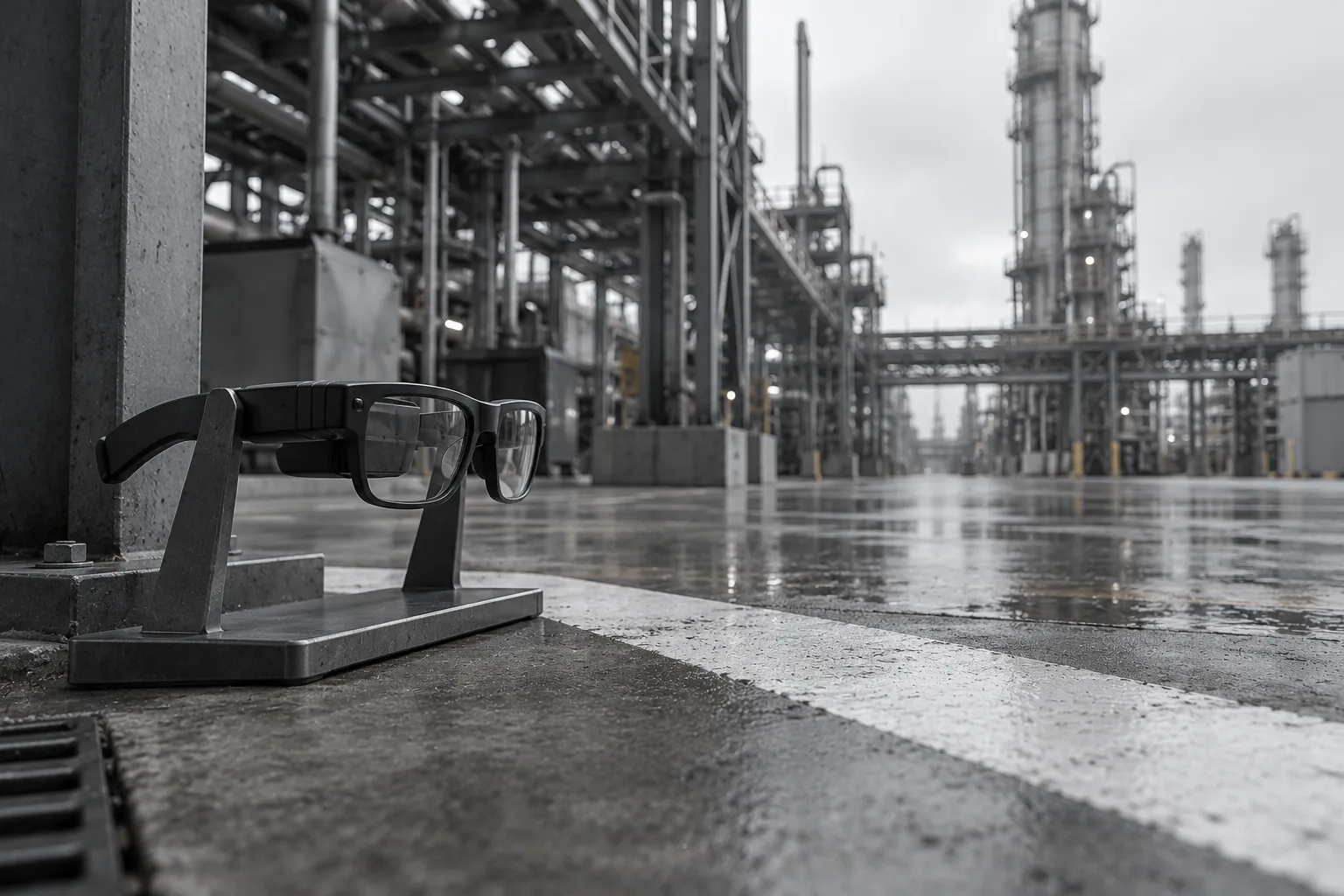
Illustrative image. These are not what our headsets look like.
Most XR hardware, including most enterprise VR headsets and smart glasses, is not certified for these areas. That is the starting point for this paper. It is not a criticism of the hardware; it reflects the fact that hazardous-area certification is a specialised discipline with its own design constraints, testing and approval process, and most devices are not built for it.
People searching for "ATEX smart glasses" usually want a device they can take into a classified zone. This paper does not offer one. It sets out the questions a buyer should ask to establish whether any device is eligible, and what XR can still contribute to hazardous-area operations without entering the zone at all.
This paper does not state that any QWR product holds hazardous-area certification.
Why zone classification comes before device selection
Hazardous areas are classified according to how likely an explosive atmosphere is to be present, and for how long. Under the widely used international approach:
- Gas and vapour areas are classified as Zone 0, Zone 1 or Zone 2, from most to least likely.
- Combustible dust areas are classified as Zone 20, Zone 21 or Zone 22, on the same logic.
Equipment is certified for use in particular zones, gas groups and temperature classes. A device suitable for one zone may not be suitable for another.
The site's area classification drawings define where each zone is. These are the first document to consult. A device decision made without them is not a decision.
Typical pattern. An operations team trials AR glasses for maintenance guidance at a processing plant. The trial goes well in the workshop and control room. The team then wants to use the glasses at the process units. The safety team checks the area classification and confirms that most of the units are in a classified zone. The glasses carry no hazardous-area certification. The programme is redesigned around work that can be done outside the zone.
The certification frameworks to recognise
Several frameworks govern equipment for explosive atmospheres. A buyer does not need to master them, but should recognise the names and know what to ask for.
ATEX. In the European Union, the ATEX Equipment Directive (2014/34/EU) sets requirements for equipment intended for use in potentially explosive atmospheres. Equipment compliant with it carries specific markings.
IECEx. An international certification scheme run under the International Electrotechnical Commission, based on the IEC 60079 series of standards for explosive atmospheres. It is used in many countries as a basis for acceptance.
National approvals. Many countries have their own approval requirements. In India, the Petroleum and Explosives Safety Organisation (PESO) is the authority commonly associated with approving electrical equipment for use in hazardous areas. Buyers should confirm the current Indian requirements for their specific application with the site's safety team and the relevant authority.
Other regional schemes. North America and other regions have their own systems and markings.
A device certified under one framework is not automatically accepted under another. The site determines which apply.
Questions to ask before considering any device
These questions apply to any XR device proposed for hazardous-area use, from any vendor.
Certification
- Does the device carry a hazardous-area certification? Under which framework: ATEX, IECEx, a national approval, or more than one?
- For which zones, gas groups and temperature classes is it certified?
- Is the certification for the complete device as it will be used, including battery, charger and accessories, or only for part of it?
- Who issued the certificate, and can you see it, along with the certificate number?
Marking
- Does the device carry the required markings physically on it?
- Do the markings match the zone, gas group and temperature class of the area where it will be used?
Conditions of use
- What conditions does the certificate impose? For example, restrictions on charging, battery replacement or use of accessories inside the zone.
- Can the battery be charged or replaced inside the zone, or only outside?
- Does any peripheral, such as a paired phone, earpiece or scanner, also need certification?
The last point is easy to miss. A certified pair of glasses tethered to an uncertified phone is not a certified system.
Documentation for the request for proposal
Ask vendors to provide:
- The certificate and its scope.
- The marking details.
- Conditions of safe use.
- Confirmation of which national approvals apply in your country.
Ask the site's safety team to confirm, in writing, that the documentation meets the site's requirements before any trial in a classified area.
What standard XR hardware can still do outside the zone
If no suitable certified device is available, or the programme cannot justify one, XR can still contribute a great deal to hazardous-area operations. Much of the value lies in preparation, training and support that happen outside the zone.
Training in a safe area
Virtual reality is well suited to rehearsing hazardous-area procedures precisely because those procedures cannot be practised for real without risk. Typical modules include permit-to-work processes, gas testing, isolation, confined space entry, emergency response and evacuation. These run in a training centre, nowhere near a classified area.
The companion papers Which Safety Modules Need Which Headset and Getting Training Records Off the Headset cover the hardware and reporting requirements.
Pre-job briefing
Before a crew enters a classified area, they can walk through the task in VR or review it on AR glasses in a safe area: the location, the isolation points, the sequence, the hazards. When they enter the zone, they carry the plan in their heads rather than on a device.
Digital twin review
Engineers can review a unit, plan a shutdown or rehearse a modification using a digital model, in an office or control room. The companion paper on digital twin VR covers the hardware questions.
Remote assistance at the zone boundary
A technician working inside the zone cannot wear uncertified glasses. But a colleague at the boundary, outside the classified area, can relay guidance from a remote expert, or the technician can step out to consult. This is slower than direct guidance, but it keeps the expert involved without bringing an uncertified device into the zone.
Work in unclassified parts of the site
Many sites include large unclassified areas: workshops, warehouses, control rooms, offices and some utilities. Standard XR hardware can be used there under normal site rules.
Temporary arrangements
Some sites manage exceptional use of uncertified equipment in classified areas through permit systems, gas testing and continuous monitoring. Whether that is acceptable, and under what conditions, is a decision for the site's safety authority and its regulators. It is not something a device vendor can authorise, and this paper does not recommend it.
Who owns which decision
| Decision | Owner |
|---|---|
| Where the classified zones are | Site safety, from area classification drawings |
| Which certification frameworks apply | Site safety, with regulatory advice |
| Whether a specific device is acceptable | Site safety, based on vendor documentation |
| Whether any temporary arrangement is permitted | Site safety authority and regulator |
| What XR does outside the zone | Operations and training, within site rules |
The operations or training team should not make any of the first four decisions alone.
Typical pattern: a hazardous-area XR programme designed around the boundary
Typical pattern. A refinery wants to improve maintenance quality without buying certified devices.
- VR training in the training centre covers permits, gas testing, isolation and emergency response.
- Before each significant job, the crew reviews the task on AR glasses in the control room: location, isolation points, sequence.
- For complex work, a remote expert joins a session with a supervisor at the zone boundary.
- Inside the zone, work proceeds with certified radios and paper or certified tablets, as before.
The programme improves preparation and support without putting an uncertified device inside a classified area.
Where to go next
To match training and pre-job briefing needs to a device class, start with the Platform Finder. For rugged requirements in other demanding settings, see Specifying Rugged XR for Defence and Aerospace.
Sources
- Directive 2014/34/EU (ATEX Equipment Directive), European Union.
- IECEx System, International Electrotechnical Commission; IEC 60079 series.
- Petroleum and Explosives Safety Organisation (PESO), Department for Promotion of Industry and Internal Trade, Government of India (peso.gov.in).
FAQ
Frequently asked questions
Can standard smart glasses or VR headsets be used in a hazardous area?+
Generally not. Equipment used in classified hazardous areas must be certified for the specific zone, gas group and temperature class. Most XR hardware does not carry this certification. Confirm with the site's safety team before any use.
What certification should a buyer ask about?+
Depending on the site and country: ATEX in the EU, IECEx internationally, national approvals such as those administered by PESO in India, and other regional schemes. Ask for the certificate, its scope, the markings and the conditions of use.
Does a certified device make the whole system safe?+
Only if everything used with it in the zone is also suitable. A certified pair of glasses paired with an uncertified phone, charger or earpiece is not a certified system.
What can XR do for hazardous-area work without entering the zone?+
Training in a safe area, pre-job briefings, digital twin review, remote assistance at the zone boundary, and work in unclassified parts of the site.
Who decides whether a device can be used?+
The site's safety authority, based on the area classification and the device's certification documentation, and in line with regulatory requirements.
Request a Technical Briefing
Our team provides direct support for procurement officers, institutional buyers, and enterprise technology leads.