Industry Insights · Optics & Display
What is a Waveguide Display? The Physics of Transparent AR.
By QWR Engineering
From Total Internal Reflection to diffractive, holographic, and geometric architectures. A first-principles breakdown of the optics powering HUMBL and enterprise AR smart glasses.
Abstract: The Evolution of Head-Worn Computing
As the Indian Armed Forces and global heavy industries transition toward Industry 4.0 and the Digital Soldier paradigm, the requirement for unobtrusive, high-fidelity information overlays has become a strategic priority. Traditional display technologies have historically failed this transition due to the "Goggle Gap" — the physical bulk and weight required to project digital data onto a transparent surface using conventional refractive optics.
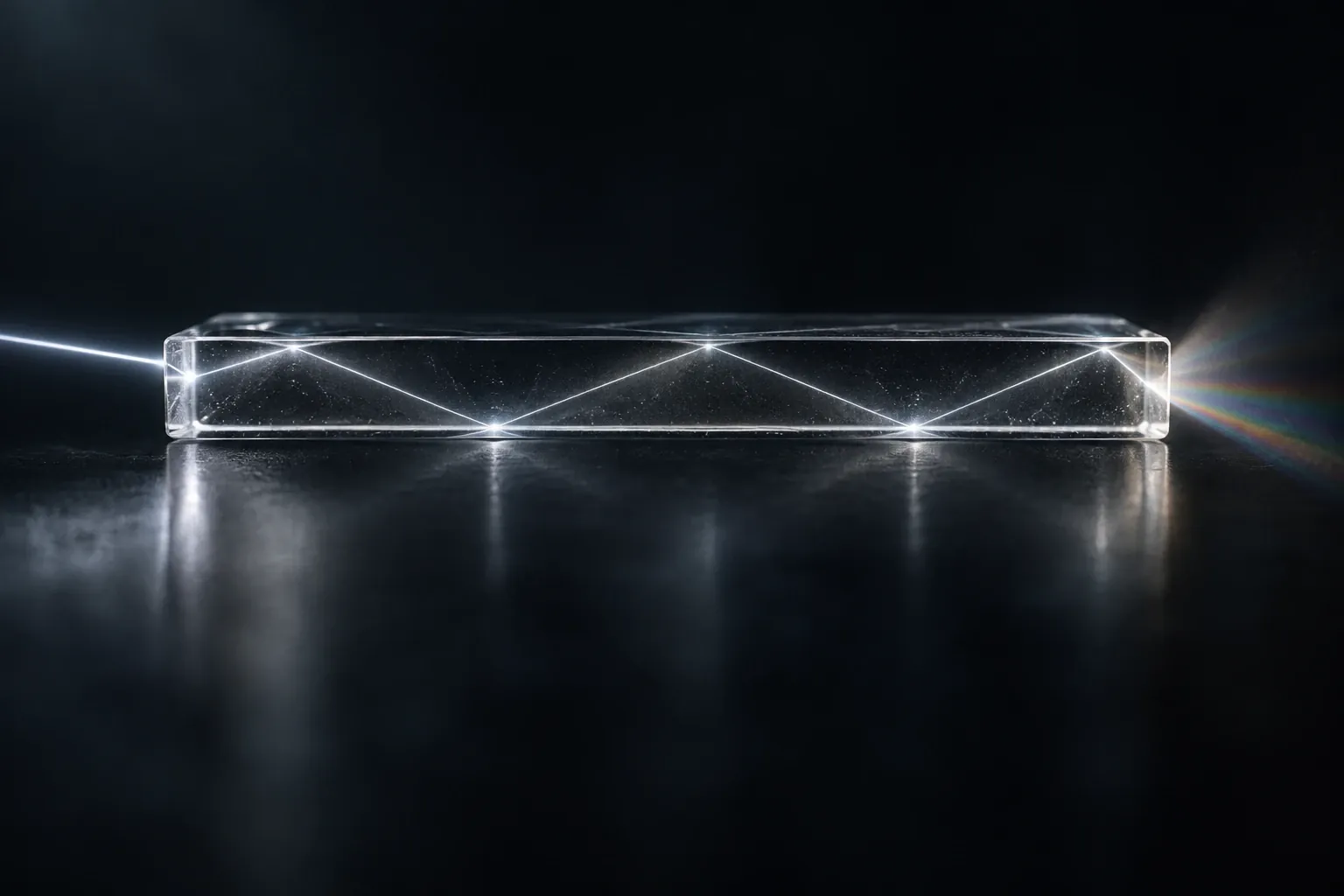
A waveguide display is the specialized optical substrate — typically composed of high-index glass or polymer — designed to bridge this gap. It works by "trapping" light from a micro-display and channeling it to the user's eye via Total Internal Reflection (TIR). Unlike legacy "Birdbath" or prism-based optics that obstruct peripheral vision and cause neck fatigue, waveguide technology enables AR to reach a form factor indistinguishable from standard premium eyewear.
"Waveguide technology enables Augmented Reality to reach a form factor indistinguishable from standard premium eyewear — while maintaining the structural integrity required for field deployment."
Principles of Waveguide Propagation & Optical Architectures
The mechanical efficiency of a waveguide lies in its ability to manipulate light within a medium thinner than a standard prescription lens. While the core mechanism — Total Internal Reflection — is constant, the method of controlling that light varies significantly based on mission profile. QWR utilises three distinct architectures:
Diffractive (Surface Relief Grating)
Nanoscale gratings etched onto glass redirect light into the eye via Bragg angles. Superior colour uniformity across the display area. Scalable for mass production using nanoimprint lithography — high yields at 100,000-unit scale.
Holographic (Volume Holographic Grating)
Interference patterns recorded in photopolymer film. Enables highest transparency (85–92%) and the thinnest possible waveguide profile. Preferred for premium, compact wearables where the "invisible" aesthetic is a primary design requirement.
Geometric (Reflective / Birdbath-Hybrid)
Partial mirrors or microscopic prisms redirect the light path. Offers the widest possible Field of View up to 52°. Optimised for low-cost, high-FOV applications where a slightly larger frame profile is acceptable.
The Optical Light Engine: Generating the Digital Image
If the waveguide is the delivery highway, the light engine is the vehicle. It generates the actual image that is "in-coupled" into the waveguide substrate. QWR optimises these engines based on three primary technologies:
- LCoS (Liquid Crystal on Silicon): A reflective LCD using LED or laser illumination. Mature, rugged technology providing up to 2,500 nits — the workhorse for enterprise and defence applications where sunlight readability is critical.
- Micro-OLED (Silicon-backed OLED): Self-emitting pixels on a silicon backplane. Industry-leading contrast ratio of >100,000:1. High pixel density achievable in an ultra-compact module.
- LBS (Laser Beam Scanning): MEMS-based RGB laser scanning for infinite focus depth (retinal projection). Least power consumption — the ideal candidate for all-day smart glasses.
Comparative Performance Matrix
| Parameter | Diffractive + LCoS | Holographic + Micro-OLED | Geometric + LBS |
|---|---|---|---|
| Field of View (FOV) | 30–50° | 25–40° | 35–52° |
| Max Brightness | 1500–2500 nits | 500–1500 nits | 300–800 nits |
| Optic Module Weight | 8–14g | 5–9g | 6–12g |
| Transparency | 70–80% | 85–92% | 65–75% |
| Power Consumption | Moderate | Moderate–High | Lowest |
| Primary Vertical | Defence & Enterprise | Premium Consumer | All-day Wearables |
Tactical & Industrial Operational Advantages
Environmental Awareness & Sunlight Readability
Unlike VR passthrough which can suffer from latency or camera failure, waveguides are natively transparent. If power fails, the user maintains natural sight with zero latency — critical in kinetic environments. By pairing waveguides with high-output LCoS engines, QWR ensures mission waypoints remain visible even in high-ambient sunlight (verified up to 2,500 nits).
Human Factors & Mission Endurance (<49g)
Traditional optics are front-heavy, creating a "lever effect" leading to chronic neck fatigue. QWR's HUMBL series utilises waveguides to move the centre of gravity back toward the ears. Maintaining a total device profile under 49g allows operators to wear the device for entire shifts.
Tactical Flush-Fit & NVG Compatibility
Because waveguides are thin-glass substrates, they sit closer to the user's face — engineered for compatibility with standard-issue night vision devices (PVS-14, PNV-10T) without causing focal interference. The flush-fit ensures simultaneous wear with ballistic helmets and gas masks.
Manufacturing & IP Security
In a "China Plus One" global hardware landscape, owning the optical IP is a matter of national security. QWR mitigates foreign dependency through a localised, air-gapped manufacturing lifecycle: all waveguide calibration, engine integration, and high-precision optical testing occur at our domestic facility in Pune.
- Clean AOSP Firmware: 100% Indian-origin IP — strictly no foreign backdoors or hidden cloud dependencies.
- DAP 2020 Compliance: Class 1 certified, aligning with "Buy Indian" (IDDM) categories and the Positive Indigenisation List for the MoD.
- Data Residency: All telemetry stored on DPDP Act 2023 compliant Indian servers (AWS Mumbai).
Conclusion: The Roadmap to Domestic AR
Waveguide technology is not merely an alternative to VR; it is the only viable path for the national-scale rollouts required by the Indian Armed Forces and precision-critical industrial sectors. By localising this high-precision engineering, QWR provides the sovereign architecture necessary to maintain a technological edge in the age of spatial computing.
FAQ
Frequently asked questions
What is the difference between diffractive, holographic, and geometric waveguides?+
Diffractive (surface relief grating) uses nanoscale gratings for superior colour uniformity and scales well to mass production. Holographic (volume holographic grating) offers the highest transparency, 85 to 92 percent, and the thinnest profile, for premium compact wearables. Geometric (reflective/birdbath-hybrid) offers the widest field of view, up to 52 degrees, for low-cost, high-FOV applications.
How bright can a waveguide display get?+
Up to 2,500 nits with an LCoS light engine, the workhorse for enterprise and defence applications where sunlight readability matters. Micro-OLED and LBS engines trade peak brightness for higher contrast or lower power draw instead.
Are waveguide glasses compatible with night vision devices?+
Yes. Because waveguides are thin-glass substrates that sit close to the face, they are engineered for compatibility with standard-issue night vision devices like the PVS-14 and PNV-10T without causing focal interference, and fit for simultaneous wear with ballistic helmets and gas masks.
Request a Technical Briefing
Our engineering team provides direct support for procurement officers and enterprise technology leads.