Industry Insights · Technology · Hardware
The Battery, Weight, and Thermal Trilemma. Why You Cannot Maximise All Three on a Head-Worn Device.
By QWR Engineering
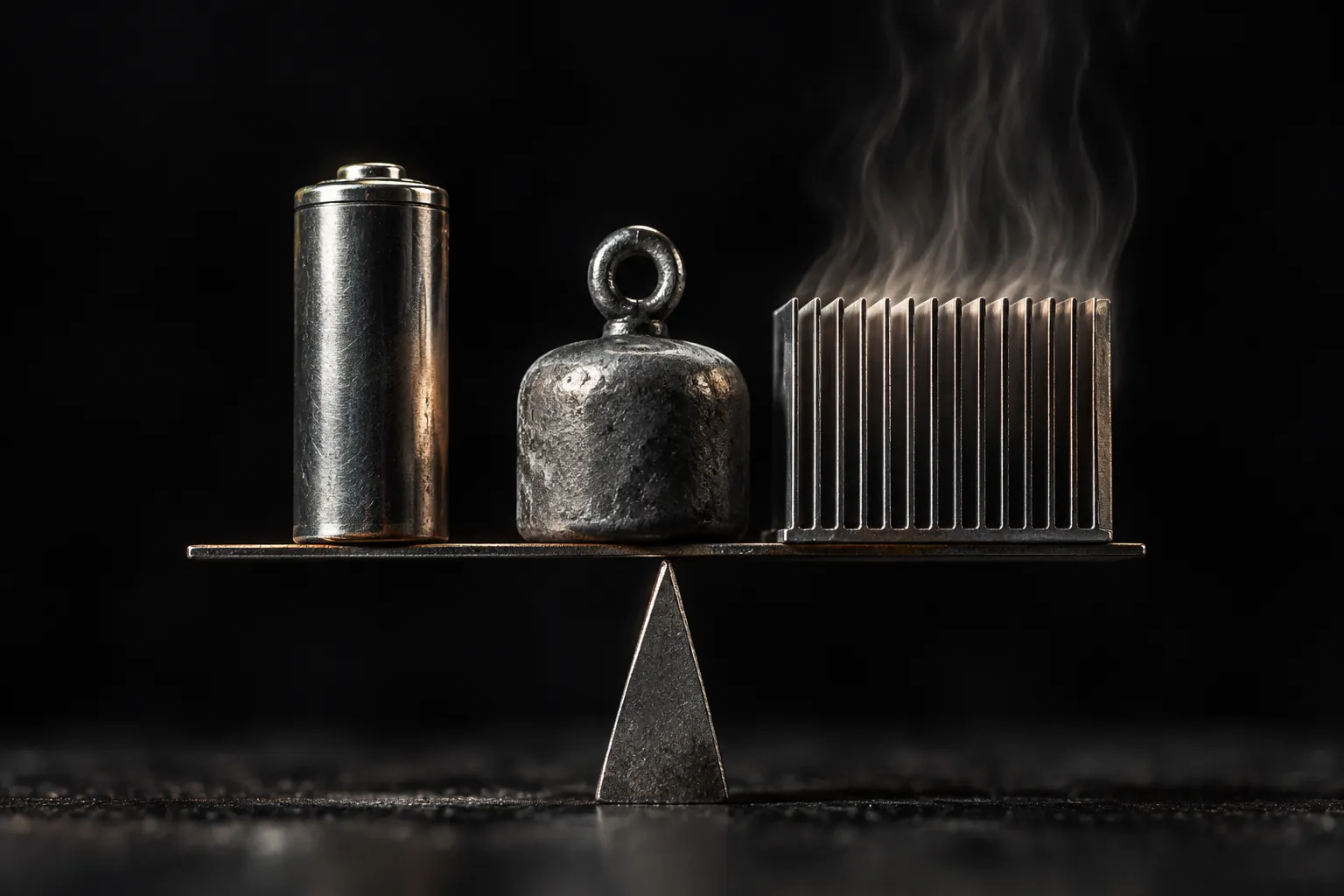
Every head-worn XR device is a negotiation between three specs that actively fight each other: how long it runs, how much it weighs, and how much heat it can shed. A bigger battery adds mass and heat; a lighter frame has less room to dissipate that heat; more on-device compute demands both. There is no device that wins all three — only a device that has chosen its trade-offs deliberately.
Why This Is a Trilemma, Not a Checklist
On a phone, battery, weight, and heat are constraints you balance across a slab you hold at arm's length. On a device worn on the face for a full shift, they become a trilemma, because each one is bounded by the human head. Runtime wants a larger cell; wearability wants less mass; sustained on-device AI generates heat that a thin, light frame has little volume to move away from skin. Improve one axis and you spend budget on another. The engineering question is never "how do we maximise all three" — it is "which axis does this deployment refuse to compromise, and what do we trade for it." That is precisely the decision QWR's Design Customization framework is built to structure.
"You do not solve the battery-weight-thermal trilemma. You choose which of the three your deployment cannot live without, and you engineer the other two around it — before anyone opens a CAD file."
1. Thermal Is a Hard Point, Not a Styling Decision
- The thermal envelope is fixed for a reason: In QWR's customisation framework, the thermal envelope is an engineering hard point — the SoC dissipation zones must remain unobstructed. This is not a preference; blocking them causes sustained thermal throttling during on-device AI processing, which turns a headline compute spec into a number the device can only hit for seconds.
- Heat is the axis that punishes over time: A device can feel fine in a five-minute demo and become a comfort complaint by hour three. Because the dissipation path is a hard point, your industrial design has to route around it — you do not get to seal it off for a sleeker shell.
- Compute you can't cool is compute you don't have: The more on-device AI a deployment needs, the more thermal headroom it must protect. Treat the thermal envelope as the first constraint, because it silently caps the other two.
2. Weight Is Felt as Torque — and Material Is the Lever
- Grams matter, but distribution matters more: Mass on the face is felt as leverage against the nose and ears, not as an abstract number. Form-factor engineering is as much about where the weight sits as how much there is — a principle the waveguide human-factors analysis covers in depth.
- Material selection is the primary weight lever, and it's a soft point: QWR exposes material choice as a customisation soft point with real trade-offs — TR90 for the lowest weight and all-day flexibility, carbon fibre for the highest strength-to-weight ratio in flagship and industrial builds, magnesium alloy for premium rigidity with built-in EMI shielding on defence AR HUDs and high-end enterprise units, and PC/ABS for impact-resistant, cost-effective high-volume education and consumer fleets.
- The material choice is a thermal choice too: A housing material is also part of the heat story — rigidity, shielding, and conductivity travel with the material decision, so picking a shell material is never purely about grams or cost.
3. Battery Is the Swing Variable
- Capacity trades directly against the other two axes: A larger cell buys runtime at the cost of mass and of heat under load. This is the axis a deployment usually flexes, because it has the most direct lever — how long does this device actually need to run between charges, honestly?
- Placement is a form-factor decision, not just a capacity one: Where the cell sits reshapes the device's balance; moving mass off the front of the face changes how heavy a given battery feels. Hot-swappable versus sealed is a further fork — swappable packs trade a sealed, lighter profile for zero-downtime shift changes, a trade enterprise fleets often make deliberately.
- Battery configuration reaches all the way to certification: It is not only an ergonomic variable. Per QWR's ODM process, standard BIS certification timelines vary with radio technology and battery configuration — so a late battery change is not a free swap; it can touch your compliance schedule.
4. How the Trilemma Resolves Inside Hard Points and Soft Points
- The framework exists to make the trade explicit before tooling: QWR's hard-points / soft-points model draws the boundary before an ID team opens a CAD file — no optical recalibration after the enclosure changes shape, no surprises at tooling stage. The trilemma is resolved on paper, not discovered on the line.
- Your levers are the soft points; your constraints are the hard points: Shell geometry (submitted as STEP/IGES, reviewed within about 5 business days), material selection, and control placement are yours to move. The optical stack, PCB and antenna footprint, thermal envelope, and sensor alignment are fixed. You navigate the trilemma inside that boundary.
- Every added sensor spends the same budget: Integrating secondary modules — thermal imaging, LiDAR, biometric, or environmental sensors — adds both mass and power draw, drawing directly from the same trilemma budget. A rugged field device with extra sensing has less room to spend on battery and shell, not more.
5. The Environment Sets the Target You Optimise For
- A climate-controlled office and a 45°C field site are different design briefs: The right resolution of the trilemma depends on where the device works. A lightweight all-day office wearable optimises weight; a rugged field or defence unit protects thermal headroom and durability first and accepts more mass to do it. QWR's Frontline Localization paper details the climate-resilience end of this spectrum, including thermal-cycling standards.
- Material follows environment: This is why the material menu maps to deployment — magnesium and carbon fibre for rugged and premium builds, TR90 for lightweight all-day glasses, PC/ABS for high-volume indoor fleets. The environment picks the corner of the trilemma you defend.
The Engineering Conclusion: Choose the Corner You Defend
The battery-weight-thermal trilemma has no winning configuration in the abstract — only a configuration that is right for a stated deployment. The discipline is to name, before design begins, which axis is non-negotiable: runtime for a device that can't be recharged mid-shift, weight for one worn all day, or thermal headroom for one running continuous on-device AI. QWR's customisation framework turns that into an explicit engineering contract — a fixed thermal envelope and optical stack as hard points, material and geometry as soft-point levers — so the trade-offs are chosen on purpose rather than surfacing as a hot, heavy, short-lived device three months into tooling.
FAQ
Frequently asked questions
Why can't a headset maximise battery life, weight, and thermal performance at once?+
A bigger battery adds mass and heat; a lighter frame has less room to dissipate that heat; more on-device compute demands both runtime and cooling. Each axis is bounded by the human head, so improving one spends budget on another.
What material options affect weight and thermal performance?+
TR90 for the lowest weight and all-day flexibility, carbon fibre for the highest strength-to-weight ratio in flagship builds, magnesium alloy for premium rigidity with built-in EMI shielding on defence AR HUDs, and PC/ABS for impact-resistant, cost-effective high-volume fleets.
Is the thermal envelope customisable?+
No. The thermal envelope is an engineering hard point; the SoC dissipation zones must remain unobstructed, since blocking them causes sustained thermal throttling during on-device AI processing.
Request a Technical Briefing
Our engineering team provides direct support for procurement officers, institutional buyers, and enterprise technology leads.