Industry Insights · Procurement · Strategy
AI Glasses ODM. How Brands Build Smart Glasses with a Manufacturing Partner.
By QWR Partner Success
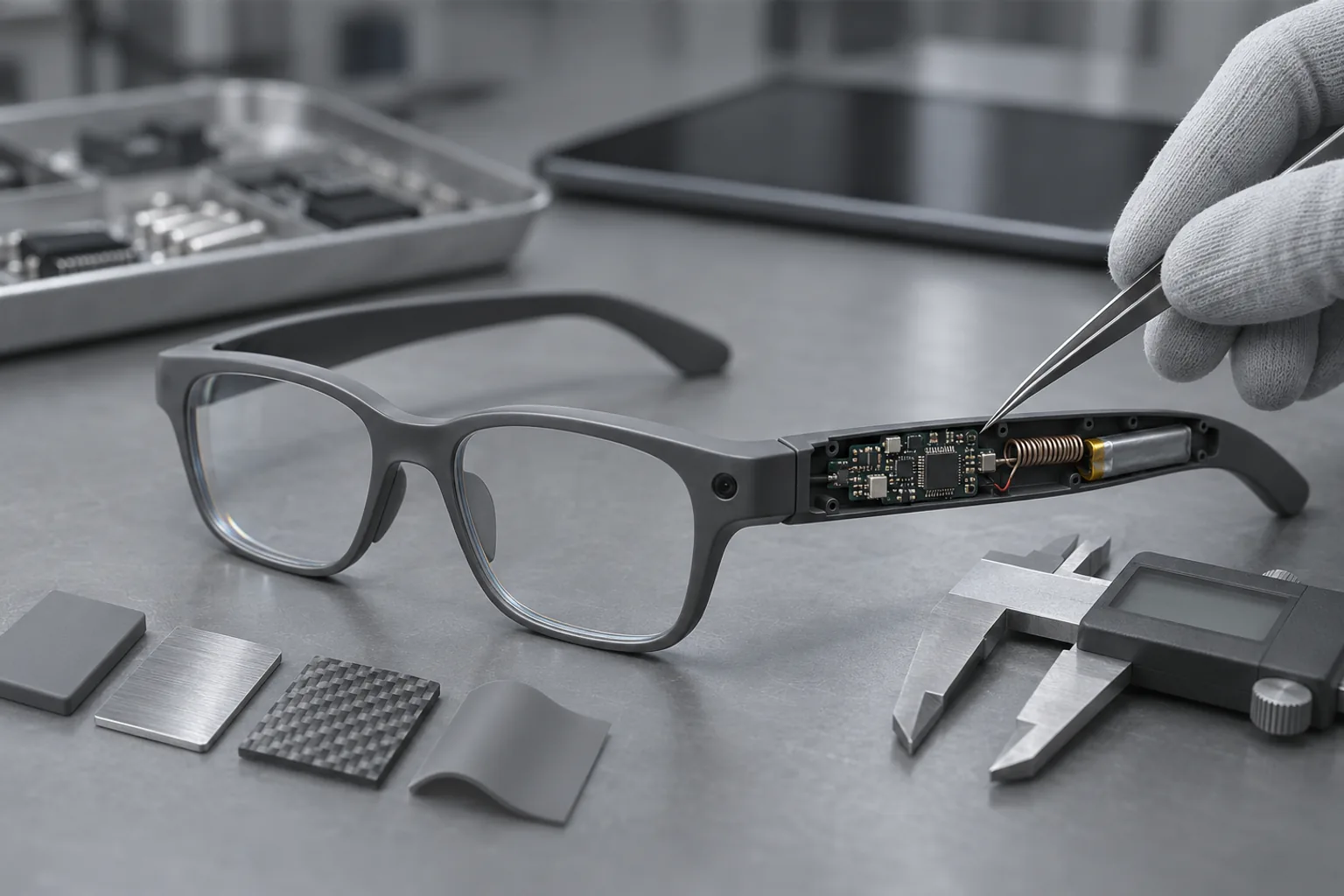
A pair of AI glasses has to fit a camera, microphones, speakers, a radio, a battery and an AI assistant into a frame people will wear all day. This is how brands get one built under their own name, and what to settle with an ODM before the first sample.
Abstract
Choosing an AI glasses ODM is a different decision from choosing a headset partner. A headset has room for batteries, boards and cooling. Glasses do not. Weight, heat, battery life, audio and antenna performance all compete inside a frame that must still look and feel like eyewear, so the partner's engineering decisions show up directly in whether people keep wearing the product.
This paper explains what an AI glasses ODM engineers, how the Co-Brand, ODM and OEM models apply to glasses, where a brand's designers have freedom and where they don't, and how a programme moves from brief to certified production. It is written for brands, operators and integrators who want smart glasses under their own name without building a factory.
A note on scope: on questionwhatsreal.com, AI Smart Glasses are voice-native glasses with no visual display (audio-only and camera AI). Display glasses sit under AR Display Glasses. This paper follows that split.
Why AI Glasses Need a Different ODM Approach
In a headset, a few extra grams or a slightly larger board rarely decides the product. In glasses, it often does. The frame is the enclosure, the heat sink, the antenna housing and the battery compartment at once, and every one of those jobs sits on the wearer's face and ears.
- Weight is the first spec buyers feel. Across the four QWR AI glasses models that publish a weight, it runs from 39 g (QAI-05) to 50 g (QAI-07). A few grams separate a product people wear all shift from one that goes back in the case.
- The temples carry the electronics. Boards, battery, speakers and microphones are split between two thin arms and joined through the hinge, so mechanical design and electronics design cannot be separated.
- Heat has nowhere to hide. The processor sits millimetres from the wearer's temple. Thermal design decides how long the AI assistant and camera can run before performance has to drop.
- Radios share space with metal and skin. Antenna placement in a frame affects Bluetooth and Wi-Fi performance and has to be validated for certification.
"An AI glasses ODM is not judged by its spec sheet. It is judged by whether the glasses are still being worn at the end of the day."
That is why the engineering split between the ODM and the brand matters more for glasses than for any other head-worn device. QWR's Battery–Weight–Thermal Trilemma paper covers the underlying trade-off in more depth.
What an AI Glasses ODM Actually Engineers
When a brand works with an AI glasses manufacturer, it is buying the engineering of a complete system, not just assembly. For voice-native AI glasses, that system has six parts.
- Processor and memory. The chip decides what AI can run on the glasses, how much power it draws and which voice AI platforms it supports. QWR's range spans entry silicon to a Snapdragon AR1-class chip on QAI-05, and a 2 GB / 32 GB memory tier on QAI-04.
- Camera module. For camera AI glasses, the sensor, lens and its position in the front frame. QAI-06 and QAI-07 carry a 13 MP camera.
- Microphones and speakers. Voice is the interface, so microphone placement decides how well the assistant hears the wearer in a noisy place. QAI-05 uses a 5-mic array.
- Radios. Bluetooth to pair with the phone app and, on some models, Wi-Fi for direct uploads: Bluetooth 5.3 on QAI-01, 5.4 on QAI-02, and Wi-Fi 5 on QAI-03.
- Battery and charging. Split across the temples and sized against weight. QAI-04 and QAI-05 come with their own charging case, for field use away from a wall outlet.
- Frame, hinge and sealing. The frame material, hinge design and ingress protection. QA-02 is rated IP65, and QWR recommends TR90 for lightweight, all-day smart glasses.
Beyond the core, QWR's platforms support secondary sensor modules for specialist programmes, such as nose-bridge or temple PPG sensors for heart rate and SpO₂, and gas and air-quality modules for industrial safety roles. QWR's Secondary Sensors in an XR ODM Platform paper explains how these are integrated.
For glasses with a visual display, the optical stack (light engine and waveguide) becomes the hardest engineering problem. QWR covers those under AR Display Glasses and in Choosing a Light Engine for See-Through AR.
The Software Layer: Voice AI, Phone App and Data
AI glasses have no screen, so the software is the product experience. Three parts need to be settled with the ODM alongside the hardware, not after it.
The voice AI platform. Many glasses chips ship with a default assistant. A brand building its own product will usually want to replace it. QWR's HUMBL platform is built for this: it states compatibility with Allwinner V821, BES2700, Qualcomm AR1, MediaTek and JieLi silicon, and integration onto a new chip in 2–4 weeks. It runs the same AI across audio-only, audio-plus-camera and audio-plus-camera-plus-display glasses.
The phone app. Glasses pair with a phone app for setup, photo and video sync and settings. HUMBL's iOS and Android app is white-label ready for OEM partners, so the app can carry the brand's name and design within the same programme.
Data and updates. Where voice, photo and video data is stored and processed matters to enterprise buyers and regulators, so ask any voice AI provider to state both in writing. HUMBL states AWS Mumbai hosting and DPDP Act 2023 compliance for stored data. On the hardware side, QWR's ODM model includes a dedicated firmware branch, firmware is delivered encrypted, and post-production support includes OTA fleet management.
The pre-integration questions for a licensed voice AI platform are covered in What OEM Partners Should Know Before Integrating a Licensed Voice AI Platform. Update commitments after launch are covered in Firmware & OS Update Commitments.
Co-Brand, ODM or OEM: Choosing a Model for AI Glasses
QWR offers three engagement models, and all three build on the same certified hardware foundation. The right one depends on how far the brand wants to move from a reference design, and how much time it has. Buyers often search for "white label smart glasses"; at QWR, that fastest route is called Co-Brand.
| Co-Brand | ODM | OEM | |
|---|---|---|---|
| Starting point | QWR's production-ready reference platforms | QWR's validated platform, customised | The brand's own hardware specification and industrial design files |
| Timeline | 3–4 months | Scoped to the brief | Scoped to the brief |
| What the brand changes | The surface: branding, UI colours, splash screens, packaging | Deep BOM-level customisation within the hard points | The full specification |
| Firmware | QWR platform firmware | Dedicated firmware branch | Custom firmware and software |
| Volumes | Single-digit unit samples supported | Pilot runs from 5,000 units | Scoped to the partner's specification and forecast |
| Best for | Fastest path to market | Most flexible route to a differentiated product | Partners with existing industrial design files |
Ownership differs by model: in OEM the brand owns 100% of the product IP, in ODM it owns the final product while QWR retains the manufacturing process, and in Co-Brand it owns its brand and experience layer. What a Brand Actually Controls: Co-Brand Deal vs ODM Deal explains where the control line falls in each model, and ODM vs OEM vs Co-Brand compares the three in full.
Hard Points and Soft Points: Where Your Designers Have Freedom
The biggest risk in a custom glasses programme is a beautiful frame that can't be certified, overheats or loses its radio range. QWR prevents that with its hard points and soft points framework: every platform has fixed engineering constraints and open design zones, defined before the brand's industrial design team opens a CAD file.
Hard points (engineering constants), held by QWR's engineers:
- PCB and antenna footprint. Main board dimensions and antenna keep-out zones are pre-validated for BIS and FCC certification.
- Thermal envelope. The processor's heat dissipation zones must stay unobstructed.
- Optical stack and sensor alignment. On display glasses and headsets, display, lens and sensor positions are fixed to sub-millimetre tolerance.
Soft points (the brand's design canvas):
- Shell geometry. The external frame shape is customisable through STEP/IGES file submission.
- Material. PC/ABS, TR90, magnesium alloy or carbon fibre.
- Colour, material, finish and branding. Custom Pantone colours, laser-engraved logos and surface textures.
- Controls and haptics. Power, volume and action buttons can be repositioned for the brand's ergonomics. QWR's own range shows how much this shapes a product: QAI-07 is the same 13 MP build as QAI-06 without the touchpad.
"Your industrial designers work in the soft points. QWR's engineers hold the hard points. The result is a branded device that is certifiably manufacturable."
QWR reviews a brand's STEP files for mouldability, draft angles and thermal clearance within 5 business days and returns a marked-up DFM report. The full framework is on QWR's Design Customization page, and Choosing Enclosure Materials covers material trade-offs.
Six Decisions to Settle Before the Brief
The brief drives every quote and every engineering trade-off that follows. These six decisions shape an AI glasses programme more than any others, and each is cheaper to make now than after tooling.
- Which tier. Audio-only, audio plus camera, or a display. Each tier is a different integration scope, and the choice sets weight, battery and price. QWR's Display or Voice paper gives a decision rule for field tasks.
- Where it will be worn. Office, outdoors, factory floor or hazardous area. The environment sets the ingress rating and materials. See IP Ratings for AI Glasses.
- How the camera is governed. If the glasses carry a camera, decide early how wearers and bystanders will know it is recording, how consent is handled at work sites, and where footage is stored. These choices affect hardware, firmware and app together, and they sit squarely within India's DPDP Act obligations.
- Fit and prescription. Decide which frame sizes the programme needs and whether wearers need prescription lenses. Both affect the frame design, so they belong in the brief.
- Whose AI assistant. The brand's own, a licensed platform such as HUMBL, or the chip's default. This sets integration time, per-user AI cost and data residency.
- Which markets. Each market needs its own approvals, such as BIS and WPC in India and FCC and CE abroad, and the antenna and battery design must be validated for them. See BIS Certification for XR and XR Certification Pathways.
From Brief to Production: The 7-Phase DFM Pipeline
Every QWR project follows the same Design for Manufacturing (DFM) pipeline, built to remove the certification risk, cost surprises and timeline slippage that are common in hardware ODM projects.
- Requirement freeze. Specs, rules and cost locked in writing.
- System architecture. SoC and BOM locked, with dual-source critical parts.
- EVT, DVT, PVT. Validation gates with failure analysis.
- Optical calibration. Waveguide and light engine alignment in an ISO cleanroom (display glasses only).
- Certification. In-house pre-compliance for FCC, CE, BIS and WPC.
- Production and scale. 5,000-unit pilot builds, scaling to 100,000+ units a year from Pune.
- Post-production. OTA fleet management, SLA-backed RMA, spares and a stable BOM.
For AI glasses, three stages carry the most weight. System architecture fixes the chip and BOM early, so the voice AI platform and battery life are settled before tooling. Certification runs in-house pre-compliance so QWR submits once instead of three or four times; standard BIS certification spans 4–8 weeks depending on radio and battery configuration. Production and scale starts with 5,000-unit pilot builds and ramps to 100,000+ units a year from QWR's Pune facility, on 30-day ramp notice.
Before hard tooling, QWR builds 3–5 soft-tooled prototype units for form, fit and function testing. Steel moulds then go through T0–T2 iterations with production sign-off before the first pilot run. Crossing the Hardware Valley of Death covers this stage in depth.
Why Build AI Glasses with QWR
QWR is an end-to-end ODM for head-worn computing. For a brand building smart glasses, that means:
- One accountable vendor. Optics, firmware, mechanical design, certification and mass production under one roof, with no supply chain stitched together across three vendors and two continents.
- Ten AI glasses platforms to start from. Audio-only and camera AI configurations, from entry builds to a flagship with BMS integration and NVG compatibility for defence field operations.
- A voice AI platform built for OEMs. HUMBL replaces a chip's default assistant, with a white-label phone app and AWS Mumbai hosting for stored data.
- Protected from day one. NDAs from day one, isolated manufacturing cells and encrypted firmware delivery. Where ownership falls depends on the model, as set out above.
- A sovereign, India-origin supply chain. A credible China-plus-one for global brands, built in QWR's BIS-certified Pune facility alongside strategic Tier-1 EMS partners for BOM-level traceability.
- Ready for Indian and global buyers. Make in India Class 1, DAP Buy Indian eligible, PLI-aligned and GeM-registered for defence, education and PSU tenders, while QWR already ships to 17+ countries with devices certified for FCC, CE, UKCA and RoHS.
- Production discipline. 98%+ yield targets on production runs.
Decision Logic: Choosing Your Route
Choose Co-Brand When:
Speed matters more than uniqueness. You want your brand on proven, certified AI glasses in 3–4 months, to test a market, serve a launch window or start an enterprise pilot, and QWR's existing platforms already meet your customers' needs.
Choose ODM When:
You need a product that is visibly and functionally yours. Your frame design, materials, controls and firmware need to differ from what is on the market, but you want to build on a validated platform rather than start from scratch.
Choose OEM When:
You already have industrial design files and a hardware specification, and you need a manufacturer to build exactly that, with custom firmware and 100% of the product IP.
FAQ
Frequently asked questions
What does an AI glasses ODM do?+
An AI glasses ODM designs and manufactures smart glasses that a brand sells under its own name. It engineers the processor, camera, microphones, speakers, radios, battery, frame and firmware, then certifies and mass-produces the product. The brand defines the experience and the market.
Who owns the design in an AI glasses ODM project?+
It depends on the model. In OEM, the brand owns 100% of the product IP, including the specification. In ODM, the brand owns the final product while QWR retains the manufacturing process. In Co-Brand, the brand owns its brand and experience layer but not the base platform. NDAs apply from day one, and partner projects run in isolated manufacturing cells.
How long does it take to launch branded AI glasses?+
Co-Brand programmes on QWR’s production-ready platforms take 3–4 months. ODM and OEM timelines depend on how far the design moves from a reference platform, and are scoped against the brief.
What is the minimum order for an ODM smart glasses project?+
Co-Brand projects support single-digit unit samples. Full ODM projects start at 5,000-unit pilot runs and scale to 100,000+ units a year on 30-day ramp notice.
Can we use our own AI assistant?+
The assistant is part of the brief. ODM projects get a dedicated firmware branch and OEM projects get custom firmware, so the choice is settled with QWR’s engineers up front. Brands that want a ready platform can license HUMBL, which supports Allwinner V821, BES2700, Qualcomm AR1, MediaTek and JieLi chips and states integration onto a new chip in 2–4 weeks.
Is “white label smart glasses” the same as Co-Brand?+
It is the closest equivalent. At QWR, Co-Brand puts your brand on QWR’s production-ready, certified platforms. It changes the surface of the product, while the firmware branch and platform roadmap stay with the platform. For deeper control, choose ODM.
Request a Technical Briefing
Our team provides direct support for procurement officers, institutional buyers, and enterprise technology leads.