Industry Insights · Technology · Hardware
What Secondary Sensors Can Be Integrated into an XR ODM Platform. And What That Changes for the Buyer.
By QWR Engineering
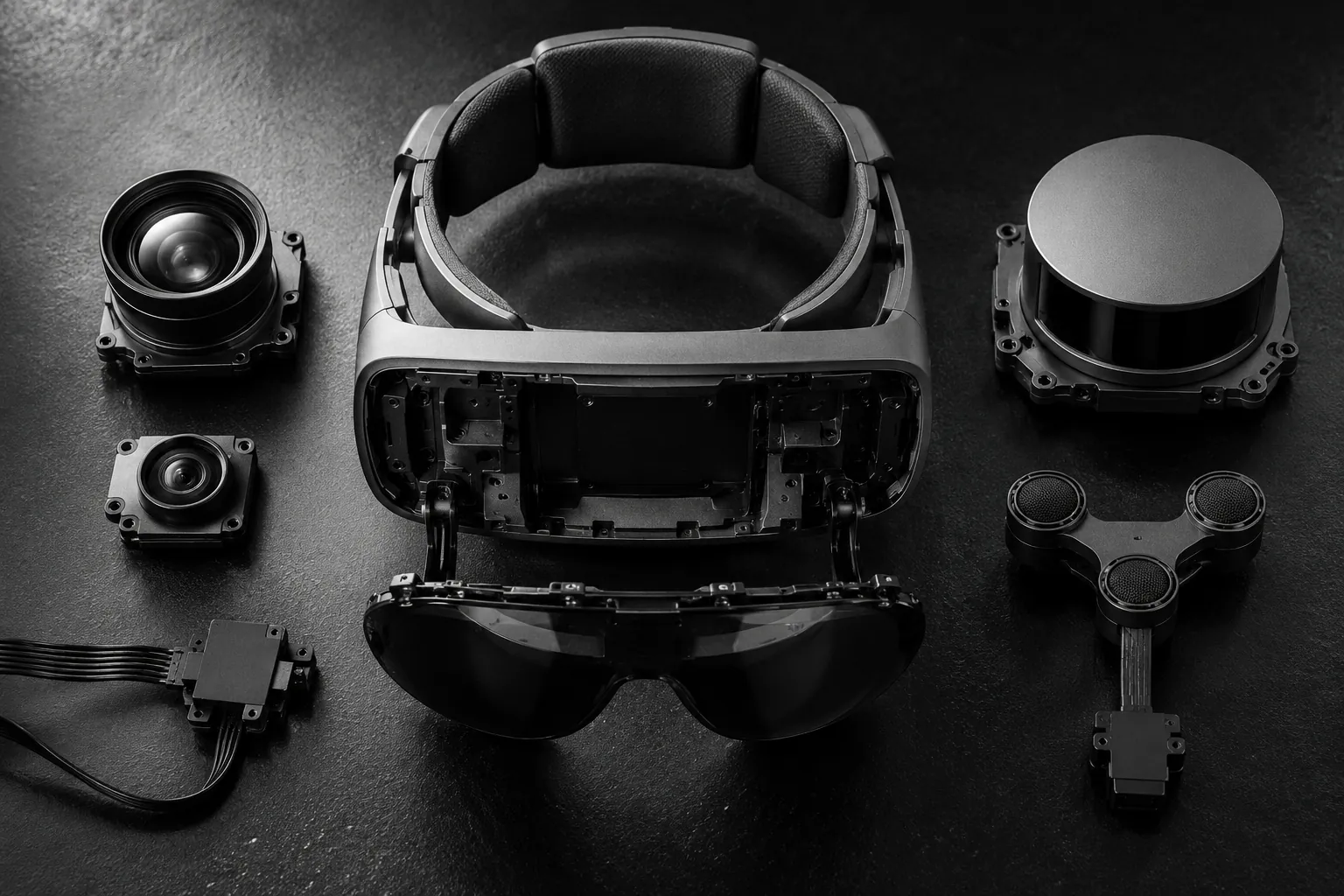
Standard XR sensing — cameras, IMUs, depth for 6DoF tracking — is the baseline every platform ships with. The more interesting procurement question for a custom OEM project is what else can go on the device: QWR’s platforms support secondary sensor modules for specialised data inputs beyond standard sensing, across four categories, each tied to a specific vertical need.
Start Here: This Is the Sensor Menu, Not the Customization Framework
The general engineering framework behind QWR customization — fixed hard points versus open soft points, and why that split exists — is introduced in Evaluate an XR ODM Partner. This paper assumes that framework and goes one level deeper: what the four available secondary sensor categories actually are, what each is for, and the specific hard-point constraint that governs where any of them can physically go.
"Adding a sensor to a headset isn't a bill-of-materials line item — it's a placement decision inside a sensor-alignment hard point that's already fixed for 6DoF tracking. Ask where it goes before you ask what it costs."
1. Thermal Imaging Is for Seeing What Standard Sensing Can't
- FLIR/LWIR modules serve a specific data need, not general vision: thermal imaging is positioned for industrial inspection, predictive maintenance, and defence HUD visualisation — use cases where the data that matters is a heat signature, not visible light, and standard XR cameras simply don't capture it.
- Placement is fixed to a specific module zone: thermal imaging integrates into the nasal bridge or forehead module zone — a physical constraint on the device's industrial design, not a free choice for the OEM's ID team to relocate.
2. LiDAR Adds a Precision-Mapping Capability Standard Depth Sensing Doesn't Reach
- Solid-state LiDAR is for spatial accuracy standard depth sensors can't deliver: high-accuracy spatial mapping, digital twin creation, and AEC as-built documentation depend on a level of ranging precision beyond what a standard XR depth module provides — the reason this is offered as a distinct, addable sensor rather than a firmware upgrade to existing sensing.
- This is the module most likely to matter for AEC and industrial-digital-twin buyers specifically: if a project's value proposition depends on accurate as-built capture rather than just visualisation, LiDAR integration is a procurement question to raise early, not an afterthought once the base platform is chosen.
3. Biometric Monitoring Turns the Headset Into a Health-Data Device
- PPG sensors add a data category the base platform was never designed to capture: nose-bridge or temple-integrated photoplethysmography for continuous heart rate and SpO₂ tracking is positioned for healthcare and defence fitness-monitoring applications — a genuinely different data stream from anything standard XR sensing produces.
- This is a data-governance question as much as a hardware one: a device that captures continuous biometric data is capturing a more sensitive data category than session telemetry, which makes this the sensor choice most worth pairing with an early conversation about data handling and consent, not just a component selection.
4. Environmental Sensors Extend the Headset Into Industrial Safety Monitoring
- VOC, CO2, and temperature modules serve rugged enterprise deployments specifically: gas and air-quality sensing is positioned for industrial safety roles on rugged enterprise smart glasses — a use case distinct from the other three, aimed at monitoring the wearer's environment rather than the wearer or the work object.
- This is the sensor category most tied to a specific deployment context: environmental sensing only earns its cost in industrial-safety-relevant deployments; specifying it for a general enterprise or education rollout is adding a component with no use case behind it.
The Hard-Point Constraint That Governs All Four
Every one of these modules has to coexist with sensor alignment that's already a fixed hard point — tracking camera angles, IR sensor positions, and depth module geometry are locked to maintain 6DoF spatial accuracy and hand-tracking quality. That means a secondary sensor isn't dropped in wherever there's spare board space; it has to be positioned within a module zone (nasal bridge, forehead, temple) that doesn't disturb the sensors the core tracking system already depends on. This is exactly the kind of constraint the DFM review process is built to catch — raise the sensor requirement at the industrial-design-review stage, not after tooling has started.
The Sensor Selection Checklist
Before specifying a secondary sensor for a custom XR project, confirm: which of the four categories actually serves your use case — thermal for inspection/predictive maintenance, LiDAR for precision mapping, biometric for health data, environmental for industrial safety — rather than adding one because it's available; which module zone (nasal bridge, forehead, temple) the sensor physically requires, and whether that's compatible with your industrial design intent; and, for biometric monitoring specifically, whether your data-governance plan already accounts for a genuinely more sensitive data category. Pick the sensor the use case demands, then design around where it has to sit.
The Conclusion: The Sensor Menu Is Real, but Placement Is the Constraint
Four secondary sensor categories are available beyond standard XR sensing, each solving a specific, named problem: thermal for what visible light can't show, LiDAR for precision beyond standard depth sensing, biometric for a health-data stream the base platform doesn't produce, and environmental for industrial safety monitoring. None of them is a free addition — each has to be placed within a module zone that respects the sensor-alignment hard point the core tracking system depends on. Specify the sensor your use case actually needs, and raise its placement requirement at the design-review stage, not after the enclosure is already tooled.
FAQ
Frequently asked questions
What secondary sensor categories can be integrated into a QWR XR platform?+
Thermal imaging (FLIR/LWIR) for industrial inspection, solid-state LiDAR for precision spatial mapping, biometric PPG sensors for heart rate and SpO2 tracking, and environmental sensors for gas, air quality, and temperature monitoring.
Where does thermal imaging get physically placed on the device?+
Into the nasal bridge or forehead module zone, a fixed physical constraint on the industrial design rather than a free placement choice.
Why can't a secondary sensor go anywhere there's spare board space?+
Sensor alignment, tracking camera angles, IR sensor positions, and depth module geometry are already a fixed hard point locked to maintain 6DoF spatial accuracy, so any added sensor has to fit within a module zone that does not disturb that core tracking system.
Request a Technical Briefing
Our engineering team provides direct support for procurement officers, institutional buyers, and enterprise technology leads.