Industry Insights · Technology · Hardware
How to Read an XR Spec Sheet. The Difference Between Enterprise and Consumer Is in the Conditions, Not the Numbers.
By QWR Engineering
Consumer and enterprise XR datasheets often quote similar headline figures. The difference that decides a deployment is not the number — it is the operating condition the number was measured under, and the specs the consumer sheet never prints at all. This is a procurement engineer’s method for reading any XR spec, whatever the logo on the box.
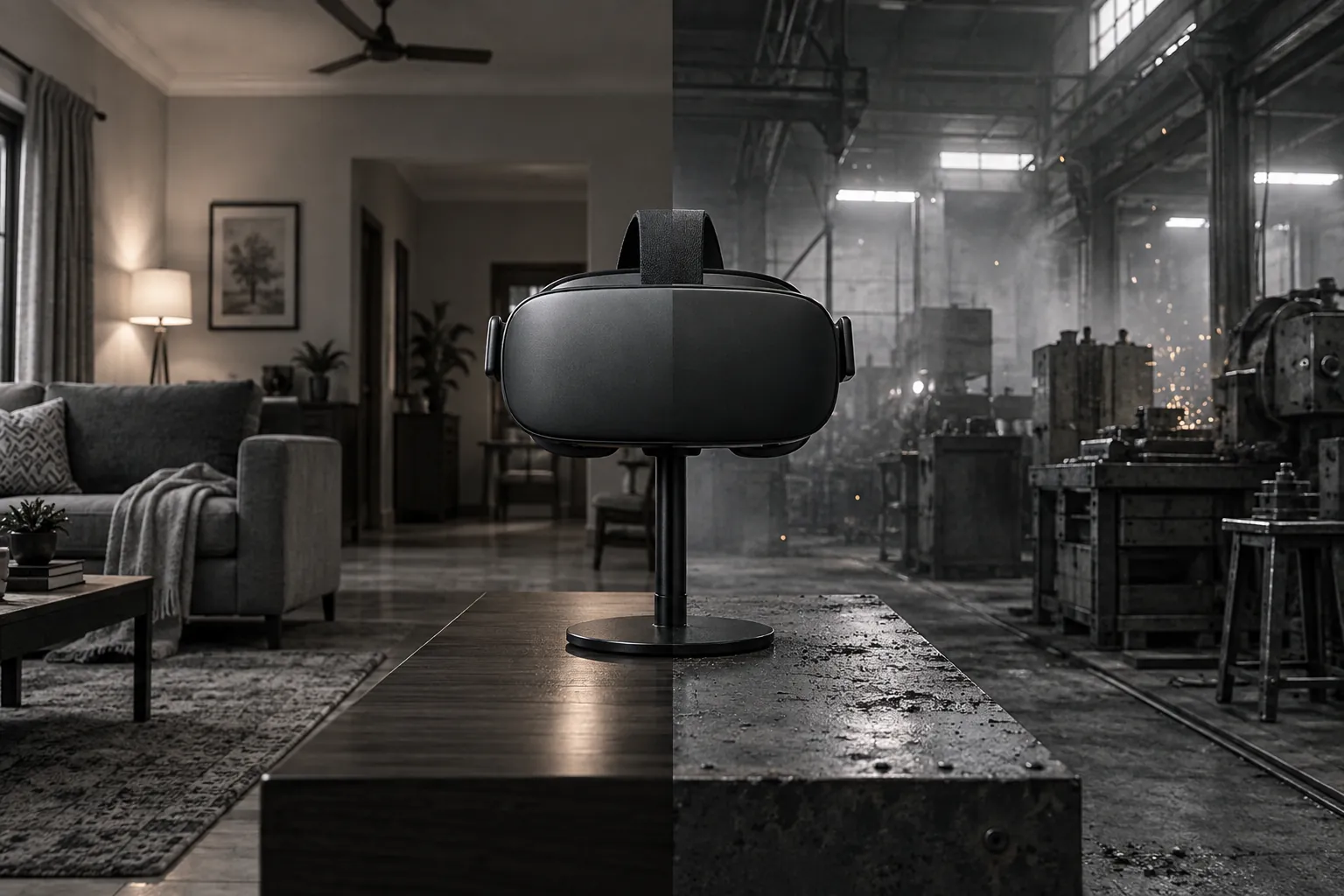
Illustrative image. These are not what our headsets look like.
The Trap: Two Devices, the Same Numbers, Different Machines
A consumer headset is engineered for a controlled room, a two-hour session, and a return window. An institutional device is engineered for a factory floor at noon, an eight-hour shift, and a five-year deployment. Both can print a flattering brightness or resolution figure — but only one of them holds that figure under your conditions. Enterprise procurement is the discipline of reading past the headline to the condition beneath it, then checking for the specs a consumer sheet omits entirely.
For the raw optics numbers themselves — the FOV, brightness, weight, and transparency figures across diffractive, holographic, and geometric stacks — the waveguide deep-dive already lays them out in a single matrix; this paper won't repeat them. What follows is how to interpret a datasheet, not the datasheet.
"Two headsets can quote the same nits. One measured it in a dim lab for a five-second peak; the other holds it in sunlight through hour eight. The number is identical. The devices are not."
1. The First Question: "Under What Condition Was This True?"
- Every figure has a hidden test setup: A brightness rating measured at peak, briefly, in a lab bench is a different promise than one sustained in high ambient light. Before comparing two numbers, ask whether they were measured under the same condition — and whether that condition is yours.
- Your worst case is the only case that matters: Consumer specs describe a best case; institutional deployment lives in the worst case — the brightest light, the longest session, the coldest warehouse. Read every number as "…under ideal conditions" until proven otherwise.
2. The Omitted-Number Problem: What a Consumer Sheet Never Prints
- Absence is the tell: The fastest way to distinguish an enterprise device is to look for the specs a consumer sheet leaves off — sustained (not peak) output, thermal envelope, ingress and drop ratings, spare-parts availability, and supply-guarantee terms. If those are missing, the omission is the answer.
- A short spec sheet is a short-lived device: Consumer marketing prints the two or three figures that flatter. An institutional datasheet is longer precisely because a buyer is committing for years and needs the unflattering numbers too.
3. Sustained vs Peak: Thermals Are the Real Performance Spec
- Peak is a headline; sustained is a deployment: A device can hit an impressive brightness or frame rate for seconds, then throttle as it heats. What a shift needs is the number the device holds, not the number it touches. Always ask for sustained figures under continuous load.
- Heat is an ergonomic and reliability spec, not just performance: A headset that runs hot becomes a comfort complaint by hour three and a reliability risk over years. Thermal design is invisible on a consumer sheet and decisive on an enterprise one.
4. Ruggedisation Is a Certificate, Not an Adjective
- "Durable" means nothing; a rating means everything: The words "rugged" or "built tough" are marketing. IP-rated dust and water ingress and MIL-STD-810H drop/shock certification are testable claims with documentation behind them. Demand the certificate, not the adjective.
- The environment is a spec input: A device destined for a shop floor, a hangar, or a field unit must be matched to that environment's ingress and impact profile. Consumer hardware carries no such rating, which is why it fails the first time it leaves the desk.
5. Serviceability and Lifecycle: the Specs That Only Surface at Fleet Scale
- A consumer device is replaced; an enterprise device is maintained: Field-replaceable modules, real spares inventory, SLA-backed RMA, and repair documentation are design-time decisions. They never appear on a consumer sheet because the device is meant to be thrown away, not serviced.
- Supply continuity is a spec you must read before you buy: A component-supply guarantee (QWR commits to a 5-year BOM), end-of-life notice, and OTA update infrastructure with rollback determine whether a fleet survives year three. A brilliant device with a 90-day EOL clause is a liability, not an asset.
- Support geography is a hidden latency spec: A 48-hour local swap is a different operating reality than a 4–6 week cross-border repair turnaround for a fleet that is down in the meantime.
6. BOM Configurability: the Spec Consumer Hardware Structurally Cannot Offer
- Fixed vs configurable is the deepest enterprise/consumer divide: A consumer device ships with frozen specs — you take what exists. An ODM-grade platform lets you set the specs at the bill-of-materials level, so the hardware is engineered to your deployment rather than your deployment bent around the hardware.
- This is where "enterprise-grade" becomes literally true: When brightness, optics, weight target, sensors, and ruggedisation are all configurable to the use case, the phrase stops being marketing and becomes an engineering fact. QWR publishes its reference stacks precisely as BOM-configurable starting points for exactly this reason.
The Engineering Conclusion: Read the Conditions, Not the Adjectives
The honest way to compare XR hardware is to treat every number as a promise about an operating condition, then ask whether that condition is yours — and to notice which specs a sheet declines to print at all. "Enterprise-grade" is not a tier you can trust on the label; it is the presence of sustained figures, ingress and drop certificates, serviceability terms, supply guarantees, and BOM-level configurability. A device that can show you all of those under your conditions is enterprise hardware. One that quotes two flattering numbers and goes quiet on the rest is a consumer device wearing the word.
FAQ
Frequently asked questions
What is the difference between peak and sustained performance specs?+
A device can hit an impressive brightness or frame rate for seconds then throttle as it heats. Sustained figures under continuous load reflect what a shift actually gets, not what the device briefly touches.
What specs does a consumer XR datasheet typically omit?+
Sustained, not peak, output, thermal envelope, ingress and drop ratings, spare-parts availability, and supply-guarantee terms. Their absence is itself the tell that a device is not built for institutional deployment.
What makes enterprise-grade an engineering fact rather than marketing language?+
BOM-level configurability, where brightness, optics, weight target, sensors, and ruggedisation can all be set to the use case, rather than a consumer device's fixed, frozen specs.
Request a Technical Briefing
Our engineering team provides direct support for procurement officers, institutional buyers, and enterprise technology leads.