Industry Insights · Procurement · Strategy
Specifying a School VR Lab. Fleet Size, Charging, Offline Content and Classroom Control.
By QWR Technical Marketing
A school VR lab is not a room full of headsets. It is a charging routine, a content path that works without reliable internet, and a teacher who controls thirty to forty students at once. Most lab proposals describe the first and skip the other three.
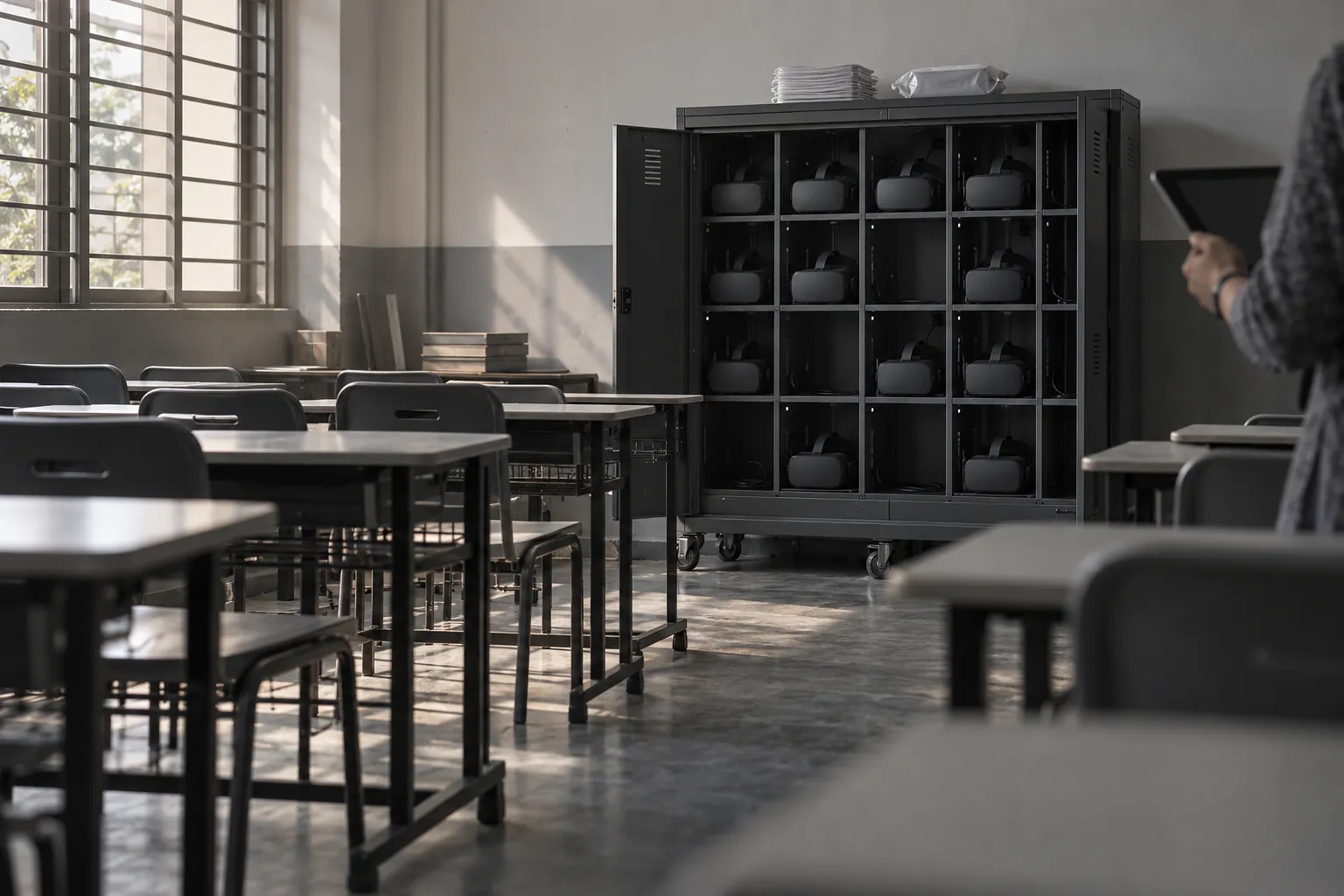
Illustrative image. These are not what our headsets look like.
Start Here: The Room-Level Checklist
Large-scale rollout operations are covered in Hardware Requirements for Large-Scale Education XR, and the tracking decision in 3DoF vs 6DoF. This paper is narrower: the questions to settle for one school or one lab before you sign. It uses QWR's published QVR-03-01 classroom headset as the worked example. QWR publishes no room dimensions, floor layouts, headsets-per-room ratios or prices for a lab, so none appear here. Where a number is missing, the checklist says to ask.
"A lab runs on its slowest daily routine. Usually that is charging."
1. Size the Lab From the Class, Not From the Headset
QWR describes the QVR-03-01 as built for 40-unit classroom fleets, not per-seat enterprise training, and reports 35,000+ headsets deployed across 500+ schools. The useful reading of that is a design target: one class, one fleet. Start from your own numbers, such as the largest class that will use the room and how many sessions run per day, and ask the vendor for a reference layout at that scale. If none exists, you have learned something about how much of the room is yours to design.
2. Charging Is the Capacity Limit
QWR lists charging cabinets for 30 units. A 40-unit class fleet is therefore more than one cabinet, whether that means two cabinets, a shared arrangement or a different class size. Neither figure is wrong; the question is which arrangement the quote assumes, where the cabinets sit, and what power they need. Two further consumables are easy to miss. The QVR-03-01 controller runs on external AAA batteries, and the headset charges over Micro USB. Both are routine items to budget for, replace and stock.
3. Content Must Work Without a Connection
The QVR-03-01 supports offline mode: pre-loaded NCERT-aligned content plays from internal storage, which is QWR's stated answer for schools with intermittent connectivity. The headset has 6 GB of memory, 128 GB of storage and a memory card slot. QWR's education page cites 300+ pre-loaded lessons and delivery in Hindi, Tamil, Telugu, Kannada, Marathi and English. Confirm which lessons and languages are on the device at delivery, and how new content reaches a headset when the school's network is poor. QWR mentions OTA content updates infrastructure alongside its charging cabinets; ask how that works in your building.
4. The Teacher's Control Layer
QWR states that a teacher can cast their screen to all student headsets or lock them into a specific module, from a single tablet, and that the headset supports screen mirroring. Ask the practical questions: how many headsets one tablet session can hold, what a teacher sees when a headset drops out, and how a lesson restarts. Teacher time is the scarcest resource in the room.
5. Shared Use and Session Rules
The QVR-03-01 weighs 350g and has sanitisable surfaces for multi-user environments. QWR's FAQ leaves session-length guidance to the deploying institution, so it is a school-policy decision, not a device setting. Decide who cleans the face contact surfaces between classes, and put a session-length rule in writing before the first lesson. For fleet security and loss, see Physical Loss, Theft & Recovery Questions.
6. The Procurement File
For government and institutional buyers the QVR-03-01 page lists GeM registration, BIS certification and Make in India Class 1, with a 5-year BOM stability guarantee. QWR states pilots can start at 500 units. Check that the paperwork you need matches the exact model on your purchase order, not the family name. If you want the newer Snapdragon XR2 Gen 1 in the same 350g chassis, QWR names QVR-03-03 as the direct next-generation option; ask what changes in the cabinet, the content and the price.
The Lab-Setup Checklist
Before you sign: a reference layout at your class size; cabinet count, placement and power for your fleet; AAA battery and cable stock planned; the exact offline lesson and language list on the device; the content update path on a weak network; teacher-tablet capacity and failure behaviour; a cleaning owner and a session-length rule; and GeM, BIS and BOM-stability documents for the specific model.
The Conclusion
The headset is the easy part of a school VR lab. What decides whether it works in month six is the cabinet count, the offline content, the teacher's control and a routine someone owns. Ask for each in writing, and treat anything the vendor cannot show as yours to plan.
Request a Technical Briefing
Our team provides direct support for procurement officers, institutional buyers and school-network leads.