Industry Insights · Education · Training
Hardware Requirements for Large-Scale Education XR Deployments.
By QWR Technical Marketing
A classroom headset is nothing like a headset on a developer's desk. It's shared by dozens of children in a day, run by a teacher who isn't an IT admin, charged overnight in a cabinet, updated remotely across hundreds of sites, and bought by the tens of thousands against a per-seat budget. The requirements that decide an education VR rollout come from that operational reality — not from the lessons it plays.
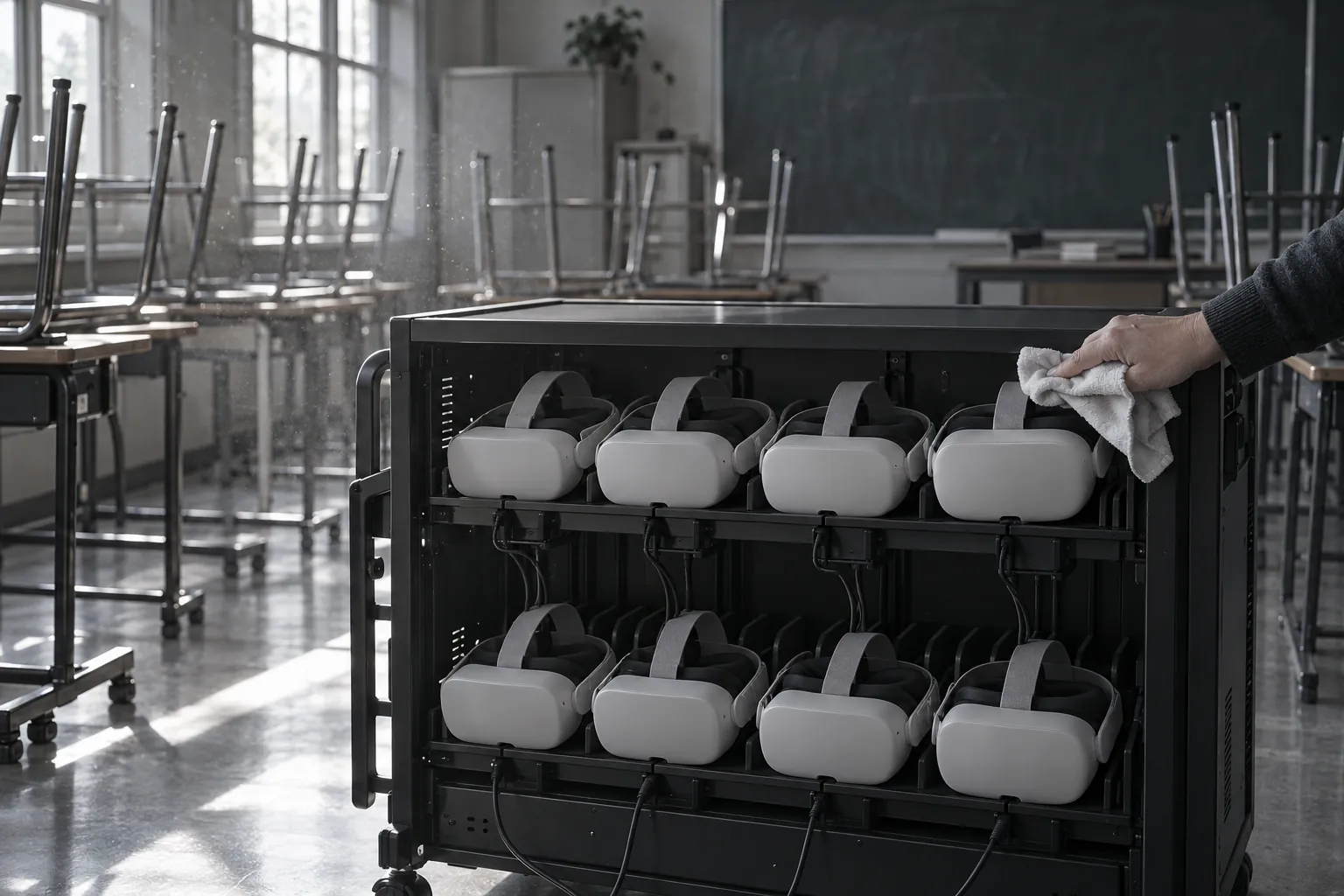
Illustrative image. These are not what our headsets look like.
Start Here: The Content Is Solved; the Deployment Is the Hardware
The learning side of education VR is well handled — QWR's platform ships NCERT- and CBSE-aligned content, 300+ pre-loaded lessons, and multi-language delivery. This paper is deliberately about the other half: the device and deployment-operations requirements that determine whether 35,000 headsets across 500+ schools actually run day to day. The choice of tracking architecture (3DoF vs 6DoF) is covered in its own guide, and the ROI/TCO case in the enterprise VR comparison. What follows is the operational hardware brief for scale.
"In a classroom, the hardest engineering problem isn't the immersion — it's that one teacher has to run thirty headsets, charge them by tomorrow, and never file a support ticket. Spec for that, or the fleet sits in a cupboard."
1. Manageability: the Teacher Is the Administrator
- The device has to be run by a non-technical educator: In a school there is no IT desk behind every classroom. The defining requirement is that a teacher can drive the whole set from one place — QWR's model is teacher-led control of the entire classroom from a single tablet via its fleet-management XR software.
- Simplicity of the headset itself is part of manageability: a single-controller design (QVR-03-01 ships with one 3DoF controller, not the two-controller setup typical of enterprise headsets) cuts down the single biggest classroom failure mode — lost, swapped, or flat controllers — and means a child can be in a lesson in seconds without setup.
- Fleet visibility is what makes scale governable: managing thirty headsets in a room, and thousands across a district, is an administration problem first; session analytics and central control are what keep it from becoming chaos.
2. Durability and Hygiene: Shared by Dozens, All Day
- A school headset is a shared, high-turnover device: It's worn by class after class, so it must be built for multi-user use in a way a personal headset never is. QWR's QVR-03-01 is designed with sanitisable surfaces precisely for shared classroom environments — a hygiene requirement unique to education.
- Weight is an age requirement, not a comfort preference: children can't wear an adult-weight headset comfortably. An ultra-lightweight 350g design is what makes all-class, all-day use viable — spec weight against the youngest users, not the average adult.
- Fewer parts means fewer failures: a single external controller and a simple physical design reduce the breakage and loss that otherwise erode a fleet a few units at a time.
3. Charging and Storage: a Class Set Has to Be Ready by Morning
- Charging is the logistics problem that quietly kills deployments: thirty headsets that aren't charged are thirty paperweights at 9 a.m. The hardware plan has to include how a class set is powered and stored overnight — QWR builds for this with charging cabinets that hold 30 units.
- Storage and charging are one requirement: a cabinet that charges, secures, and organises a class set turns "thirty loose headsets" into a manageable unit. Treat the cabinet as part of the hardware spec, not an accessory bought later.
4. OTA: Updating Thousands of Headsets Without Visiting Them
- You cannot hand-update a national fleet: pushing new lessons, fixes, and configuration to 35,000 devices across hundreds of schools is only possible over the air. QWR's education stack includes OTA content-update infrastructure for exactly this — the mechanism that keeps a distributed fleet current without a technician per site.
- OTA is what makes a rollout maintainable, not just launchable: the difference between a pilot and a program is whether the fleet can be kept updated centrally for years. Confirm content and firmware both update over the air, at fleet scale.
5. Cost-Per-Seat: the Metric That Governs Nationwide Scale
- At national volume, the deciding number is cost per seat: equipping 500+ schools is an exercise in per-unit economics. QWR's QVR-03-01 is a 3DoF reference architecture purpose-built for high-volume institutional deployment — the tier where cost-per-seat, not peak spec, determines how many classrooms get reached.
- The right spec is the one that scales, not the richest one: vocational training on this stack cites a 60% cost reduction against physical training rigs, and deployments scale from 500-unit pilots to 100,000+ devices. Match the device tier to the seat budget and the rollout size — over-speccing the headset shrinks the number of children it can reach.
- Sovereign, BIS-certified, Class-1 manufacturing underpins the volume: nationwide public rollouts require hardware that clears procurement and can be produced at scale — the supply-and-compliance floor beneath any cost-per-seat number.
The Education Hardware Checklist
For a large-scale education deployment, put these on the spec: teacher-led fleet control from a single tablet, so a non-IT educator can run the room; a simple, single-controller headset light enough (≈350g) for children and built with sanitisable surfaces for shared use; charging-and-storage cabinets sized to a class set; OTA infrastructure to update content and firmware across every school without a site visit; and a device tier chosen on cost-per-seat at your rollout volume, on a BIS-certified, high-volume manufacturing base. The lessons make the case for VR in schools; these requirements are what let it survive contact with an actual classroom.
The Engineering Conclusion: Spec for the Classroom, Not the Demo
Education XR fails or scales on unglamorous things: whether a teacher can start a lesson without help, whether the headsets are charged, whether a fix reaches every school without a truck roll, and whether the per-seat cost lets the program reach the children it's meant to. The immersive lesson is the easy part to love; the manageability, durability, charging, OTA, and cost-per-seat are what turn 500 pilot units into a national deployment. Spec for the classroom as it actually runs, and the learning takes care of itself.
FAQ
Frequently asked questions
Why does QVR-03-01 ship with a single controller instead of two?+
A single-controller design cuts down the biggest classroom failure mode, lost, swapped, or flat controllers, and lets a child start a lesson in seconds without setup.
How much does QVR-03-01 weigh?+
350 grams, an ultra-lightweight design spec'd against the youngest users rather than the average adult, since children cannot comfortably wear an adult-weight headset.
How does a school charge and store a full class set of headsets?+
QWR builds charging cabinets that hold 30 units, treating charging and storage as a single requirement so a class set is ready by morning rather than thirty loose headsets.
Request a Technical Briefing
Our engineering team provides direct support for procurement officers, institutional buyers, and enterprise technology leads.