Industry Insights · Training
What Is XR Training? A Hardware-First Definition for Enterprise Buyers.
By QWR Technical Marketing
XR training is training delivered through extended reality devices: virtual reality headsets that place the trainee in a fully simulated environment, augmented reality glasses that overlay information on the real world, and mixed reality devices that blend the two. "XR" is the umbrella term covering all three.
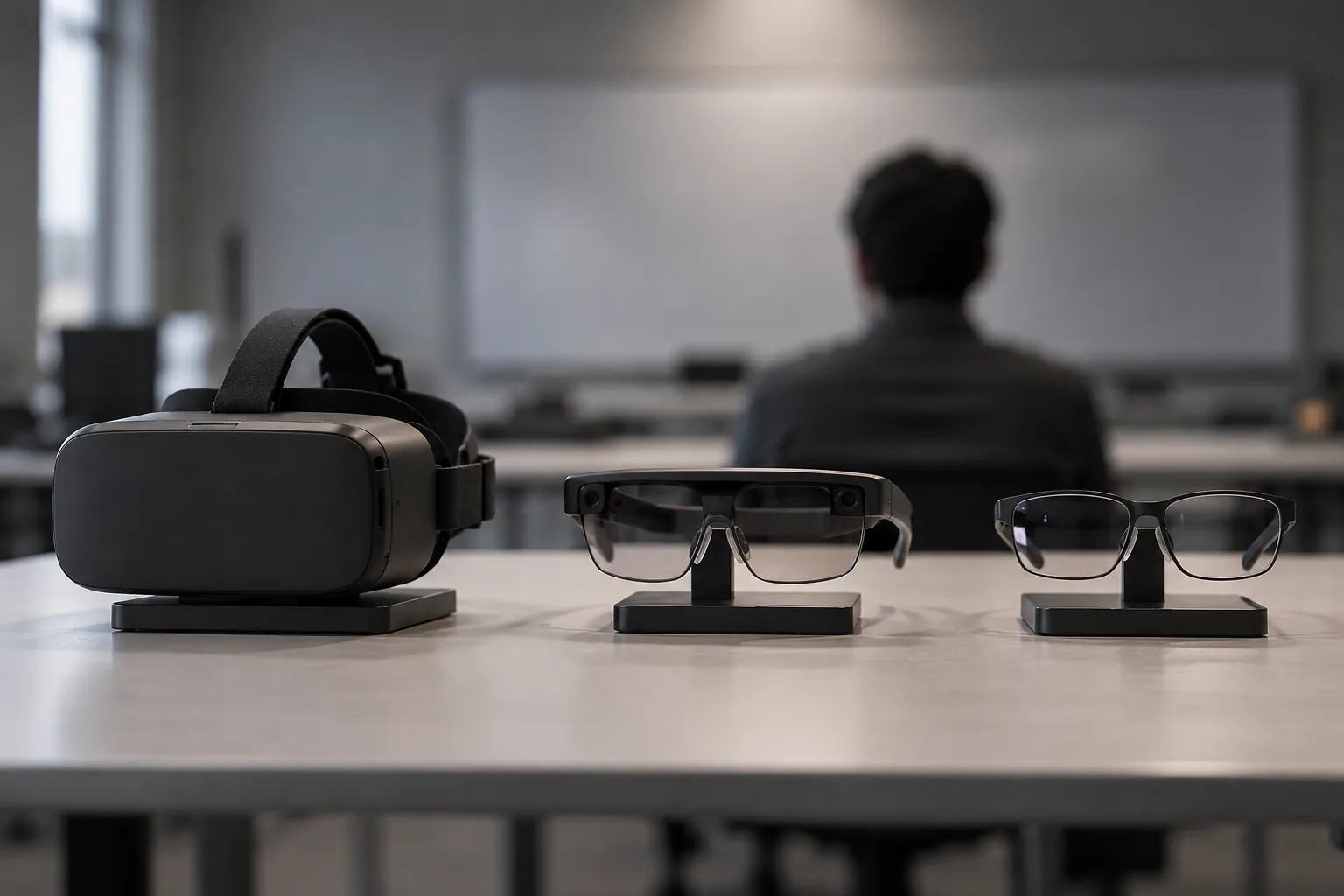
Illustrative image. These are not what our headsets look like.
A plain definition
From a buyer's point of view, XR training is a combination of three things: content that simulates or guides a task, a device that the trainee wears, and a system that manages devices and records results. Most descriptions focus on the first. This one starts with the second, because the device decides whether the content can be delivered at all, to how many people, and with what evidence.
VR, AR and MR in training terms
Virtual reality (VR) replaces the trainee's surroundings. It suits rehearsing procedures that are dangerous, expensive or rare: high-voltage switching, confined space entry, emergency response, equipment that cannot be taken out of service for practice.
Augmented reality (AR) adds information to the real world. It suits guidance during real work: showing the next step, a diagram or a remote expert's annotation while the worker's hands stay on the task.
Mixed reality (MR) places virtual objects in the real environment so they appear to interact with it, often through a headset's cameras (passthrough). It suits practising with real tools or fixtures while a scenario plays around them.
Voice-first glasses without a display are a related category: they guide the worker through audio and can capture what the worker sees, without showing anything. QWR's paper on when a field task needs a display and when voice is enough explains how to choose.
What the device must enable
For XR training to work in an enterprise, the device has to make four things possible.
The task. It must track and register what the training requires. A procedure involving walking and reaching needs positional tracking. A procedure built on fine hand movements benefits from hand tracking. QWR's paper on 3DoF vs 6DoF explains the difference.
The record. It must produce training records that reach the organisation's learning management system, attributed to the right person, even when the device was offline during the session. QWR's paper Getting Training Records Off the Headset covers the standards and device capabilities involved.
The fleet. It must be manageable at scale: enrolled, updated, locked to approved applications and wiped if lost, using the tools IT already runs. QWR's paper on kiosk mode, secure boot and remote MDM covers what to require.
The environment. It must work where training happens: shared between shifts, cleaned between users, worn with protective equipment, and charged on a realistic schedule.
A device that meets the first requirement but not the other three makes a good demonstration and a poor programme.
How XR training differs from classroom and e-learning
Classroom training explains a procedure. E-learning tests knowledge of it. XR training lets the trainee perform it: the actions, in sequence, in a realistic setting, as many times as needed. That is its main advantage for procedural and safety training.
The trade-off is logistics. Classroom and e-learning need a room or a screen. XR training needs devices that must be bought, managed, charged, cleaned and supported. Treating the hardware as part of the training design, rather than an afterthought, is what makes the difference between a pilot and a programme.
Questions to settle first
- Which tasks will be trained, and what do they physically involve?
- Where will training happen, and who will run it?
- Where must records end up?
- Who will manage the devices?
The answers define the hardware. QWR's paper on what corporate training actually demands of XR hardware goes further into enterprise use cases.
Where to go next
To match training needs to a device class, start with the Platform Finder.
FAQ
Frequently asked questions
What is XR training?+
Training delivered through virtual reality, augmented reality or mixed reality devices, combining simulation or guidance content, a worn device, and a system that manages devices and records results.
What must a headset support for enterprise XR training?+
The tracking and input the task requires, training records that reach the learning system, fleet management with existing IT tools, and practical use in the training environment.
How does XR training differ from e-learning?+
E-learning tests knowledge. XR training lets the trainee perform the procedure repeatedly in a realistic setting, at the cost of managing physical devices.
Is AR or VR better for training?+
They serve different purposes. VR suits rehearsing tasks away from the real environment. AR suits guidance during real work. Many programmes use both.
Request a Technical Briefing
Our team provides direct support for procurement officers, institutional buyers, and enterprise technology leads.