Industry Insights · Healthcare · Training
Shared Clinical XR Devices. The Questions Hospital Buyers Should Ask Before They Specify.
By QWR Technical Marketing
A personal headset has one wearer. A hospital device has a rota: the next clinician puts on whatever the last one wore. That single fact changes what you should ask a vendor, and most of the answers you need are not on a datasheet. This paper is a question list, not a claim about what any vendor has certified.
Start Here: A Checklist, Not a Specification
The hardware demands of each clinical use case are covered in What Clinical Training Actually Demands of XR Hardware, and patient-data obligations in DPDP Act & Patient Data Privacy. This paper covers the gap between them: what changes when the device is shared. It is built the way the loss and theft questions paper was, and for the same reason. QWR's healthcare page describes use cases, hardware pairings and a DPDP-compliant platform. It does not publish cleaning protocols, material specifications for clinical use, or medical-device certifications, so none are claimed here.
"A hospital doesn't buy a headset. It buys the thirty-first use of it in a week, by someone who didn't wear the first thirty."
1. "What Touches the Next User, and Can It Be Cleaned or Replaced?"
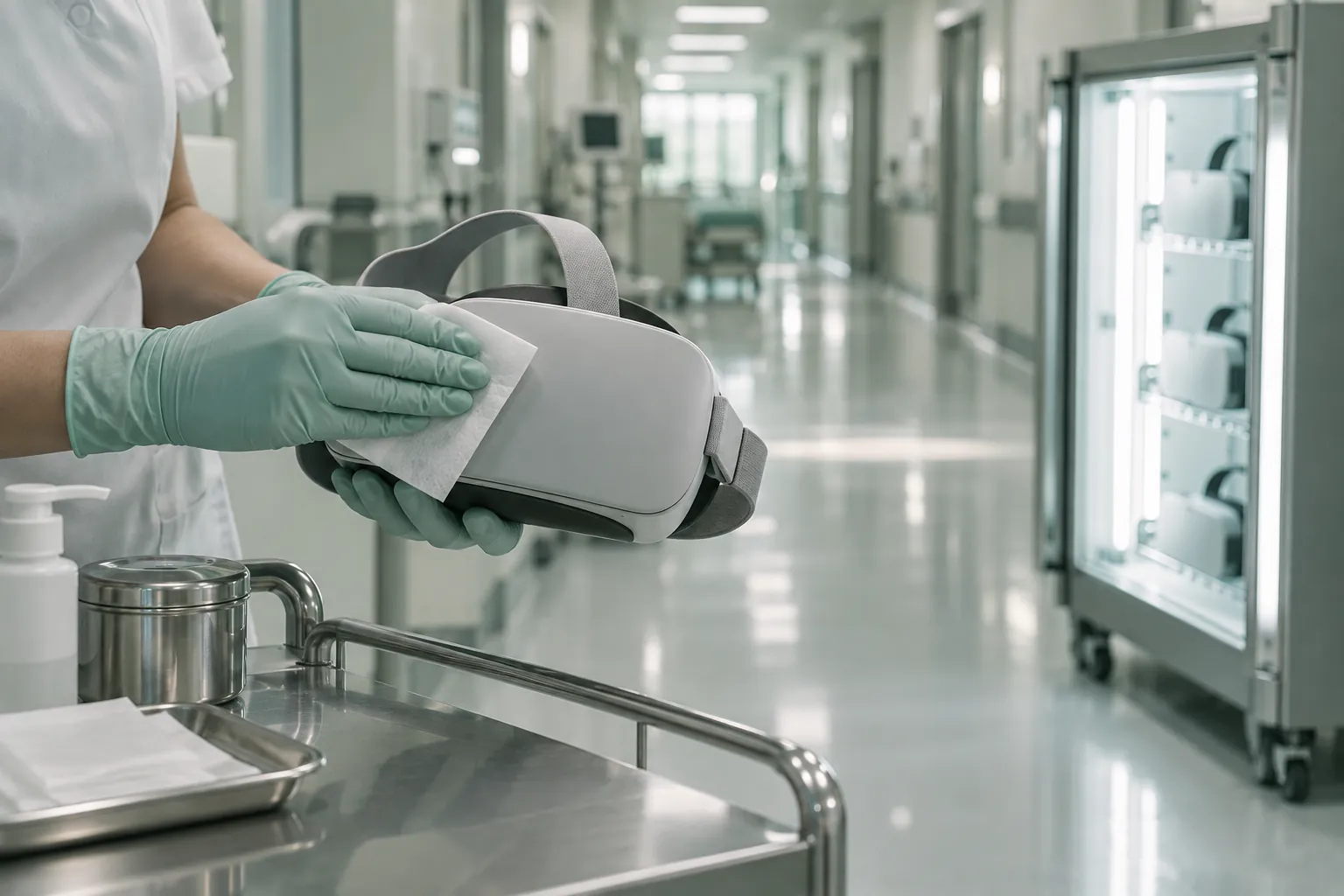
Ask for a list of every surface that contacts skin, hair or hands: face interface, strap, temple arms, nose pads, controllers. Then ask, for each, whether it is wipeable, replaceable, or covered by a disposable barrier, and who is expected to do that between users. The only sanitisable-surface claim QWR publishes is for QVR-03-01, a classroom headset; do not read it across to a clinical deployment. A vendor who can name each contact point and its between-user routine has thought about shared use. One who answers "standard cleaning" has not.
2. "Which Device Class Fits a Sterile or Sterile-Adjacent Workflow?"
QWR's healthcare page splits the two jobs plainly. QXR-06-07, with sub-millimeter tracking and 3,882 PPI clarity, is the surgical-training device: scheduled, supervised, in a simulation room. QAR-06 is the lightweight assistant for ward rounds, nursing staff and remote clinical guidance, and the page's ward-rounds use case is hands-free access to patient records and vitals without breaking the sterile field. The question for any vendor is which of its devices is meant to leave the simulation suite, and what makes it suitable: weight, hands-free operation, nothing to hold. A full headset on a ward round is the wrong tool even if the same company sells it.
3. "What Does the Camera Record, and Who Decides?"
Both HUMBL tiers carry a camera: QAI-06 for vision-based object recognition, QAR-06 with a 12MP camera. A camera on a clinician is a patient-data event whether or not the training content is sensitive. Ask where captured frames go, whether anything is stored on the device, and whether recording can be disabled by policy rather than by the user remembering. QWR states HUMBL is DPDP Act 2023 compliant with data resident on AWS Mumbai; confirm in writing how that applies to captured video specifically, and treat consent at the bedside as your institution's process to define, not the device's.
4. "Who Can Lock It, Wipe It, or Restrict It?"
A shared device needs controls an individual's does not: restricting it to approved applications, and clearing it when it goes missing. QWR documents Intune-compatible remote lock, wipe and app allowlisting, covered in Kiosk Mode, Secure Boot & Remote MDM (stated on QWR's SDK page and for QVR-06-04; confirm it applies to the exact HUMBL model you are buying). Ask whether allowlisting survives a wipe, so a reissued device returns to its clinical configuration rather than a blank image.
5. "What Is Not Published?"
Ask directly, and get the answer in writing: Is there a validated cleaning agent list? Which contact materials are used? Are there any medical-device certifications relevant to your intended use? On what QWR publishes today, the honest position is that its healthcare offering is a training and assist platform, not a certified medical device. A vendor who is plain about that is easier to trust than one who implies otherwise.
The Shared-Use Checklist
Before specifying: every skin-contact surface named, with a wipe, replace or barrier routine and an owner; the device class matched to the setting (simulation room versus ward); camera data flow, storage and policy-level disablement confirmed; application restriction and remote wipe confirmed for the specific model; and the vendor's unpublished items answered in writing rather than assumed.
The Conclusion: Specify the Rota, Not the Device
Shared clinical XR succeeds or fails on the unglamorous routine between one wearer and the next. Ask who cleans what, which device belongs on the ward, what the camera captures, and who can lock it. Where a vendor's published material is silent, that silence is the answer to bring to the table.
Request a Technical Briefing
Our engineering team provides direct support for procurement officers, institutional buyers, and enterprise technology leads.