Industry Insights · Industry
What Automotive Assembly Training Demands of XR Hardware. A Requirements Read for Line and Quality Engineers.
By QWR Engineering
Automotive assembly is built on sequence and repetition. An operator at a station performs the same set of actions on every vehicle that passes, in a fixed order, within a fixed time. Getting that sequence right, every time, is what quality depends on. Getting a new operator to that standard quickly is what keeps a line running when people move, model changes arrive, or a new shift is added.
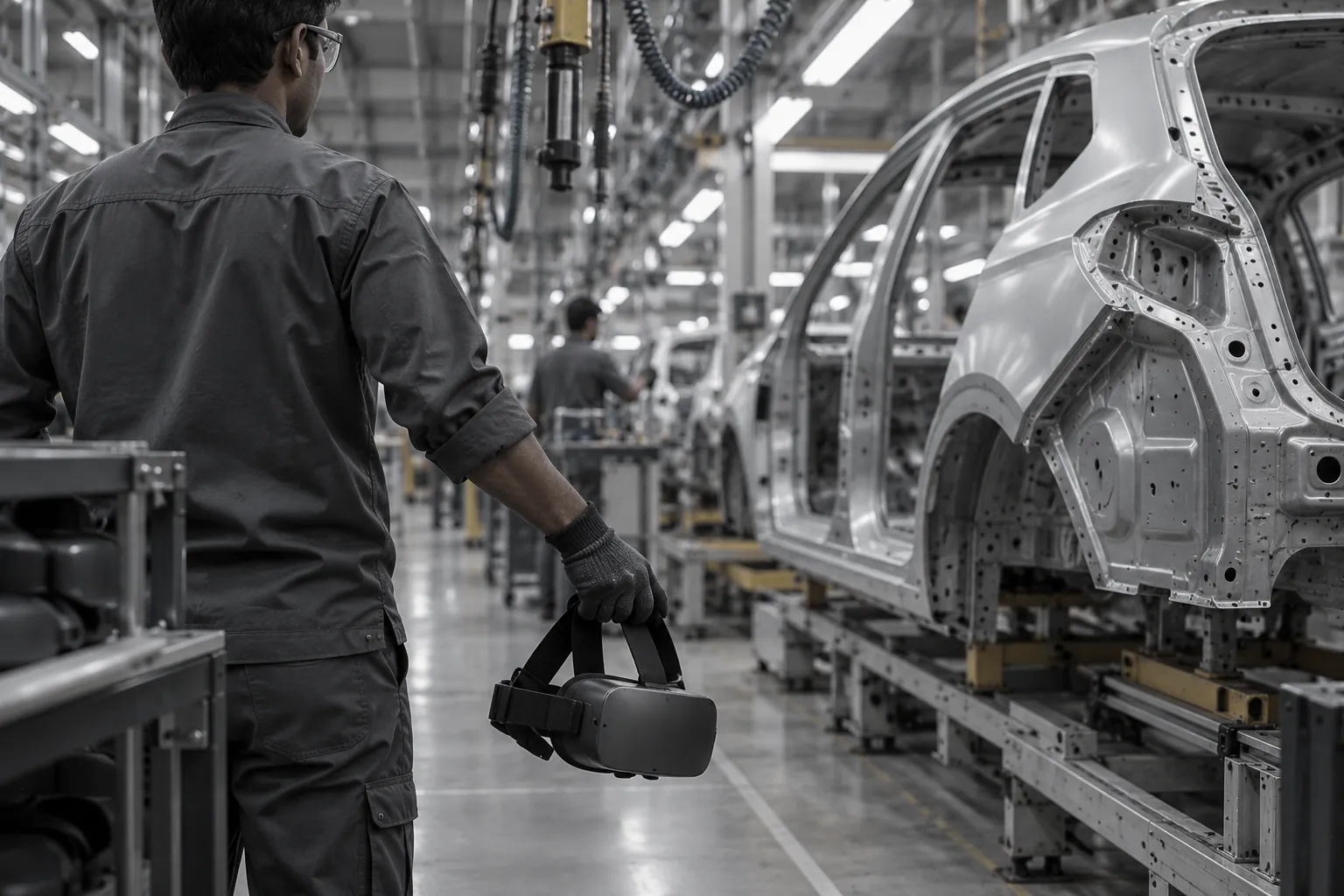
Illustrative image. These are not what our headsets look like.
Immersive training suits this well. A new operator can rehearse a station's sequence many times before touching a real vehicle. A model changeover can be practised before the first car of the new model reaches the station. But assembly plants run on a discipline that most training programmes do not have to respect: takt time. Training that does not fit around the rhythm of the line will not be used, however good it is.
This paper sets out what automotive assembly training asks of XR hardware, for line engineers, quality engineers and the training teams who support them. Much of it also applies to auto-component suppliers, whose lines run on the same discipline.
Where assembly training happens
Assembly training tends to happen in one of three places.
A training school or dojo away from the line. New operators learn general skills and specific station sequences before joining. Space and time are available.
A training bay near the line. Operators practise a specific station, often with real parts and fixtures, close to where they will work.
At the station itself. Refreshers, changeover rehearsals and guided work, done during or between production cycles.
Each places different demands on hardware. A device chosen for the training school may be impractical at the station, and the reverse.
Takt-time constraints and line-side fit
This section is specific to assembly and is the main way assembly training differs from other industrial training.
The time budget
Takt time sets the pace at which each station must complete its work. Training that happens near or at the line has to fit into gaps: before shift start, during planned breaks, during line stoppages, or on a relief rotation. A module that takes twenty minutes to start, calibrate and complete cannot be used in a five-minute gap.
What to ask. - How long does it take from picking up the device to starting a module? Include waking, fit adjustment, any tracking set-up and launching the application. - Can modules be broken into short segments, each covering one station or one step, that run in a few minutes? - Can a trainee resume where they left off in a later gap?
Fast don and doff
Operators in assembly wear gloves, sleeves, safety glasses and sometimes hearing protection. A headset that requires removing safety glasses, carefully adjusting straps and recentring the view adds friction to every session.
What to ask. Can the device be put on and taken off quickly, with one hand? Does it fit over safety glasses? Does it need re-centring or re-calibration each time? Ask an operator to try it with full protective equipment, not just a trainer in office clothes.
Short, repeated practice
Assembly skills are built by repetition. The most effective use of a headset near the line may be many short sessions of the same sequence rather than a single long one. That favours devices that start quickly, keep their tracking set-up between sessions, and do not need the trainer's help each time.
Not disrupting the line
At or near a station, the training must not distract other operators or create a hazard. A trainee in full immersion near moving conveyors or vehicles is a safety concern.
What to ask the plant's safety team. Where can a fully immersed trainee safely stand? Should line-side training use passthrough so the trainee can see the real surroundings? This is a site decision, not something a device vendor can settle.
Input and tracking for assembly sequences
Hand tracking versus controllers
Assembly is hand work: picking parts, orienting them, fitting fasteners, routing harnesses, connecting couplers. Training that builds the sequence into muscle memory benefits from hand tracking, where the device follows the operator's real hands, because it is closer to the real motion than pointing with a controller.
Hand tracking has limits. It can struggle with gloved hands, fast movements and hands that are partly hidden behind parts. Controllers are more robust but less natural.
What to ask. - Does the module require hand tracking, or does it support controllers as well? - How reliably does the device track hands wearing the gloves your plant uses? - How does the module behave when tracking is lost mid-step?
The companion paper Which Safety Modules Need Which Headset discusses the same trade-off for safety procedures.
Positional tracking
Stations involve stepping around a vehicle or reaching into it. Modules that simulate this need positional tracking. QWR's paper on 3DoF vs 6DoF explains the distinction.
Passthrough for mixed practice
Some plants want operators to practise with real parts and fixtures while the headset adds guidance: highlighting which fastener comes next, showing the correct torque sequence, flagging a missed step. That requires passthrough, where the headset's cameras show the real world with virtual elements overlaid.
What to ask. Does the device offer full-colour passthrough? Is it clear and responsive enough to handle small parts and fasteners accurately? Is there noticeable delay between moving a hand and seeing it move?
For guided work at the station itself, see-through AR glasses may suit better than a headset with passthrough, because the operator sees the real world directly. QWR's paper on hands-free smart glasses for industry covers how to define what "hands-free" should mean before buying.
The plant environment
QWR's paper on what the factory floor demands of XR hardware covers environmental hardening, see-through optics and fleet integration for plants generally. For assembly specifically, a few points stand out.
Noise. Assembly halls are loud. Voice commands and narration need to work over line noise, or modules should not depend on them.
Lighting. Overhead lighting in assembly halls is often bright and even, which helps camera-based tracking, but reflective vehicle surfaces can confuse it.
Durability. Devices used near the line get knocked, dropped and handled with dirty gloves. Ask about drop resistance and how easy the device is to clean.
Reporting and quality systems
Assembly plants track operator qualifications closely. An operator may need to be certified on each station before working it alone. Training records from XR modules should feed that system.
The companion paper Getting Training Records Off the Headset covers how records leave the device. For assembly, two points are specific:
Station-level records. Records should identify which station sequence was practised, not just which module, so they map onto the plant's qualification matrix.
Error patterns. When many operators make the same mistake at the same step, the cause may be the station design or the work instruction, not the operators. Aggregated training data can surface this for quality engineers.
Model changeovers
New models and facelifts change station sequences. A changeover is one of the highest-risk periods for quality, because operators who have built one sequence into habit must replace it with another.
XR training can help by letting operators rehearse the new sequence before the new model reaches the line. The hardware requirement here is content agility: the training team must be able to update modules quickly as engineering changes arrive. Ask whether the content platform lets the plant's own engineers update sequences, and whether the device fleet can receive updated content quickly through remote management. QWR's paper on kiosk mode, secure boot and remote MDM covers fleet management.
Typical pattern: matching device to setting
Typical pattern. An assembly plant runs three settings with two devices.
- In the training school, VR headsets with positional tracking and hand tracking run full station sequences for new operators.
- In the training bay, the same headsets run with passthrough so operators can practise with real fixtures.
- At the station, see-through glasses show the next step and flag missed actions during the first weeks after a changeover, then are withdrawn once operators are certified.
The plant chose devices for each setting rather than one device for all three, because the station's takt-time and protective equipment constraints ruled out a full headset there.
Where to go next
For plant-floor hardware requirements, see the manufacturing industry page. To match each training setting to a device class, start with the Platform Finder.
FAQ
Frequently asked questions
What hand input suits automotive assembly VR modules?+
Hand tracking is closer to real assembly motions, but check how it performs with the gloves your plant uses and how modules handle lost tracking. Controllers are more robust when gloves interfere.
Does assembly training benefit from passthrough?+
Yes, when operators practise with real parts and fixtures. Check that passthrough is clear and responsive enough for small parts.
How do takt-time constraints affect headset choice?+
Training near the line must fit into short gaps. Favour devices that start quickly, fit over safety glasses, keep their set-up between sessions, and run modules in short segments.
Can XR help with model changeovers?+
Operators can rehearse the new sequence before the new model arrives. That depends on updating content quickly and pushing it to the fleet through remote management.
Should training happen at the station or away from the line?+
Both have roles. Full immersion suits a training school or bay. At the station, see-through glasses or passthrough are safer, subject to the plant safety team's assessment.
Request a Technical Briefing
Our team provides direct support for procurement officers, institutional buyers, and enterprise technology leads.