Industry Insights · Industry
What Pharma GMP Training Demands of XR Hardware. A Requirements Read for Quality and Manufacturing Leads.
By QWR Compliance & Regulatory Affairs
Good manufacturing practice training is repetitive by design. Gowning, aseptic technique, line clearance, equipment cleaning, deviation handling: the same procedures, performed the same way, every time. That is exactly what makes them suitable for virtual reality. A trainee can practise a gowning sequence or an aseptic transfer as many times as it takes, without consuming materials, occupying a cleanroom or risking contamination.
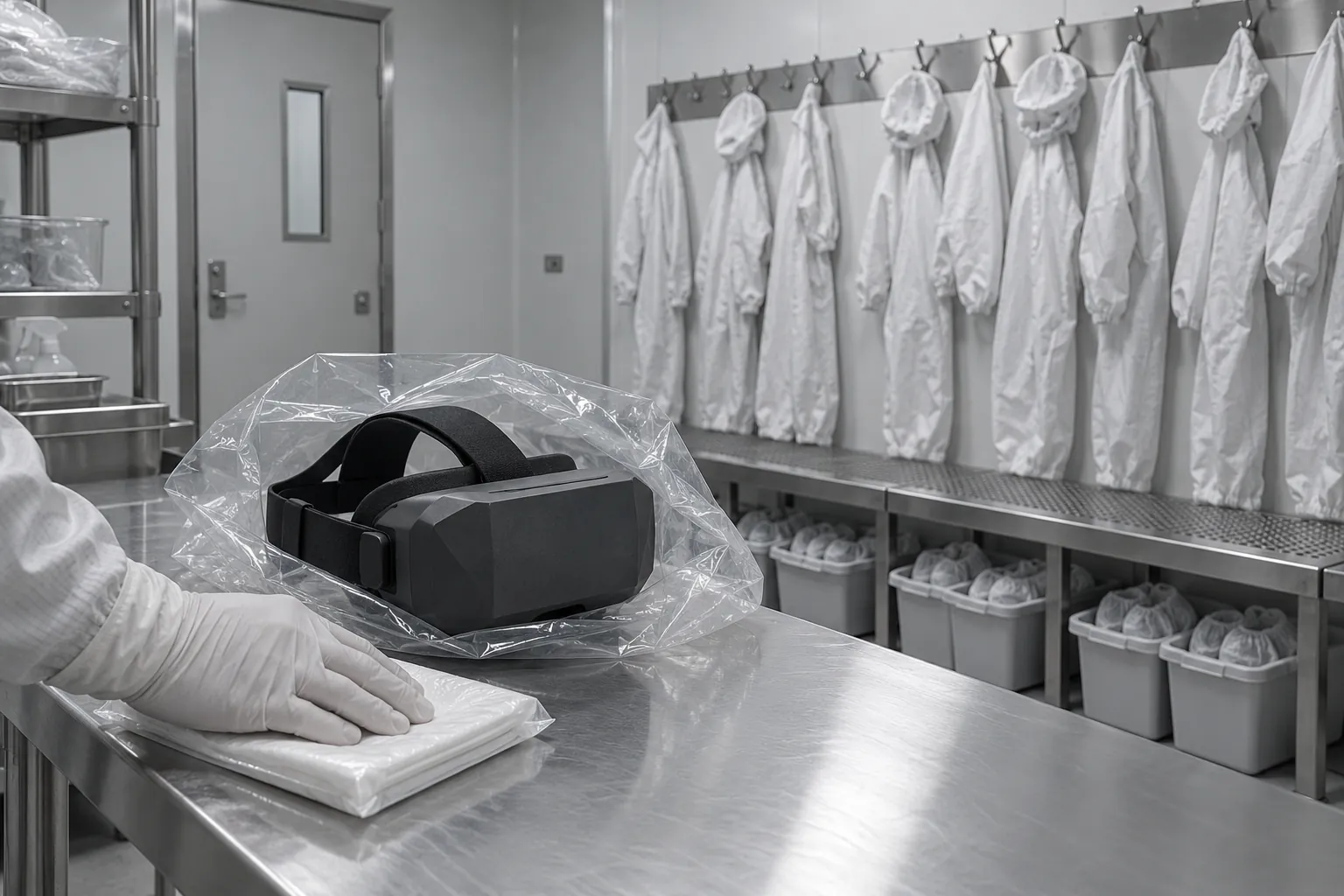
Illustrative image. These are not what our headsets look like.
What GMP training also brings is a set of constraints that most other training does not: controlled environments, contamination concerns, cleaning regimes, and an expectation that training records are reliable. Each of these turns into a hardware question. This paper sets them out for quality assurance leads, manufacturing heads and the IT teams who will run the fleet.
It focuses on the device. It does not address whether any particular system satisfies a specific regulatory requirement. That assessment belongs to the site's quality and validation teams.
Why GMP training shapes the hardware choice
Typical pattern. A pharmaceutical site introduces VR gowning training using general-purpose headsets in a training room. The training works. Then the quality team asks whether the same headsets could be used inside a grade C area for refresher training near the line, and whether the face interfaces can be wiped with the site's standard disinfectant. Nobody had asked these questions during selection, and the answers are not in the device documentation.
GMP training sits in a different place from most enterprise training: close to environments where what a device is made of, how it sheds particles and how it is cleaned all matter. The first decision is therefore not which headset, but where it will be used.
The first question: where will the headset be used?
There are broadly three settings, each with different requirements.
A general training room outside the production area. Most GMP VR training happens here. Contamination is not a direct concern, but hygiene between users still is.
A gowning room or ancillary area. Training near the point of practice, where trainees may be partially gowned. Cleaning compatibility and how the headset interacts with gowning garments become relevant.
Inside a classified area. Rare, and it should be treated as a separate decision. Any device brought into a cleanroom becomes part of the site's contamination control strategy. Under the EU GMP guidelines, Annex 1 sets expectations for contamination control in sterile manufacturing, and cleanroom classification is defined under ISO 14644. Whether a headset can enter a classified area is a question for the site's quality team, based on the device's materials, cleaning compatibility and particle behaviour, not something a device vendor can declare on the site's behalf.
Settle this before evaluating devices. A headset that is ideal for a training room may be unsuitable for a gowning room and inappropriate for a classified area.
Gowning, cleanroom protocol and materials compatibility
This section is specific to pharma and is where GMP requirements differ most from other industries.
Cleaning and disinfection
Shared headsets in GMP settings need a defined cleaning routine, and the routine depends on what the device's surfaces can tolerate.
What to ask. - Which surfaces contact the user (face interface, straps, controllers), and which materials are they made of? - Which cleaning agents and disinfectants has the vendor tested the device with? Isopropyl alcohol is common; sporicidal agents and hydrogen peroxide-based products are harsher. Ask specifically about the agents your site uses. - Are face interfaces removable and replaceable, so that each trainee can have a dedicated one or a disposable cover? - Does repeated cleaning degrade materials over time, and what is the replacement schedule?
QWR's paper on shared clinical XR devices covers hygiene questions for shared devices in a related setting.
Materials and particle shedding
In classified areas, materials that shed fibres or particles are a concern. Fabric straps and foam interfaces are typical sources.
What to ask. Are there non-fabric, non-foam options for straps and face interfaces? What are the enclosure materials, and how do they behave under repeated cleaning? QWR's paper on enclosure materials for XR hardware describes the main material families and what each delivers.
Interaction with gowning
A trainee practising aseptic technique may wear a hood, mask and goggles, or be practising the gowning sequence itself.
What to ask. Can the headset be worn over a hood or with a mask without breaking the light seal or fogging? Does the training module expect the trainee to put the headset on before or after gowning steps, and is that practical?
Tracking and input for GMP procedures
GMP procedures are often about precise, ordered hand movements: the sequence in which gloves are donned, the path of a hand over a sterile field, the order in which surfaces are wiped.
Hand tracking versus controllers
Aseptic technique training relies on trainees learning what their hands should and should not do. Hand tracking, where the headset's cameras follow the trainee's hands directly, is closer to the real motion than pointing and clicking with controllers. It also avoids the controllers themselves becoming an additional item to clean.
The trade-off is reliability. Hand tracking depends on lighting, line of sight and the quality of the tracking system. Gloved hands, especially in white or translucent gloves, can be harder to track than bare hands.
What to ask. Does the module require hand tracking or support it optionally? How does the device track gloved hands in the gloves your site uses? What happens in the module when tracking is lost mid-step?
Positional tracking
Line clearance, equipment cleaning and material transfer involve moving around a room or a piece of equipment. These need positional tracking. QWR's paper on 3DoF vs 6DoF explains why. Seated knowledge modules may not.
Passthrough
Some sites want trainees to practise with real objects, such as a real glove box port or a real wiping tool, while the virtual scenario plays around them. That requires passthrough: the headset shows the real environment through its cameras, blended with virtual elements.
What to ask. Does the device offer full-colour passthrough, and is it clear enough to handle small objects accurately?
Training records and device capabilities
GMP training produces records that quality systems depend on. This paper does not address whether a given system meets a specific regulation on electronic records. It addresses what the device must do so that whatever system the site uses receives complete, attributable records.
Attributable. Each record must be tied to the right person on a shared device. Ask which identity methods the device supports: sign-in, badge scanning, assignment from a trainer's dashboard.
Complete. Records generated while the device is offline must survive until it reconnects. Ask what happens to queued records on low battery, restart or remote wipe.
Accurate. Timestamps depend on the device clock. Ask how the device keeps time while offline.
Exportable. Records must reach the site's learning management or quality system. The companion paper Getting Training Records Off the Headset covers the standards and device capabilities involved.
Whether the resulting system is validated, and to what standard, is a decision for the site's validation team.
Fleet and operational questions
Fleet management. IT will expect to manage devices remotely, lock them to approved training applications, control updates and wipe lost devices. QWR's paper on kiosk mode, secure boot and remote MDM covers what to require.
Change control. Pharma sites manage changes to systems carefully. A firmware update that changes how the device behaves may need assessment before deployment. Ask whether updates can be staged, tested and approved before reaching the fleet, and how long the device will receive them. QWR's paper on firmware and OS update commitments sets out what to request.
Data residency. Training records contain personal data about employees. For Indian sites, QWR's paper on architecting for DPDP covers stack-level controls worth verifying.
Battery and charging. Plan charging against the number of sessions per day, and include time for cleaning between users in the schedule.
Typical pattern: a staged rollout
Typical pattern. A site introduces VR GMP training in three stages.
- Training room only. Gowning sequence and line clearance modules, run in a dedicated room. Removable face interfaces, cleaned with isopropyl alcohol between users. Records exported to the learning management system.
- Gowning room refreshers. After the quality team reviews cleaning compatibility with the site's disinfectants, short refresher modules move closer to the point of practice.
- Classified-area use, if any. Assessed separately by quality and validation, as a change to the contamination control strategy, with a decision that may be no.
Each stage starts only after the previous one's questions are answered.
Where to go next
For plant and production hardware requirements, see the manufacturing industry page. To match training requirements to a device class, start with the Platform Finder.
Sources
- EU GMP Guidelines, Annex 1, Manufacture of Sterile Medicinal Products (European Commission). Cited for the existence of contamination control expectations only; no specific requirement is paraphrased.
- ISO 14644, Cleanrooms and associated controlled environments. Cited for cleanroom classification only.
FAQ
Frequently asked questions
Can a VR headset be used inside a pharmaceutical cleanroom?+
That is a decision for the site's quality team, as part of its contamination control strategy. It depends on the device's materials, cleaning compatibility and particle behaviour. Most GMP VR training takes place in training rooms outside classified areas.
What cleaning questions should a site ask about an XR headset?+
Which agents the vendor has tested, which surfaces contact users, whether face interfaces are removable and replaceable, and whether repeated cleaning degrades the materials.
Does GMP training need hand tracking?+
Modules that teach aseptic technique benefit from hand tracking because the skill is in the hand movement. Confirm how well the device tracks the gloves your site uses, and how the module behaves when tracking is lost.
What device capabilities support reliable training records?+
Attributing each session to the right person on a shared device, holding records safely while offline, keeping accurate time and exporting to the site's learning or quality system. Whether the resulting system is validated is a separate decision for the site.
How should firmware updates be handled on a GMP training fleet?+
Updates should be stageable and testable before reaching the fleet, so they can pass through the site's change control. Ask how long the device will receive updates.
Request a Technical Briefing
Our team provides direct support for procurement officers, institutional buyers, and enterprise technology leads.