Industry Insights · Procurement · Strategy
VR Arcade Setup. The Hardware and Operations Questions to Settle Before the Floor Opens.
By QWR Technical Marketing
A VR arcade earns by throughput, and throughput is set by the unglamorous parts: how fast a headset is charged, reset and handed to the next guest. The business case lives in the ROI model. This paper covers the equipment behind it.
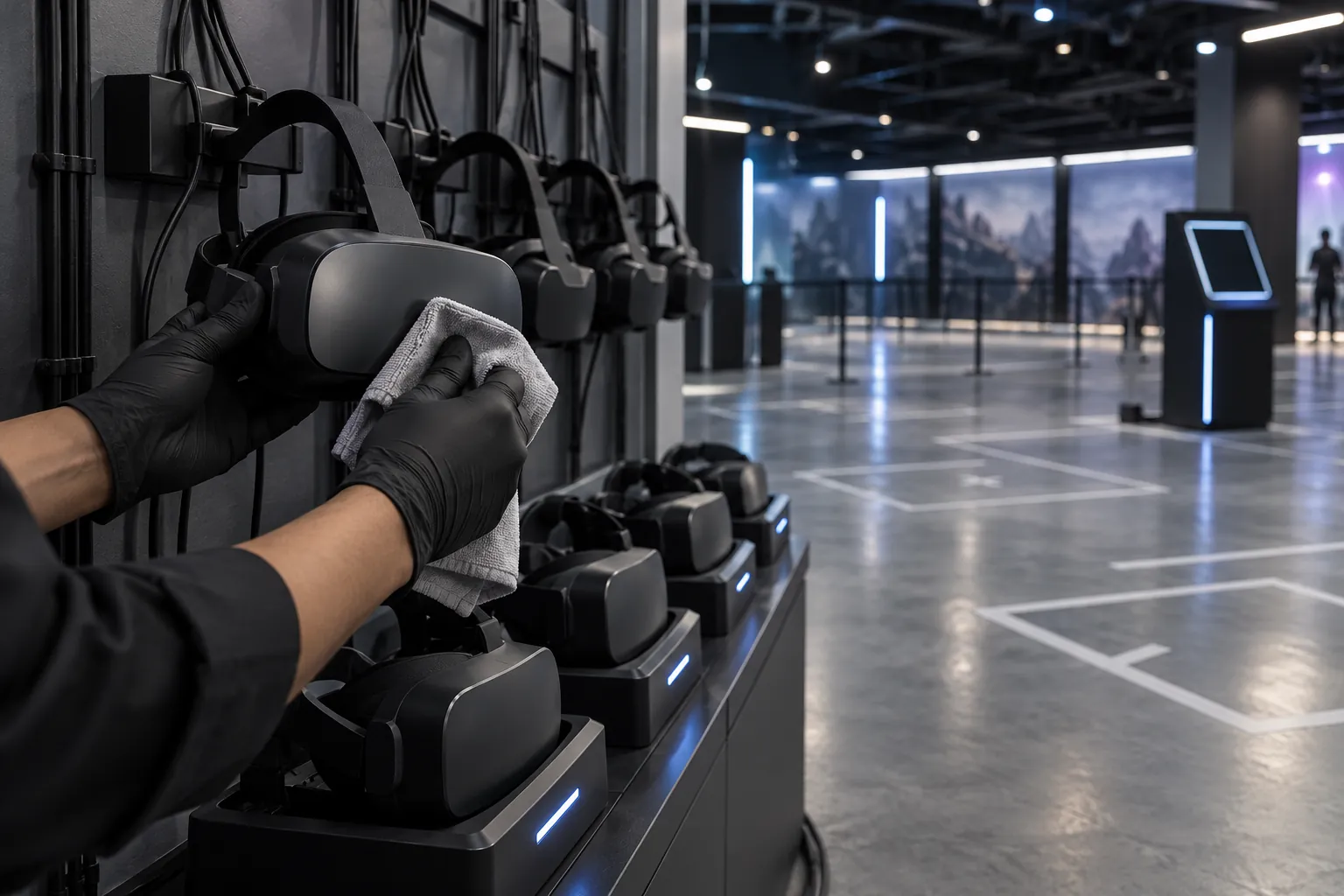
Illustrative image. These are not what our headsets look like.
Start Here: Equipment, Not Payback
How to model revenue per session and payback is covered in How to Model ROI & Payback Period. This paper starts after that decision, with a different question: what must be true of the hardware and operations for the model's numbers to hold. QWR's published arcade offer is a turnkey kit, so this uses it as the worked example. QWR publishes no station counts, floor areas, power requirements or prices for it, so none appear here.
"A headset that is slow to reset has changed your payback model without anyone updating the spreadsheet."
1. What the Published Kit Contains
QWR's arcade solution is built on the QXR-06-10 Arcade Kit: 6DoF standalone headsets with dual motion controllers and full-colour passthrough, with charging stations for 10 units, and auto-wipe and session reset. Content is pre-loaded licensed experiences such as roller coasters, racing and multi-user VR. Operations come with integrated ticketing, session timers and a remote content management system. White-label hardware lets a franchise put its own logo on the headsets. Turnkey delivery covers the headsets, charging cabinets and OTA library updates, along with operational SOPs and staff-training modules.
2. Charging Is Your Peak-Capacity Limit
Charging stations are specified for 10 units. Your capacity question is how many guests you want in headsets at the same time at peak and how many units are charging while they play. Ask the vendor how many stations a floor of your size needs, whether stations can be added as the circuit grows, and how long a headset takes to recover between heavy sessions. QWR describes growth from "a single kiosk to an entire entertainment circuit", which is a reason to ask about adding stations.
3. "Auto-Wipe and Session Reset": Ask What They Do
Both features are listed without detail. Ask directly: what does auto-wipe clear, such as guest data, the previous session's state or both, and how long does a reset take between guests? A reset that is quick and complete is a throughput feature. One that is slow or partial leaves staff doing it by hand.
4. Content Licensing Is an Operating Cost
QWR includes pre-loaded licensed experiences. Licence terms are not published, so ask: who holds the licence, how long it runs, what happens at expiry, whether new titles arrive through the OTA library updates and whether they cost extra. Multi-user content raises its own questions about how many headsets can join one session and how the floor is sequenced.
5. Ticketing, Timers and Remote Management
An arcade needs a ticket, a timer and a way to change content on every headset without walking the floor. QWR lists all three as integrated. Ask whether they are one system or separate parts, what you can change remotely, and what happens when the venue's network drops mid-session. For lockdown and remote controls on shared devices, see Kiosk Mode, Secure Boot & Remote MDM; the loss and theft questions for a public floor are in Physical Loss, Theft & Recovery Questions.
6. What Is Not Published
Ask for each in writing: floor area and layout assumptions, power per station, station count for your target capacity, the price and what it includes, the licence terms, and the service and replacement path for a headset that fails during opening hours. The turnkey model is only as good as what it covers.
The Arcade Hardware Checklist
Before committing: stations needed for your peak capacity; the meaning and duration of auto-wipe and session reset; licence holder, term and expiry behaviour; whether ticketing, timers and content management are one system; the remote update path; the replacement route for a failed unit; and the unpublished items above answered in writing.
The Conclusion
The ROI model says what the arcade could earn. The hardware questions decide whether it does: charging, reset, licensing and service. Settle them before the floor opens, and the model's assumptions become commitments the vendor has seen.
Request a Technical Briefing
Our team provides direct support for venue operators, franchise buyers and enterprise technology leads.