Industry Insights · Retail · Commerce
The Spatial Previews Pivot. How Indian Retail Is Killing Product Returns.
By QWR Technical Marketing
For a decade, 'reverse logistics' was the silent tax on Indian e-commerce. In 2026, AR smart glasses and AI-driven preview systems are closing the expectation-reality gap before the box ever leaves the warehouse.
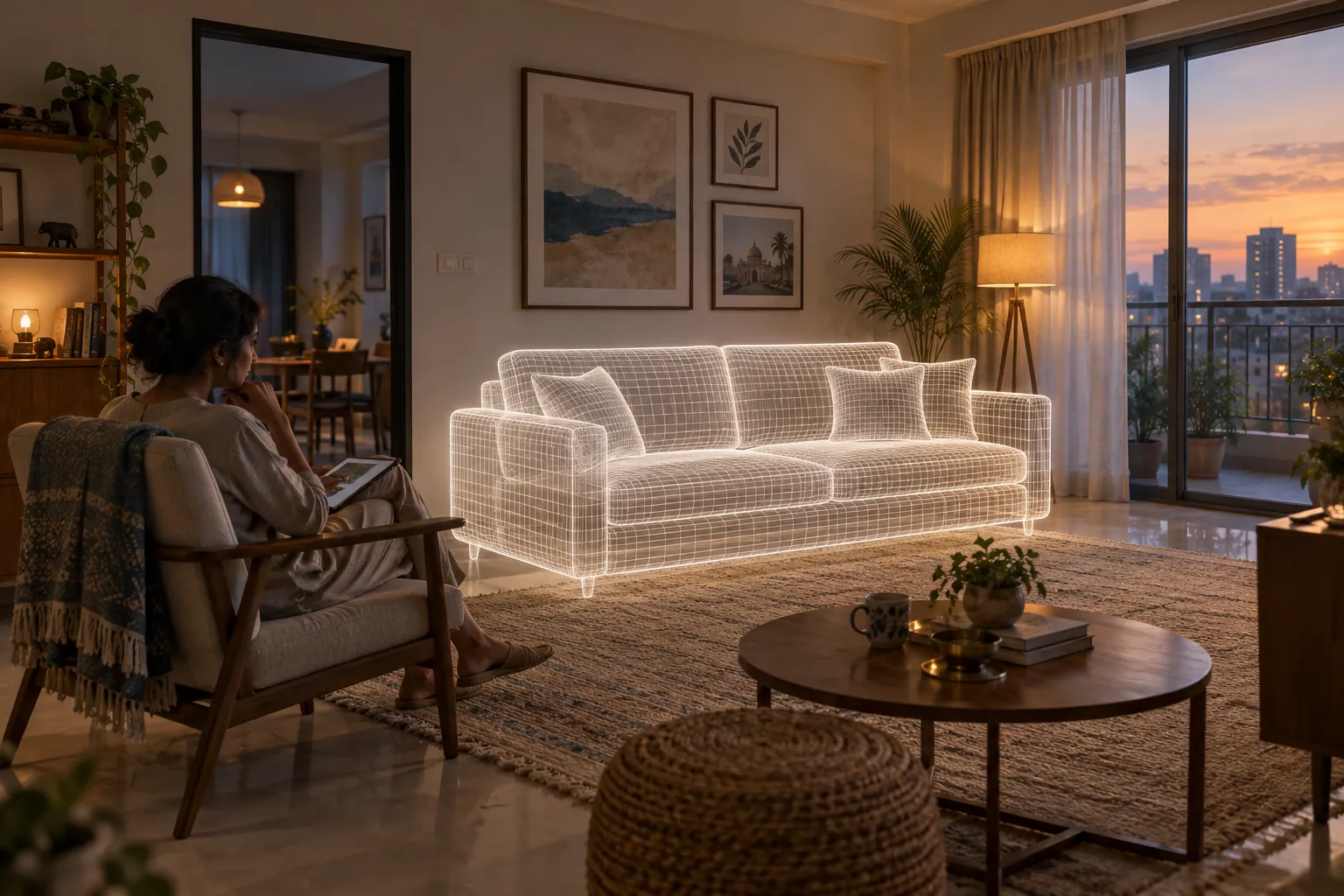
The Add-to-Cart Gatekeeper
In the high-velocity retail environment of April 2026, the Add-to-Cart button has a new, multi-billion-rupee gatekeeper: the Spatial Preview. For over a decade, Indian e-commerce was plagued by a reverse-logistics crisis, with return rates in furniture, home decor, and appliances hovering at unsustainable levels.
Forward-thinking organisations are now leveraging AR smart glasses and AI to close the expectation-reality gap. For the first time, Indian retailers are turning to remote support and spatial visualisation to address the widening productivity gap, maintain shrinking margins, and create a competitive advantage.
"The future of Indian commerce is heads-up, hands-free, and spatially intelligent."
1. From Scrolling to Spatialising: 2026 Consumer Psychology
By early 2026, the consumer journey has moved beyond the fatigue of 2D imagery. AR allows computer-generated images of products to be superimposed onto the user's physical environment — an experience that feels present, not projected.
- Millimetre precision: Modern AR wearables enable users to enhance real-world objects with superimposed data, ensuring a large modular wardrobe fits a renovated apartment with 98% accuracy.
- Hands-free exploration: Unlike the clunky smartphone-AR of the early 2020s, 2026 is the year of the wearable smart glass — keeping hands free and heads up while physically moving through rooms.
- Assisted Reality (aR): Retailers push real-time technical specs or price comparisons directly to the shopper's field of vision as they "test" products in their space.
2. Killing the 'Reverse Logistics' Tax: The ROI of Certainty
The business case mirrors the dramatic cost savings in industrial field services. Indian retailers face a 7% year-on-year increase in service and resolution costs due to supply chain disruptions and inflation. Spatial previews flip the curve:
- Revenue growth: Companies with full AR deployment see 62% higher growth in annual revenue compared with legacy 2D platforms.
- Customer retention: AR deployment delivers a 4× increase in customer retention rates.
- Profitability scaling: 42% higher YoY profitability. Reducing "truck rolls" — delivering and reclaiming rejected products — cuts service costs significantly.
- Resolution speed: 80% of organisations see a significant decrease in resolution times when spatial tools pre-verify fit before the item leaves the warehouse.
3. The 'Trusted Advisor' Associate: Closing the Skills Gap
India's retail sector is grappling with a significant loss of domain knowledge as veteran staff leave the workforce. AR wearables allow a junior retail associate — or the customer themselves — to connect with an off-site master designer in a "see-what-I-see" call.
- Remote mentoring: The expert views exactly what the on-site user sees and walks them through complex spatial layouts.
- Time-to-proficiency: 65% of organisations employing AR benefit from a decrease in ramp-up time for new employees.
- 3-in-1 toolsets: Modern wearables combine AR, assisted reality, and AI into a single platform — detecting technical problems with 98% accuracy during home installations.
4. AI Integration: The 'Smart' in Smart Glasses
In 2026, the true power of the spatial preview lies in its AI layer:
- Intelligent upselling: 52% of best-in-class companies use AI- and AR-driven product recommendations to boost cross-sell rates on accessories.
- Logistics optimisation: Integrated AI in smart glasses enables intelligent scheduling and inventory management. If a customer "previews" a lamp in a specific colour, the system verifies local availability instantly.
- Customer Lifetime Value: Businesses employing AR + AI see a 17.8% YoY increase in CLV — 3× the rate of traditional retailers.
5. Building Business Agility
Covid-19 accelerated the move into remote services. Today, 63% of best-in-class organisations have integrated AR and AI into daily operations. AR empowers consumers to become their own trusted advisors — previewing a product, viewing a digital-twin 3D model of equipment or furniture, and visualising the "how-to" of installation before they buy.
Strategic Conclusion: The Standard for 2026
AR is no longer a futuristic luxury — it is the standard by which Indian customers evaluate retail performance. Field service and retail organisations that have not incorporated AR are missing a crucial tool for creating a competitive advantage. In 2026, the Simulation-First mandate applies to commerce just as much as to the factory floor.
Request a Technical Briefing
Our team provides direct support for procurement officers, institutional buyers, and enterprise technology leads.