Industry Insights · Smart Cities · Digital Twins
The 1:1 City. How Smart Cities Mission 2.0 Runs on Digital Twins.
By QWR Technical Marketing
India's 100 ICCCs are complete. The next leap is cognitive: every street lamp, water sensor, and bus route mirrored in a spatial digital twin, simulated before it's built.
The Death of the Static Blueprint
Historically, urban planning in India was a reactive science. We built flyovers to fix yesterday's traffic and laid pipes based on decades-old maps that didn't account for the rapid urban sprawl of the 2010s. The result was a cycle of constant digging, mismatched utility lines, and trial-and-error infrastructure that drained municipal budgets.
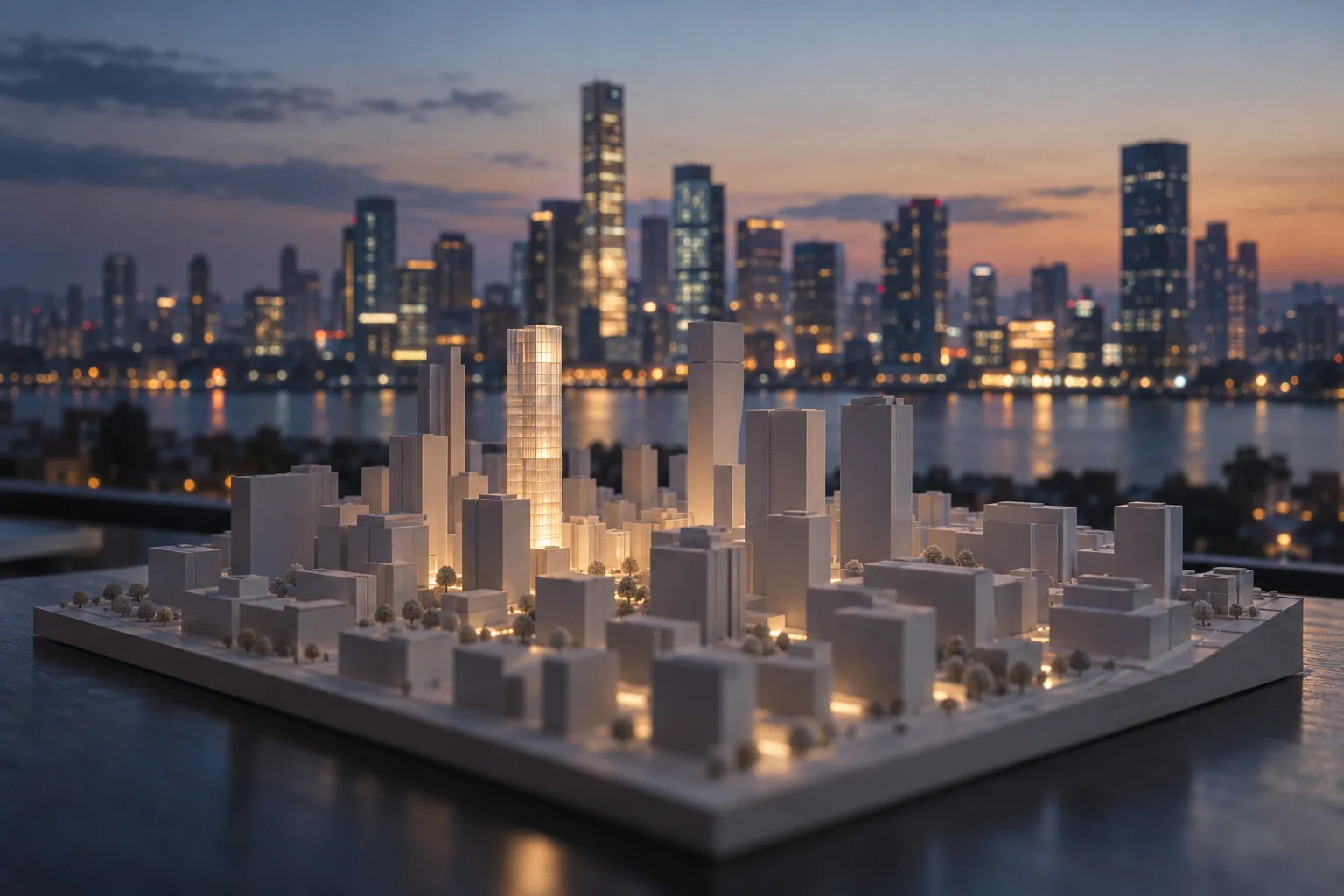
By April 2026, Smart Cities Mission 2.0 has fundamentally changed this workflow. The latest PIB reports confirm India has achieved 100% completion of Integrated Command and Control Centres (ICCCs) across all 100 smart cities. These centres have evolved from dashboard rooms into the "brain" of the city. Planners are no longer looking at maps — they are walking through digital reality to see the future of the city before a single brick is laid.
"In 2026, we don't just build cities; we simulate their success first."
1. GIFT City and the 90-Day Digital Sprint
The GIFT City RFP released in March 2026 called for a comprehensive Digital Twin development completed in a three-month window — reflecting a new confidence in India's ability to render massive urban environments in real time. This isn't a 3D model for marketing; it's a functional tool for:
- Utility X-raying: Engineers use immersive hardware to look "through" the pavement and see the complex network of cooling pipes, fibre optics, and power lines in the utility tunnel — preventing the accidental cable cuts that plague Indian roadworks.
- Investor walkthroughs: Global investors walk through a "completed" version of a high-rise that is currently only a foundation pit, accelerating capital inflow.
- Integrated master planning: Ensuring new riverfront developments don't impede the Sabarmati's natural floodplains.
2. The Cognitive Layer: IoT Meets AI
A Digital Twin in 2026 is only as good as the live data feeding it. With the ICCC Maturity Assessment Framework (IMAF 2.0) fully operative, Indian cities are moving from passive monitoring to predictive governance.
- Predictive simulation: City managers can ask the system to simulate a 200mm rainfall event — a critical need as climate volatility increases. The twin calculates water runoff based on real topography, identifies at-risk colonies, and lets planners test drainage bypasses in minutes.
- Language-native queries: With vernacular-first AI integration, a municipal officer in a Tier-2 city can speak to the twin in their local language, asking for the "Health of the Ward" and receive a spatial heat map of waste management efficiency.
3. The Workforce Shift: Bridging the Expert Gap
In 2025, training a technician to understand a city's complex SCADA (Supervisory Control and Data Acquisition) system cost roughly $327 per head in lost productivity and training hours. In 2026, "learning by doing" has replaced "learning by manual."
- Safe failures: New city engineers can practise managing a grid failure or a traffic gridlock in the Digital Twin without affecting the real city. They gain a decade of experience in months of simulation.
- Remote mentorship: A master architect in Mumbai can virtually join a junior team in Amravati inside the twin, providing real-time guidance on a new project's spatial footprint.
4. Sovereignty and the DPDP Act 2026
As Digital Twins become more detailed, they also become more sensitive — they are, quite literally, the "blueprints of the nation." The DPDP Act 2026 and its Rules have set a high bar for how this spatial data is handled.
- Sovereign infrastructure: To comply with Indian law, these massive 3D datasets must be stored on domestic servers.
- Consent and auditability: Every virtual walkthrough by a contractor or government official is logged and governed by strict access controls. The visual data of bridges, power plants, and naval docks never leaves Indian borders.
5. Scaling Beyond the Megacity
While GIFT City led the charge, the Hub-and-Spoke model is now bringing Digital Twin technology to 500 smaller towns through AMRUT 2.0 convergence. Urban planning has transitioned from an elite, big-budget luxury for metros to a standard operational tool for every municipality.
Actionable Insights for City Leaders
- Prioritise open standards: Ensure Digital Twin hardware and software follow National Open-Spatial standards to prevent vendor lock-in and ensure interoperability between departments.
- Invest in the 'people' layer: Use PM-SETU grants to train municipal staff on immersive interfaces — technology is only as good as the officers who operate it.
- Audit for DPDP compliance: Work with legal teams to ensure 3D assets and citizen data are stored on sovereign cloud servers to meet 2026 privacy requirements.
Request a Technical Briefing
Our team provides direct support for procurement officers, institutional buyers, and enterprise technology leads.