The complete industrial design reference for brand partners exploring customisation, CMF, mould changes, software, and engagement tiers across all 37 reference SKUs.
Section 01
Introduction
This document defines what brand partners may and may not change when customising QWR reference hardware.
It is a prerequisite read before submitting an ID brief. For manufacturing tolerances and DFM constraints,
refer to the QWR DFM Guide. For market certification obligations, refer to the QWR Regulatory Framework
Guide. These three documents are designed to be read together.
ℹ
How to read this guide
Each section maps customisation options to a specific engagement tier — Co-Branded, OEM, or ODM Full. A change not listed as available in your tier requires a tier upgrade. Changes not listed in this guide require a separate engineering review before being considered.
Relationship to the DFM Guide
The DFM Guide governs how parts are engineered — tolerances, approved material families, drawing
standards, and manufacturing constraints. Any change cleared in this document must still be validated
against the DFM Guide before production drawings are issued.
Relationship to the Regulatory Framework Guide
Certification status is directly affected by the scope of ID changes. CMF changes within approved
materials inherit existing certifications. Minor mould changes may require declaration updates. Major
mould changes or new SoC selections require re-certification. Always cross-reference before committing
to a change scope.
◈
No commercial terms in this document
NRE costs, unit pricing, and tooling fees are not quoted in this guide. All commercial terms are issued formally after NDA execution via QWR's partnerships team.
Section 02
Product Catalogue
QWR's full reference catalogue across 37 SKUs, identified by their QWR Product Name.
Expand any card for complete platform and specification data. SKU codes follow the scheme
QVR-NN-NN (VR), QXR-NN-NN (XR / Mixed Reality), QA-NN (Audio Glasses),
QAI-NN (AI Glasses), and QAR-NN (AR Display Glasses).
37 SKUs across families (VR Headsets × 13, XR / MR × 9, AI Glasses × 15).
Each SKU has full spec tables — processor, display, optics, tracking, battery, I/O, ergonomics.
3DoF StandaloneSnapdragon® XR1
QVR-03-01
3DoF Standalone
+
ProcessorSnapdragon® XR1
Memory6 GB
Storage128 GB
Display TypeFast LCD
Resolution2560 x 1440
Refresh Rate90Hz
Field of View (FoV)100°
OpticsFresnel lenses
Controller Count1
Controller Type3 DoF Controller
Controller ChargeExternal Batteries
Wi-FiSupported
BluetoothSupported
InterfaceMicro USB
Wireless OperationNo
Screen MirroringSupported
OutputDual Speakers
SpeakersIntegrated surround speakers
MicrophonesBuilt-in
3.5 mm Audio JackSupported
Battery SolutionInternal Battery
Battery4000 mAh
Controller BatteryExternal AAA Batteries
ErgonomicsHead Strap
Touch PadSupported
Memory Card SlotSupported
Weight350 gms
Weight DistributionFull Frontal
QVR-03-01A
3 DOF Standalone
+
ProcessorSnapdragon® XR1
Memory3 GB
Storage32 GB
Display TypeFast LCD
Resolution3840 x 2160
Refresh Rate90Hz
Field of View (FoV)100°
OpticsFresnel lenses
Controller Count1
Controller Type3 DoF Controller
Controller ChargeExternal Batteries
Wi-FiSupported
BluetoothSupported
InterfaceMicro USB
Wireless OperationNo
Screen MirroringSupported
OutputDual Speakers
SpeakersIntegrated surround speakers
MicrophonesBuilt-in
3.5 mm Audio JackSupported
Battery SolutionInternal Battery
Battery4000 mAh
Controller BatteryExternal AAA Batteries
ErgonomicsHead Strap
Touch PadSupported
Memory Card SlotSupported
Weight350 gms
Weight DistributionFull Frontal
QVR-03-02
3 DOF Standalone
+
ProcessorSnapdragon® XR1
Memory6 GB
Storage128 GB
Display TypeFast LCD
Resolution3664 x 1920
Refresh Rate90Hz
Field of View (FoV)100°
OpticsFresnel lenses
Compatibility Range58mm / 64mm / 70mm
IPD AdjustmentManual
Controller Count1
Controller Type3 DoF Controller
Controller ChargeExternal Batteries
Wi-FiSupported
BluetoothSupported
InterfaceUSB-C
Wireless OperationNo
Screen MirroringSupported
OutputDual Speakers
SpeakersIntegrated surround speakers
MicrophonesBuilt-in
Battery SolutionExternal Battery / Swappable
Battery5700 mAh
Controller BatteryExternal AAA Batteries
ErgonomicsHead Strap
Touch PadSupported
Memory Card SlotSupported
Weight690 gms
Weight DistributionWeight Distributed
QVR-03-02A
3 DOF Standalone
+
ProcessorSnapdragon® XR1
Memory6 GB
Storage128 GB
Display TypeFast LCD
Resolution3664 x 1920
Refresh Rate90Hz
Field of View (FoV)100°
OpticsFresnel lenses
Compatibility Range58mm / 64mm / 70mm
IPD AdjustmentManual
Eye TrackingSupported
Controller Count1
Controller Type3 DoF Controller
Controller ChargeExternal Batteries
Wi-FiSupported
BluetoothSupported
InterfaceUSB-C
Wireless OperationNo
Screen MirroringSupported
OutputDual Speakers
SpeakersIntegrated surround speakers
MicrophonesBuilt-in
Battery SolutionExternal Battery / Swappable
Battery5700 mAh
Controller BatteryExternal AAA Batteries
ErgonomicsHead Strap
Touch PadSupported
Memory Card SlotSupported
Weight690 gms
Weight DistributionWeight Distributed
QVR-03-01C
3 DOF Standalone
+
ProcessorSnapdragon® XR1
Memory6 GB
Storage128 GB
Display TypeFast LCD
Resolution3840 x 2160
Refresh Rate90Hz
Field of View (FoV)100°
OpticsFresnel lenses
Controller Count1
Controller Type3 DoF Controller
Controller ChargeExternal Batteries
Wi-FiSupported
BluetoothSupported
InterfaceMicro USB
Wireless OperationNo
Screen MirroringSupported
OutputDual Speakers
SpeakersIntegrated surround speakers
MicrophonesBuilt-in
3.5 mm Audio JackSupported
Battery SolutionInternal Battery
Battery4000 mAh
Controller BatteryExternal AAA Batteries
ErgonomicsHead Strap
Touch PadSupported
Memory Card SlotSupported
Weight350 gms
Weight DistributionFull Frontal
QVR-03-03
3 DOF Standalone
+
ProcessorSnapdragon® XR2 Gen 1
Memory6 GB
Storage128 GB
Display TypeFast LCD
Resolution3664 x 1920
Refresh Rate90Hz
Field of View (FoV)100°
OpticsFresnel lenses
Controller Count1
Controller Type3 DoF Controller
Controller ChargeExternal Batteries
Wi-FiSupported
BluetoothSupported
InterfaceUSB-C
Wireless OperationNo
Screen MirroringSupported
OutputDual Speakers
SpeakersIntegrated surround speakers
MicrophonesBuilt-in
3.5 mm Audio JackSupported
Battery SolutionInternal Battery
Battery4000 mAh
Controller BatteryExternal AAA Batteries
ErgonomicsHead Strap
Touch PadSupported
Memory Card SlotSupported
Weight350 gms
Weight DistributionFull Frontal
QVR-03-04
3 DOF Standalone
+
ProcessorSnapdragon® XR2 Gen 1
Memory6 GB
Storage128 GB
Display TypeFast LCD
Resolution3664 x 1920
Refresh Rate90Hz
Field of View (FoV)100°
OpticsFresnel lenses
Controller Count1
Controller Type3 DoF Controller
Controller ChargeExternal Batteries
Wi-FiSupported
BluetoothSupported
InterfaceUSB-C
Wireless OperationNo
Screen MirroringSupported
OutputDual Speakers
SpeakersIntegrated surround speakers
MicrophonesBuilt-in
3.5 mm Audio JackSupported
Battery SolutionInternal Battery
Battery5250 mAh
Controller BatteryExternal AAA Batteries
ErgonomicsHead Strap
Weight407 gms
Weight DistributionFull Frontal
QVR-03-05
3 DOF PC Tethered
+
Display TypeFast LCD
Resolution3664 x 1920
Refresh Rate72 Hz
Field of View (FoV)110°
OpticsFresnel Lens
Screen Size5.46"
Compatibility Range53 -73mm
IPD AdjustmentAutomatic
SensorsGyTo / ACCL sensor
Controller Count0
InterfaceHDMI Cable / USB-A
Wireless OperationNo
PC Streaming WiredYes
PC Client ApplicationYes
Screen MirroringYes
OutputNo
ErgonomicsLight Weight
Weight313 gms
Weight DistributionWeight Distributed
QVR-06-02
3 DOF PC Tethered
+
Display TypeFast LCD
Resolution3664 x 1920
Refresh Rate72/90 Hz
Field of View (FoV)116°
OpticsFresnel Lens
Screen Size5.46"
Compatibility Range53 -73mm
IPD AdjustmentAutomatic
SensorsGyTo / ACCL sensor
Controller Count0
InterfaceDisplay Port Cable / USB-A
Wireless OperationNo
PC Streaming WiredYes
PC Client ApplicationYes
Screen MirroringYes
OutputYes
SpeakersIntegrated surround speakers
MicrophonesBuilt-in
3.5 mm Audio JackSupported
ErgonomicsLight Weight
Weight450 gms
Weight DistributionWeight Distributed
QVR-03-01B
3 DOF Standalone
+
ProcessorSnapdragon® XR1
Memory3 GB
Storage32 GB
Display TypeFast LCD
Resolution3840 x 2160
Refresh Rate90Hz
Field of View (FoV)100°
OpticsFresnel lenses
Passthrough Camera1
Controller Count1
Controller Type3 DoF Controller
Controller ChargeExternal Batteries
Wi-FiSupported
BluetoothSupported
InterfaceMicro USB
Wireless OperationNo
Screen MirroringSupported
OutputDual Speakers
SpeakersIntegrated surround speakers
MicrophonesBuilt-in
3.5 mm Audio JackSupported
Battery SolutionInternal Battery
Battery4000 mAh
Controller BatteryExternal AAA Batteries
ErgonomicsHead Strap
Touch PadSupported
Memory Card SlotSupported
Weight350 gms
Weight DistributionFull Frontal
6DoF StandaloneSnapdragon® XR2 Gen 1
QVR-06-01
6 DOF Standalone
+
ProcessorSnapdragon® XR2 Gen 1
Memory8 GB
Storage128 GB
Display TypeFast LCD
Resolution3664 x 1920
Refresh Rate90Hz
Field of View (FoV)96°
OpticsFresnel lenses
Compatibility Range58mm / 63mm / 68mm
IPD AdjustmentAutomatic
Tracking Cameras4 x greyscale global shutter cameras
Sensors3-axis Gyro / 3-axis ACCL sensor
Distance SensingSupported
Hand TrackingSupported
Controller Count2
Controller Type6 DoF Controller
Controller ChargeExternal Batteries
Wi-FiSupported
BluetoothSupported
InterfaceUSB-C
Wireless OperationYes
PC Streaming WirelessSupported
PC Streaming WiredSupported
PC Client ApplicationYes
Screen MirroringSupported
OutputDual Speakers
SpeakersIntegrated surround speakers
MicrophonesBuilt-in
Battery SolutionInternal Battery
Battery5500 mAh
Controller BatteryExternal AAA Batteries
ErgonomicsBattery at the Back
Weight490 gms
Weight DistributionWeight Distributed
QVR-06-04
6 DOF Standalone
+
ProcessorSnapdragon® XR2+ Gen 1
Memory8 GB
Storage128 GB
Display TypeFast LCD
Resolution3200 x 1600
Refresh Rate90Hz
Field of View (FoV)105°
OpticsPancake Lens
Tracking Cameras4 x greyscale global shutter cameras
Sensors3-axis Gyro / 3-axis ACCL sensor
Hand TrackingSupported
Controller Count2
Controller Type6 DoF Controller
Controller ChargeRechargeable
Wi-FiSupported
BluetoothSupported
InterfaceUSB-C
Wireless OperationYes
PC Streaming WirelessSupported
PC Streaming WiredSupported
PC Client ApplicationYes
Screen MirroringSupported
SpeakersIntegrated surround speakers
MicrophonesBuilt-in
Battery SolutionInternal Battery
Battery5300 mAh
Controller BatteryRechargeable
ErgonomicsBattery at the Back
Weight350 gms
Weight DistributionWeight Distributed
QVR-06-03
6 DOF PC Tethered
+
ProcessorPC GPU-driven (no internal SoC)
Display TypeFast LCD
Resolution3664 x 1920
Refresh Rate120 Hz
Field of View (FoV)116°
OpticsFresnel Lens
Screen Size5.46"
Compatibility Range54 -74mm
Tracking Cameras4 x greyscale global shutter cameras
Sensors3-axis GyTo / 3-axis ACCL sensor
Controller Count2
Controller Type6 DoF Controller
Controller ChargeExternal Batteries
InterfaceDisplay Port Cable / USB-A
Wireless OperationNo
PC Streaming WiredYes
PC Client ApplicationYes
Screen MirroringYes
OutputDual Speakers
SpeakersIntegrated surround speakers
MicrophonesBuilt-in
Controller BatteryExternal Batteries
ErgonomicsLight Weight
Weight285 gms
Weight DistributionWeight Distributed
6DoF XR / Mixed RealitySnapdragon® XR2 Gen 1
QXR-06-05
6 DOF Standalone
+
ProcessorSnapdragon® XR2 Gen 1
Memory8 GB
Storage128 GB
Display TypeFast LCD
Resolution4620 x 2160
Refresh Rate90Hz
Field of View (FoV)105°
OpticsPancake Lens
Screen Size2.24"
Compatibility Range59mm - 68mm
IPD AdjustmentManual
Tracking Cameras4 x greyscale global shutter cameras
Passthrough CameraDual 20 MP Cameras with RGB Passtrhough
Passthrough Resolution33 PPD
Sensors3-axis Gyro / 3-axis ACCL sensor / LiDAR
Eye TrackingSupported
Distance SensingSupported
Hand TrackingSupported
Controller Count2
Controller Type6DoF Controllers
Controller ChargeExternal Batteries
Wi-FiSupported
BluetoothSupported
InterfaceDisplay Port Cable / USB-C
Wireless OperationNo
PC Streaming WirelessNo
PC Streaming WiredSupported
PC Client ApplicationSupported
Screen MirroringSupported
Output3D Spatial Audio Supported
SpeakersIntegrated surround speakers
MicrophonesBuilt-in
Controller BatteryExternal Batteries
ErgonomicsLight Weight
Weight DistributionWeight Distributed
QXR-06-10
6 DOF Standalone
+
ProcessorSnapdragon® XR2 Gen 2
Memory8 GB
Storage128 GB
Display TypeFast LCD
Resolution3664 x 1920
Refresh Rate90Hz (up to 120Hz, panel-dependent)
Field of View (FoV)115°
OpticsFresnel lenses
Screen Size5.46"
Compatibility Range54-74 mm
IPD AdjustmentSoftware, 1mm steps
Tracking Cameras4
Passthrough Camera2
Passthrough Resolution4656 x 3496 (16MP)
Sensors9-axis IMU, proximity
Controller Count2
Controller Type6 DoF Controller
Wi-FiWi-Fi 6E
BluetoothBluetooth 5.3
InterfaceUSB-C
Wireless OperationNo
PC Streaming WiredSupported (USB-C DisplayPort out, up to 5120x2560@120Hz)
OutputDual Speakers
SpeakersIntegrated, 2.0 W, ~94 dB at-ear
Microphones2x MEMS, dual-mic noise reduction
3.5 mm Audio JackSupported
Battery SolutionInternal Battery
Battery6000 mAh
ErgonomicsSoft headband, clip-on face mask
Touch PadSupported
Memory Card SlotSupported
Weight<430 gms (incl. headband, face mask)
Audio GlassesAudio Glasses
QA-01
- Smart Glasses
+
ProcessorAD6983D
SpeakersDual Speakers
MicrophonesYes
Bluetooth5.4
TouchpadSupported
Voice InteractionSupported
Battery CapacityDual 55mAh (Total 110mAh)
Charging InterfaceMagnetic Pogo Pin
CMFCustomizable
Industrial DesignCustomizable
Wear DetectionSupported
QA-02
- Smart Glasses
+
ProcessorJL7016
SpeakersDual Speakers
MicrophonesYes
Bluetooth5.4
TouchpadSupported
Voice InteractionSupported
Battery Capacity2×105 mAh (210 mAh)
Charging InterfaceMagnetic Pogo Pin
CMFCustomizable
Industrial DesignCustomizable
IP RatingIP65
Wear DetectionSupported
QA-03
- Smart Glasses
+
ProcessorAB5632F
SpeakersDual Speakers
MicrophonesYes
Bluetooth5.3
TouchpadSupported
Voice InteractionSupported
Battery Capacity100mAh
Charging InterfaceMagnetic Pogo Pin
CMFCustomizable
Weight43.5g
Industrial DesignCustomizable
Wear DetectionSupported
AI GlassesAI Glasses
QAI-01
- Smart Glasses
+
ProcessorJL7018F + V821
RAM64MB
ROM4GB
SpeakersDual Speakers
MicrophonesYes
Camera Pixel8MP
Photo Resolution3200W(3264*2448)
Video Resolution1200P(1600*1200)
Image StablizationSupported
Bluetooth5.3
TouchpadSupported
Voice InteractionSupported
Battery Capacity290mAh
Charging InterfaceMagnetic Pogo Pin
CMFCustomizable
ButtonsCustomizable
Industrial DesignCustomizable
Wear DetectionSupported
QAI-02
- Smart Glasses
+
ProcessorJL7018F + V821
RAM64MB
ROM4GB
SpeakersDual Speakers
MicrophonesYes
Camera Pixel8MP
Photo Resolution3200W(3264*2448)
Video Resolution1200P(1600*1200)
Image StablizationSupported
Bluetooth5.4
TouchpadSupported
Voice InteractionSupported
Battery Capacity220mAh
Charging InterfaceMagnetic Pogo Pin
CMFCustomizable
ButtonsCustomizable
Industrial DesignCustomizable
Wear DetectionSupported
QAI-03
- Smart Glasses
+
ProcessorNOVATEK + JL
RAM64MB
ROM4GB
SpeakersDual Speakers
MicrophonesYes
Camera Pixel13MP
Wi-Fi5
Bluetooth5.4
TouchpadSupported
Voice InteractionSupported
Battery Capacity270mAh
Charging InterfaceMagnetic Pogo Pin
CMFCustomizable
ButtonsCustomizable
Industrial DesignCustomizable
IP RatingIP65
QAI-04
- Smart Glasses
+
ProcessorVision Ray Chipset
RAM2GB
ROM32GB
SpeakersDual Speakers
Microphones3 * Mic
Camera Pixel8MP
Photo Resolution1200W
Video Resolution1080P
Image StablizationSupported
Wi-Fi5
Bluetooth5.1
TouchpadSupported
Voice InteractionSupported
Battery Capacity210mAh
Charging InterfaceMagnetic Pogo Pin
CaseSupported
Case Charging InterfaceType-C
CMFCustomizable
Weight46g
ButtonsCustomizable
Industrial DesignCustomizable
Wear DetectionSupported
QAI-05
- Smart Glasses
+
ProcessorSnapdragon® AR1
RAM2GB
ROM32GB
SpeakersDual Speakers
Microphones5 Mic Array
Camera Pixel12MP
Image StablizationSupported
Wi-Fi7
Bluetooth5.3
TouchpadSupported
Voice InteractionSupported
Battery Capacity173mAh
Charging InterfaceMagnetic Pogo Pin
CaseSupported
Case Battery Capacity3000mAh
Case Charging InterfaceType-C
CMFCustomizable
Weight39g
ButtonsCustomizable
Industrial DesignCustomizable
IP RatingIP54
Wear DetectionSupported
QAI-06
Smart Glasses
+
ProcessorNovaTek + JL
RAM64MB
ROM4GB
SpeakersDual Speakers
MicrophonesYes
Camera Pixel13MP
Photo Resolution3600W(3280*2464)
Video Resolution2000P(1500*2000)
Image StablizationSupported
Bluetooth5.4
TouchpadSupported
Voice InteractionSupported
BMS IntegrationSupported via Bluetooth 5.4 pairing to a soldier-worn BMS handset/radio
Night Vision CompatibilityPVS-14, PNV-10T
Battery Capacity290mAh
Charging InterfaceMagnetic Pogo Pin
CMFCustomizable
Weight46g
ButtonsCustomizable
Industrial DesignCustomizable
IP RatingIP54
Wear DetectionSupported
QAI-07
Smart Glasses
+
ProcessorNovaTek + JL
RAM64MB
ROM4GB
SpeakersDual Speakers
MicrophonesYes
Camera Pixel13MP
Photo Resolution3600W(3280*2464)
Video Resolution2000P(1500*2000)
Image StablizationSupported
Bluetooth5.4
Voice InteractionSupported
Battery Capacity290mAh
Charging InterfaceMagnetic Pogo Pin
CMFCustomizable
Weight50g
ButtonsCustomizable
Industrial DesignCustomizable
IP RatingIP54
AR Display GlassesAR Display Glasses
QAR-01
6DoF Smart Glasses
+
ProcessorSnapdragon® AR1 Gen 1
RAM2GB
ROM32GB
SpeakersIntegrated Speakers
MicrophonesYes
Camera Pixel12MP
Display TypeWaveguide
Resolution1920x1080 per-eye
Brightness1500 nits
Field of View (FoV)30°
Lens2 x Micro-OLED (Binocular)
ColourRGB
Wi-Fi5
Bluetooth6
TouchpadSupported
Voice InteractionSupported
Compute PuckSupported
Battery Capacity1000mAh
Charging InterfaceType-C
CMFCustomizable
Weight60g
ButtonsCustomizable
Industrial DesignCustomizable
Compute PuckSupported
Wear DetectionSupported
Hand TrackingSupported
Eye TrackingNot Supported
Head TrackingSupported
QAR-02
6DoF Smart Glasses
+
ProcessorSnapdragon® AR1 Gen 1
RAM8GB
ROM128GB
SpeakersIntegrated Speakers
MicrophonesYes
Camera Pixel48MP
Display TypeWaveguide
Resolution1920x1080 per-eye
Brightness2500 nits
Field of View (FoV)30°
Lens2 x LED | LCOS (Binocular)
ColourRGB
Wi-Fi5
Bluetooth6
TouchpadSupported
Voice InteractionSupported
Compute PuckSupported
Battery Capacity>1000mAh
Charging InterfaceType-C
CMFCustomizable
Weight185g
ButtonsCustomizable
Industrial DesignCustomizable
Compute PuckSupported
Wear DetectionSupported
Hand TrackingSupported
Eye TrackingNot Supported
Head TrackingSupported
QAR-03
6DoF Smart Glasses
+
ProcessorSnapdragon® AR1 Gen 1
RAM8GB
ROM128GB
SpeakersIntegrated Speakers
MicrophonesYes
Camera Pixel16MP
Display TypeWaveguide
Resolution640*400 per-eye
Brightness500 nits
Field of View (FoV)26°
Lens2 x Micro-OLED (Binocular)
ColourRGB
Wi-Fi5
Bluetooth5
TouchpadSupported
Voice InteractionSupported
Compute PuckSupported
Battery Capacity600mAh
Charging InterfaceType-C
CMFCustomizable
Weight100g
ButtonsCustomizable
Industrial DesignCustomizable
Compute PuckSupported
Wear DetectionSupported
Hand TrackingSupported
Eye TrackingNot Supported
Head TrackingSupported
QAR-04
3DoF Smart Glasses
+
ProcessorNot disclosed
RAMNot disclosed
ROMNot disclosed
SpeakersNone (no speakers)
Microphones4 Mic Array
Camera PixelNone (no camera)
Display TypeWaveguide
Resolution640*200 per-eye
Brightness1200 nits
Field of View (FoV)25°
Lens2 x Micro-OLED (Binocular)
ColourMonochromatic
Wi-FiNot disclosed
BluetoothNot disclosed
TouchpadSupported
Voice InteractionSupported
Battery CapacityNot disclosed
Charging InterfaceCharging case
CaseSupported
Case Charging InterfaceType-C
Weight36g
IP RatingIP67
Wear DetectionSupported
Hand TrackingSupported(External Device)
Eye TrackingNot Supported
Head TrackingNot Supported
QAR-06
6DoF Smart Glasses
+
ProcessorSnapdragon AR1 Gen 1
RAM4 GB
ROM32 GB
SpeakersOpen-ear directional (temple-mounted)
Microphones3-mic array with beamforming
Camera Pixel12MP
Video ResolutionUp to 4K/3K
Display TypeWaveguide
Resolution640x480 per-eye
Brightness3500 nits avg / 6000 nits peak
Field of View (FoV)30°
LensFull-color MicroLED (Binocular)
ColourRGB
Wi-Fi6.0
Bluetooth5.3
TouchpadSupported
Voice InteractionSupported
Compute PuckNone (standalone)
Battery Capacity245mAh
Charging InterfaceUSB-C
Weight76g
IP RatingIPX2
Compute PuckNone (standalone)
Wear DetectionSupported
Head Tracking6DoF + SLAM
ℹ
Catalogue source of truth
SKU specs above are derived from @qwr/shared-lib/products-catalog, which mirrors the master product spreadsheet. The same data drives the Platform Finder and (in future) per-product pages — change the catalog once, the SKU appears everywhere.
Section 03
CMF Guide — Colour, Material, Finish
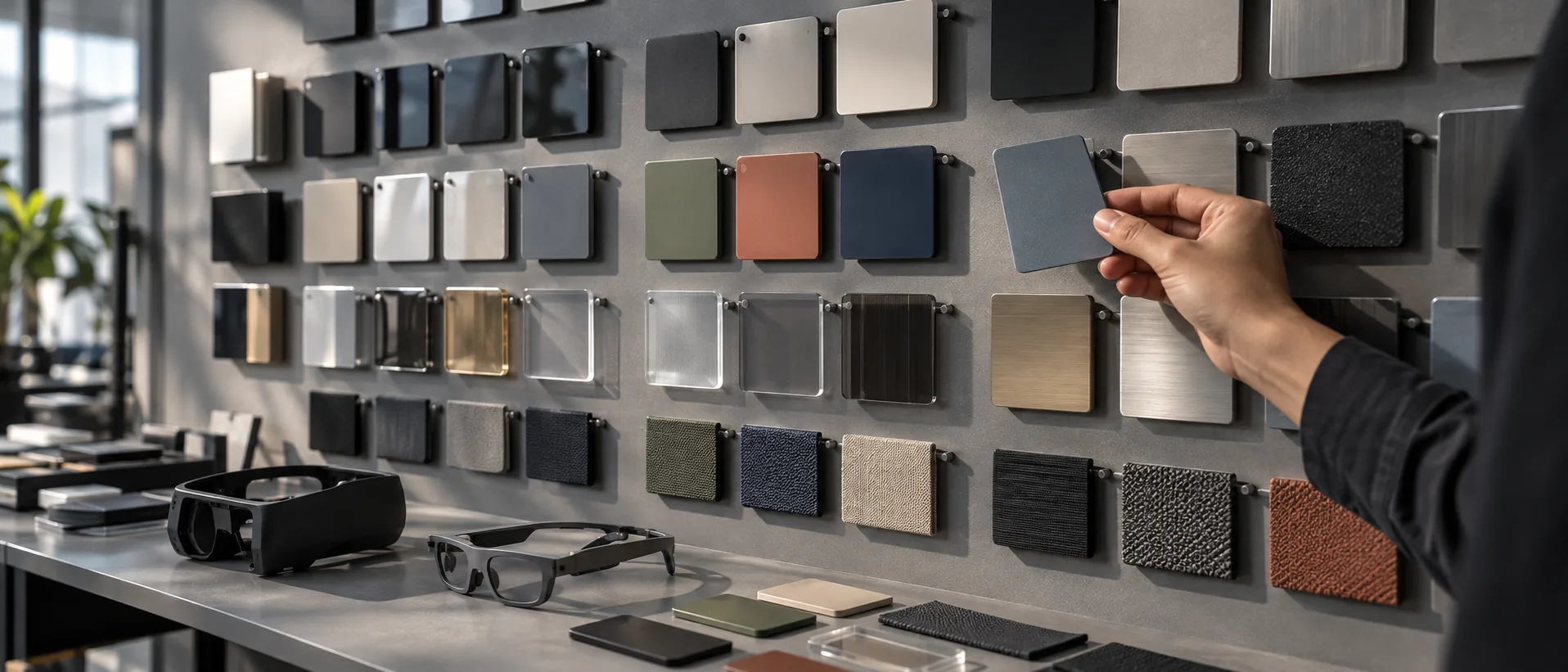
CMF customisation is the fastest path to a branded product. It requires no new tooling and inherits existing certifications within approved material families. All options have been pre-validated for thermal performance, skin-contact compliance, and regulatory requirements.
✦
Reference kit principle
CMF changes work within existing mould geometry. They do not alter structural dimensions, optical alignment, or BoM-critical component positions. Any change to a load-bearing surface, sealing interface, or thermal pathway — even if cosmetic in appearance — falls under the Mould Change rules in Section 04. Material selection must align to the approved families in the DFM Guide, Section 04.
C
Colour
Applied at the housing and moulded part level. All colours must pass UV stability, scratch resistance, and skin-contact compliance for wearable category.
Standard Palette — No tooling impact
Custom Colour — MOQ applies
Any Pantone or RAL reference at agreed MOQ
Two-tone / gradient available on review
UV-reactive and photochromic on request
Translucent requires mould texture review
M
Material
Material swaps within the same geometry family are permitted. Structural and optical housings cannot be re-specified at CMF tier. All approved families are in the DFM Guide, Section 04.
Applied post-moulding or in-mould (IMD/IML). Affects glare behaviour, perceived quality, cleaning durability, and skin-contact texture. Ra specifications are in the DFM Guide, Section 04.
Lens tints, waveguide coatings, and display brightness adjustments are optical engineering changes requiring photometric re-validation. Metallic inks or thick coatings near antenna windows require RF pre-compliance re-testing even as surface finishes. Any ambiguity should be referred to QWR engineering before brief submission.
Section 04
Mould Change Guide
Mould changes modify the physical geometry of a part. They are classified as Minor (insert modifications to existing steel) or Major (new steel or significant re-cut). Each classification carries structural, regulatory, and schedule implications and must be validated against the DFM Guide before drawing release.
✦
8 mm exclusion rule
Any surface change within 8 mm of a camera aperture, display window, optical lens, antenna clearance band, or thermal vent pathway requires a Full Engineering Review before proceeding — regardless of Minor or Major classification. This rule supersedes all other classifications in this section.
Minor Changes — Insert Level
Modifications to Existing Steel
Insert modifications within the existing tool. No new steel required. Lead time additive is 2–4 weeks. Engineering sign-off required before tooling instruction.
✓Logo emboss / deboss — brand mark on temple arm or front housing
✓Port repositioning — USB-C, SIM tray within ±5 mm of reference position
✓Vent pattern — number, shape, arrangement of thermal vents
✓Grip texture zone — pattern on touch or hold surfaces
✓Button profile — power, volume shape at same PCB footprint
✓Nose pad geometry — AI / AR glasses; clip-in form
✓Strap attachment point — VR; within existing boss locations
Major Changes — New Steel
New Tooling or Significant Re-cut
New tooling or full tool re-cut. Mandatory engineering sign-off. Lead time additive is 8–14 weeks. MOQ minimums apply. Compliance review required per Regulatory Framework Guide.
◈Frame silhouette — glasses only; overall form change
◈Face gasket geometry — VR; must re-validate IPD range and facial comfort
◈Speaker arm housing — acoustic cavity volume must remain within ±15%
◈Hinge mechanism — spring barrel change; friction re-test required
Locked Zones — No Change
Structurally or Optically Critical
Cannot be modified under Co-Branded or OEM engagements. ODM Full co-development only. All changes trigger full re-certification across active markets.
✗Optical engine housing — waveguide and lens mount position is fixed
✗Camera aperture zone — 8 mm exclusion radius
✗Antenna clearance window — Wi-Fi, BT, UWB clearance must be maintained
✗Thermal management zone — SoC heatsink, copper trace, vent pathway
✗PCB mounting bosses — mainboard and battery compartment geometry
✗IPD mechanism — VR optic block alignment rail
Packaging & Accessories — Full Freedom
Box, Case & Peripherals
All outer packaging, printed materials, carrying cases, and accessories are brand-defined with full creative freedom. QWR provides structural insert specifications only.
✓Strap / headband — VR; full CMF and material freedom
✓Documentation — brand voice, language, QR flows
Section 05
Software & UI Skinning
QWR's unified software stack runs across all SoC tiers. Brand partners can customise the experience layer without forking the core OS or AI engine. Available scope maps to engagement tier in Section 06.
Haptic pattern library — 8 base patterns, adjustable intensity
Sound scheme — system tones and confirmation chimes
Companion App — Flutter · iOS & Android
White-label app — iOS 15.5+ / Android API 30+
Brand splash, colour theme, icon replacement
Custom OTA firmware channel under brand domain
Device analytics — health, usage telemetry
BLE device pairing screen — fully skinnable
In-app content store or catalogue (optional)
◈
Immutable software components
The following cannot be modified under any engagement tier: core OS kernel, BLE and Wi-Fi firmware, optical calibration parameters, SoC PMIC tables, and hardware attestation certificates. These are immutable to preserve certification integrity across all active markets.
Section 06
Customisation Change Matrix
Quick reference across all product families. ✓ Available · ~ Engineering review required · — Not available at this tier.
Change Type
AI Glasses
AR Glasses
VR Headset
XR / MR
Min. Tier
Cert Impact
Housing colour
✓
✓
✓
✓
Co-Branded
Inherited
Logo — print / laser
✓
✓
✓
✓
Co-Branded
Inherited
Frame material swap
✓
~
—
—
Co-Branded
Review
Surface finish change
✓
✓
✓
✓
Co-Branded
Inherited
Custom Pantone / RAL colour
✓
✓
✓
✓
Co-Branded
Inherited
Custom packaging & accessories
✓
✓
✓
✓
Co-Branded
No impact
Custom AI wake word / persona
✓
✓
✓
✓
Co-Branded
No impact
Logo emboss / deboss (insert)
✓
✓
✓
✓
OEM
DoC update
Port / button repositioning
✓
~
✓
~
OEM
Pre-compliance re-test
Face gasket / nose pad change
✓
~
✓
✓
OEM
Comfort re-validation
Vent pattern change
✓
~
✓
~
OEM
Thermal re-test
White-label companion app
✓
✓
✓
✓
OEM
No impact
Custom launcher / boot animation
~
✓
✓
✓
OEM
No impact
Private OTA firmware channel
✓
✓
✓
✓
OEM
No impact
Frame silhouette change
✓
~
—
—
ODM Full
Re-file required
Housing form factor reshape
~
—
✓
~
ODM Full
Re-file required
SoC tier change
~
—
✓
~
ODM Full
Full re-cert
New optical engine / waveguide
—
—
—
—
ODM Full
Full re-cert + NB review
DoC = Declaration of Conformity · NB = Notified Body (EU/UK)
Section 07
Engagement Tiers
Three engagement tiers govern customisation depth, commercial structure, and QWR engineering involvement. All engagements operate under NDA. Commercial terms including unit pricing and NRE are issued formally post-NDA.
Tier 01
Co-Branded
From 200 units per SKU
Full CMF — colour, finish, material within approved palette
Brand logo — print, laser, pad print
Custom retail packaging and accessory bundle
Custom AI wake word and persona (HUMBL)
Companion app brand skin — splash, colours, icon
No mould changes
No firmware development
Lead Time from PO
3–4 months
Sample in 4–6 weeks
Tier 02
OEM
From 1,000 units per SKU
Everything in Co-Branded, plus:
Minor mould changes — logo inserts, port, vent patterns
White-label companion app (iOS & Android)
Custom launcher, boot animation, system font, LED
Private OTA channel under brand domain
IP protection; no third-party resale of QWR IP
QWR compliance support for declaration updates
Lead Time from PO
5–7 months
EVT sample in 6–8 weeks
Tier 03
ODM Full
From 5,000 units — project-based
Everything in OEM, plus:
Major mould changes — form factor, housing, frame
SoC tier selection from QWR platform roadmap
Co-development with QWR hardware team; dedicated PM
Full IP assignment on custom tooling and firmware forks
QWR operates manufacturing escrow with Syrma SGS and Axis Bank for all production orders above threshold. Funds are released milestone-by-milestone — EVT → DVT → PVT → MP. Standard procedure for all OEM and ODM Full engagements.
Section 08
Process & Timeline
Every QWR brand engagement follows a seven-stage process. Each gate is a quality and compliance checkpoint. Stages cannot be skipped.
Skipping EVT sign-off to compress schedule is the single most common cause of DVT failure in brand customisation programmes. QWR does not permit proceeding to DVT without formal EVT approval from both QWR engineering and the brand partner.
Section 09
Engagement Configurator
Identify your recommended engagement tier and indicative lead time before brief submission. All
outputs are pre-NDA estimates only. No commercial terms are included.
QWR Brand Partner Configurator
Indicative · Pre-NDA · No pricing quoted
Customisation Scope
Estimated Annual Volume
Section 10
Brief Submission Do's & Don'ts
The most common reasons an ID brief is returned before engineering feasibility review. Addressing these before submission avoids delays at every subsequent gate.
✓ Do
✓Submit Pantone or RAL references for all colour requests. Hex codes and photo references are insufficient for production colour matching.
✓Mark your logo exclusion zone. Minimum 4 mm clearance from any edge, port, vent, or antenna window.
✓Specify prescription lens compatibility if end users may need ophthalmic lenses — affects nose bridge geometry; this is a mould consideration, not CMF.
✓Provide target market list upfront. BIS, FCC, CE, and UKCA paths differ and affect schedule from week one. Refer to the Regulatory Framework Guide.
✓Approve 3D renders before requesting physical samples. Colour-matching physical samples is time-intensive; approve form and CMF digitally first.
✓State IP rating requirement. IPX4 is standard. IPX5 and above require mould review at all hatch and port interfaces.
✓Lock SKU count before tooling. Each colour variant is a separate paint run. SKU proliferation after tooling commitment has schedule implications.
✗ Don't
✗Don't request logo on optical or antenna zones. Metallic inks and thick embossing near antenna bands will fail RF certification regardless of visual intent.
✗Don't classify lens tint as a CMF change. Optical tint modifications require photometric re-validation and are outside CMF scope.
✗Don't submit competitor product images as ID references. QWR cannot reverse-engineer third-party designs. Submit original briefs or mood boards only.
✗Don't assume packaging dimensions carry over. Custom inserts must be re-specified per SKU. Dimensions from previous engagements do not transfer.
✗Don't change face gasket thickness independently. Affects IPD sweet-spot and optical alignment — routed through QWR optics, not the ID brief process.
✗Don't skip EVT sign-off to compress schedule. See Section 08. This is the single most common cause of DVT failure.
✗Don't add battery capacity without declaring it. Battery changes require fresh UN 38.3 certification and BIS amendment. Refer to the Regulatory Framework Guide.
Section 11
Certifications — Inheritance by Change Scope
QWR reference designs carry a full global certification stack. CMF changes within approved materials inherit certifications without re-filing. For the complete per-market compliance roadmap, refer to the QWR Regulatory Framework Guide.
BIS (India)
📡 WPC (India wireless)
FCC (USA)
ISED / IC (Canada)
CE / RED (Europe)
UKCA (UK)
RCM (Australia / NZ)
TELEC / PSE (Japan)
🔋 UN 38.3 Battery
🌐 RoHS 3 / REACH
♻ WEEE
⚙ ISO 9001 / 14001 / 27001
🔒 CMMI Level 3
Certification
CMF Change
Minor Mould
Major Mould
New SoC / Antenna
BIS / WPC (India)
✓ Inherited
DoC declaration update
Re-file required
Full re-certification
FCC / ISED (US / Canada)
✓ Inherited
SDoC update
Re-file required
Full re-certification
CE / RED / UKCA
✓ Inherited
DoC update
NB review required
Full re-certification
RCM (Australia / NZ)
✓ Inherited
ACMA registration update
Re-file required
Full re-certification
UN 38.3 Battery
✓ Inherited
✓ Inherited
✓ Inherited
Re-file if capacity changes
RoHS 3 / REACH
✓ Inherited
✓ Inherited
Substance review required
Substance review required
✦
QWR manages certification for ODM Full engagements
QWR's compliance team manages all certification filings on behalf of the brand partner. The brand's name appears as the responsible party on FCC, CE, and BIS declarations — standard practice for white-label OEM. For the full per-market roadmap, refer to the QWR Regulatory Framework Guide.
Ready to submit your brief?
QWR's partnerships team responds to all ID briefs within 48 hours. An NDA is executed before any product-specific information is shared.