Industry Insights · Procurement & Strategy
QXR-06-10 vs Meta Quest 3. Choosing a Headset for Institutional Deployment.
By QWR Product Engineering
Meta Quest 3 is built for consumer gaming and mixed reality at retail scale. QXR-06-10 is built for a different buyer: institutions and enterprises that need hardware they can adjust to a specific use case, a single vendor accountable for the whole deployment, and a path from a small pilot to a full fleet without renegotiating from zero. Here's how the two actually compare.
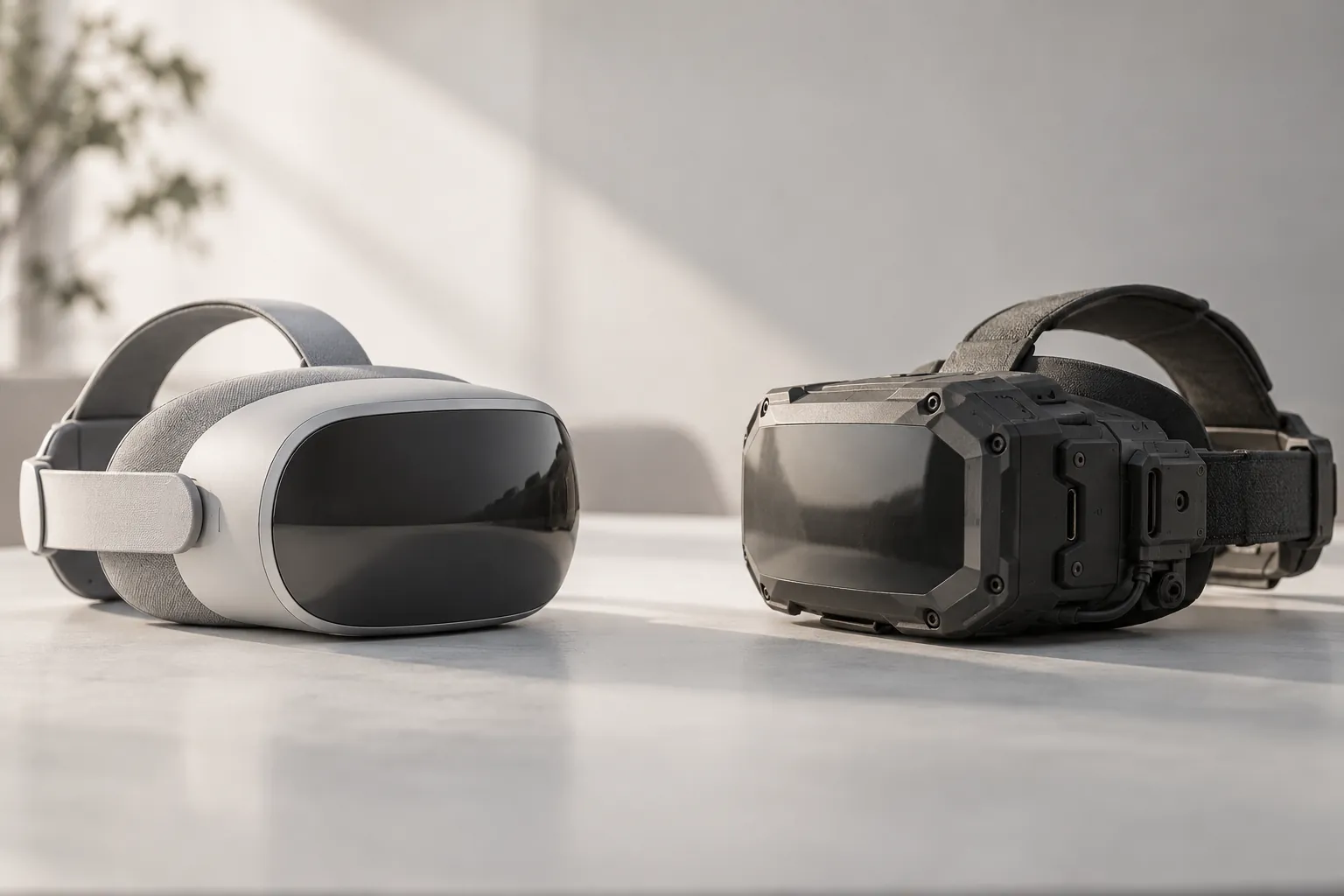
Illustrative image. These are not what our headsets look like.
Two Headsets, Two Different Buyers
Meta Quest 3 is a strong, widely available consumer standalone headset — designed to sell in the hundreds of thousands through retail, with a fixed hardware configuration and a software stack tied to a consumer account layer. QXR-06-10 competes on a different axis entirely: it's built through a direct OEM/ODM relationship, which means the buyer isn't just choosing a spec sheet, they're choosing a vendor who can adjust that spec sheet, support a phased rollout, and stay accountable for the fleet after the sale.
"For a consumer buyer, the headset is the product. For an institutional buyer, the headset is one part of a deployment — and the deployment is what actually needs to be evaluated."
1. The Specs, Side by Side
On raw hardware, the two now share more than buyers might expect — both run a Snapdragon XR2 Gen 2 SoC, 8GB of RAM, and full-colour passthrough. The differences that matter for a deployment decision are in the optics, the refresh-rate ceiling, and how spatial interaction is done: QXR-06-10 uses 2× 6DoF controllers with capacitive touch rather than Quest 3's bare-hand tracking.
| Spec | QXR-06-10 | Meta Quest 3 |
|---|---|---|
| Processor | Snapdragon XR2 Gen 2 | Snapdragon XR2 Gen 2 |
| Memory | 8 GB | 8 GB |
| Storage | 128 GB | 512 GB |
| Display | Fast LCD, 3664×1920 | LCD, 2064×2208 per eye |
| Refresh Rate | 90Hz standard (up to 120Hz on higher-spec display batch) | up to 120Hz |
| Field of View | 115° | 110° |
| Optics | Fresnel Lens | Pancake Lens |
| Passthrough | Full-colour, 2× 16MP RGB (4656×3496) | Full-colour passthrough |
| Tracking | 6DoF, 4× SLAM tracking cameras | 6DoF, inside-out |
| Controllers | 2× 6DoF, capacitive touch | 2× 6DoF, Touch Plus |
| Battery | 6000 mAh | ~2.2h general use (mAh undisclosed) |
| Hardware BOM | Adjustable per deployment | Fixed, consumer retail SKU |
| Sales channel | Direct institutional/enterprise | Consumer retail + business tier |
Quest 3 still wins on storage and raw display resolution, and matches QXR-06-10's refresh rate only against the higher-spec display batch — that's expected from a headset optimised for consumer content and games. QXR-06-10 leads on field of view (115° vs 110°, the widest in its bucket) and battery capacity (6000mAh, also the largest in its bucket). Either way, QXR-06-10's case isn't that it out-specs Quest 3 across the board; it's that everything below the sheet — the BOM, the sales relationship, and the device-management story — is built for institutional deployment rather than retail.
2. Hardware You Can Actually Adjust
Quest 3's bill of materials is fixed the moment it ships — every unit sold is identical, because it's manufactured for a single consumer SKU at retail volume. QXR-06-10 is built through a direct ODM relationship, which means the physical configuration isn't locked: strap and comfort hardware (it ships with a soft headband and clip-on face mask), port and mounting accessories, and packaging can all be adjusted to fit a specific deployment, without waiting on a general consumer product roadmap to catch up.
3. One Vendor, Accountable End to End
A consumer headset purchase ends at the retail transaction. An institutional deployment doesn't — it needs a vendor who stays involved through procurement, configuration, rollout, and the support calls that come after. QXR-06-10 is sold and supported directly by the team that builds it, so there's a single point of accountability for the hardware, the fleet configuration, and everything that happens once units are in the field.
4. Pilot-to-Scale, Not Just a Purchase
Institutional buyers rarely want to commit to a full fleet on day one, and they shouldn't have to. QXR-06-10's deployment model is built around starting small — validate the configuration on a pilot batch — then scaling the exact same specification and vendor relationship to the full fleet, rather than re-specifying and re-negotiating from scratch once the pilot proves out.
5. Built for MDM From the Start
QXR-06-10 runs a clean AOSP build with confirmed compatibility for enterprise MDM tools like Microsoft Intune — remote lock, wipe, and app allowlisting are supported without routing device management through a consumer account layer. The full mechanics of kiosk-mode lockdown and remote MDM are covered separately in Kiosk Mode, Secure Boot & Remote MDM.
Frequently Asked Questions
Can QXR-06-10's hardware be customized for our specific use case?
Yes — because it's built through a direct ODM relationship rather than sold as a fixed retail SKU, the hardware BOM can be adjusted for a specific deployment. Talk to our team about what needs to change for your use case.
Is QXR-06-10 compatible with our existing MDM setup?
Yes. It runs a clean AOSP build with confirmed support for enterprise MDM tools including Microsoft Intune, covering remote lock, wipe, and app allowlisting.
Can we start with a small pilot before committing to a full fleet?
Yes — that's the intended model. Validate the configuration on a small pilot batch, then scale the same specification and vendor relationship to a full deployment without renegotiating from zero.
How do international or first-time buyers get support?
We work directly with institutional and enterprise buyers rather than through regional distributors. Reach out via Contact and our team will scope your deployment directly, from a single pilot unit through to a full fleet.
FAQ
Frequently asked questions
Can QXR-06-10's hardware be customized for our specific use case?+
Yes, because it is built through a direct ODM relationship rather than sold as a fixed retail SKU, the hardware BOM can be adjusted for a specific deployment.
Is QXR-06-10 compatible with our existing MDM setup?+
Yes. It runs a clean AOSP build with confirmed support for enterprise MDM tools including Microsoft Intune, covering remote lock, wipe, and app allowlisting.
Can we start with a small pilot before committing to a full fleet?+
Yes, that is the intended model. Validate the configuration on a small pilot batch, then scale the same specification and vendor relationship to a full deployment without renegotiating from zero.
How do international or first-time buyers get support?+
QWR works directly with institutional and enterprise buyers rather than through regional distributors, scoping deployments from a single pilot unit through to a full fleet.
Request a Technical Briefing
Our team builds spec-aligned quotes and can adjust the hardware bill of materials for institutional and enterprise deployments.