Industry Insights · Industry · Tech
The Sentient Shop Floor. How the Industrial Metaverse Is Redefining Manufacturing ROI.
By QWR Technical Marketing
For years, the Digital Twin was a 3D dashboard. In 2026, visibility alone doesn't drive the 30–40% efficiency gains Indian factories need to win the "China Plus One" mandate. The shift has moved to Sentient Operations — an Industrial Metaverse that doesn't just show the floor, it understands it.
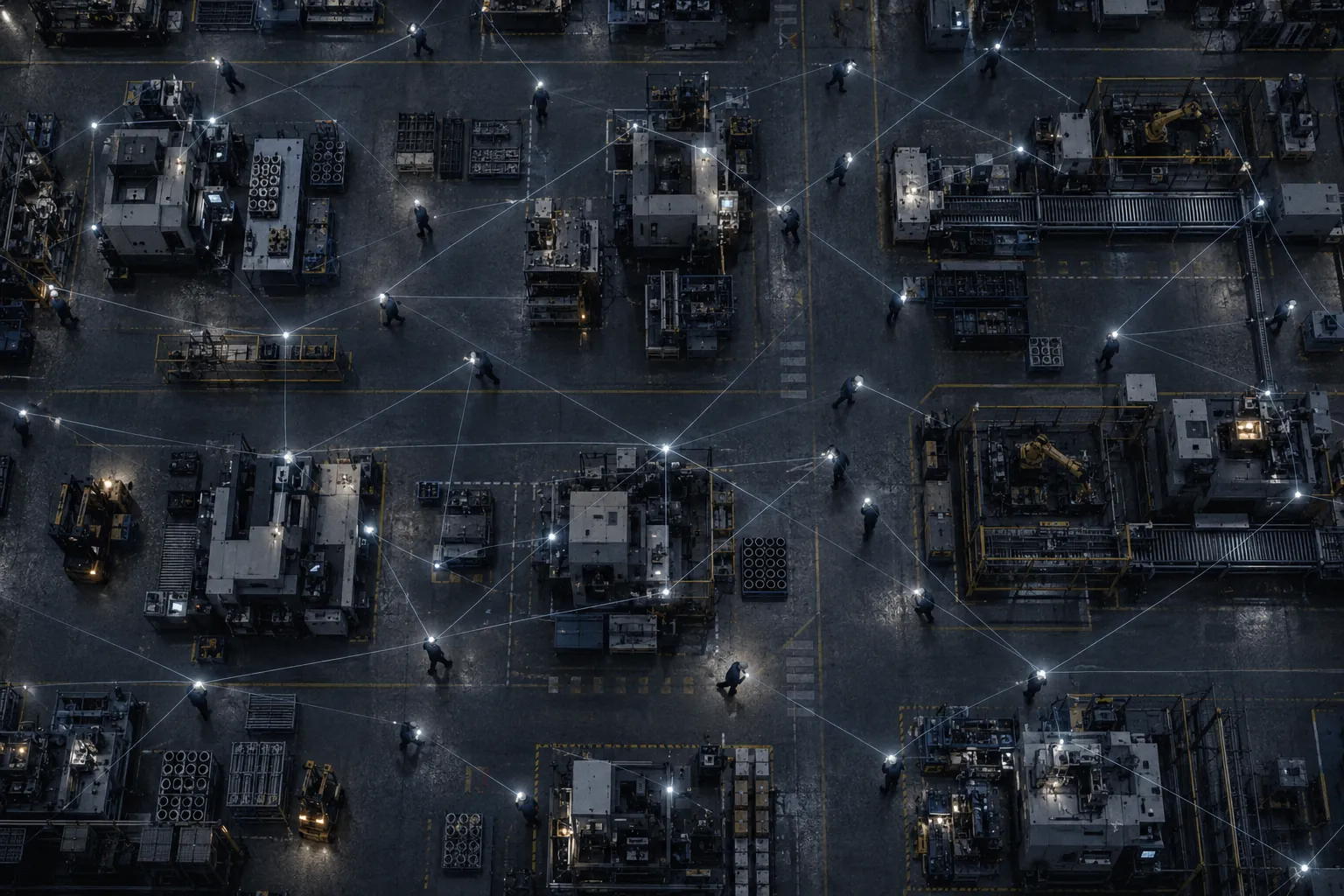
From Visibility to Sentience
This isn't about training anymore. It's about building a sentient infrastructure that proactively identifies errors, predicts downtime, and assists the human workforce with millimetre precision. Spatial computing and on-device AI have converged to create an environment where the factory floor genuinely understands the workflow — not as a metaphor, but as a measurable operational shift.
"The Industrial Metaverse is no longer a destination. It is the new operating system for the Indian factory."
1. The Anatomy of a Sentient Digital Twin
In a traditional setup, a digital twin is reactive. In a sentient setup, the twin is predictive and interactive. Three core technological pillars have matured significantly this year:
Multimodal Perception at the Edge
Modern industrial wearables are no longer just displays — they are sensory nodes. Computer vision and acoustic sensors let the hardware "hear" a bearing failure or "see" a missing safety pin before the human operator does. Local on-device AI processing delivers instant haptic and visual alerts at sub-20ms latency, the threshold below which both safety and user comfort hold.
Spatial Anchoring and Persistence
In the 2026 Industrial Metaverse, digital data is anchored to physical assets. If a senior engineer leaves a holographic note on a specific valve during the morning shift, that note is persistently visible to the evening-shift technician. This spatial continuity eliminates the "information hand-off" errors that account for nearly 15% of operational downtime in large-scale Indian plants.
Unified ERP Data Streams
The sentient floor is connected. Integrating XR hardware with existing ERP and MES systems lets the Metaverse hold real-time state on supply chains, work orders, and personnel certification. If a technician attempts to service a machine they aren't certified for, the system can physically mask the interface — preventing unauthorised, potentially dangerous interventions before they start.
2. The Workforce Transformation: Solving the Skills Gap
The most profound impact of a sentient shop floor is its ability to accelerate Time-to-Proficiency (TTP). As India aims for the USD 5 trillion economy mark, demand for skilled technical labour is outstripping supply. Spatial computing bridges the gap with "Knowledge on Demand."
Instead of weeks in a classroom, a new hire can be deployed to the floor on Day 1. The sentient environment recognises their skill level and provides a "scaffolded" experience — high-detail AR overlays for complex tasks that gradually fade as the worker gains proficiency. This "Simulation-First" approach builds correct muscle memory from the start, eliminating the Negative Training risk that plagues traditional shadowing programmes.
3. Quantifying the ROI: From Error Reduction to Servitization
The financial case has shifted from "soft" benefits like engagement to "hard" metrics that move EBITDA. Indian enterprises adopting sentient operations report a 40% reduction in manufacturing errors and a significant uptick in equipment Uptime.
Beyond internal efficiency, we're seeing the rise of Servitization. Manufacturers are no longer just selling machines — they're selling guaranteed uptime. By equipping their customers with spatial computing tools for remote maintenance and predictive diagnostics, OEMs are creating high-margin recurring revenue streams that simply weren't possible before. The model rests on the Total Cost of Ownership of the hardware: ruggedised, BIS-certified devices that can survive 24/7 industrial cycles while remaining DPDP-compliant.
4. Solving the Privacy and Compliance Hurdle
A major concern for the 2026 Indian CIO is how to inhabit this Metaverse without compromising data sovereignty. Enforcement of the DPDP Act 2023 has made on-device processing a non-negotiable requirement. A sentient factory generates petabytes of spatial maps and biometric data — if that's streamed to a public cloud, it creates a massive legal and security vulnerability.
The move toward Sovereign XR — hardware that processes and stores sensitive spatial data locally — is the only viable path forward. The layout of a sensitive defence facility, or the proprietary assembly process of a new EV battery, stays within the four walls of the factory. Compliance with IS/IEC 62368-1:2023 additionally ensures these devices are thermally safe for all-day wear — a critical factor for worker-union acceptance and long-term HSE compliance.
5. Operational Resilience in a "China Plus One" World
As global procurement leads diversify away from traditional manufacturing hubs, supply-chain resilience has become a primary metric. Spatial computing enables Remote Factory Acceptance Testing (FAT): a procurement lead in Europe can "walk" an Indian shop floor virtually, inspecting quality at the sub-millimetre level, without boarding a plane.
This transparency builds the trust necessary to shift high-value manufacturing onto Indian soil — effectively realising "China Plus One" through technological superiority rather than just lower labour costs.
6. The Path Forward: Scaling the Metaverse
As we look toward H2 2026, the goal for Indian industry is simply scale. The "Pilot Purgatory" of previous years has been solved by standardised implementation roadmaps. Success now depends on choosing hardware that is "future-proof" — devices that:
- Support Bharat 6G latency standards.
- Feature high-density waveguide optics for all-day comfort.
- Carry the on-device compute power to run the next generation of sentient AI agents.
The Industrial Metaverse is no longer a destination; it is the new operating system for the Indian factory. Those who inhabit it today will define the manufacturing standards of tomorrow. By integrating spatial intelligence into the core of the production line, we aren't just making things faster — we are making them smarter, safer, and more sovereign.
FAQ
Frequently asked questions
What does sentient mean in QWR's Industrial Metaverse framing?+
A digital twin that is predictive and interactive rather than just a reactive 3D dashboard, using multimodal perception (computer vision, acoustic sensors) to proactively identify issues.
How does QWR's shop-floor AI stay DPDP compliant?+
Through on-device processing rather than streaming spatial maps and biometric data to a public cloud; sensitive data like a proprietary assembly process stays within the factory's four walls.
What is Remote Factory Acceptance Testing (FAT)?+
A capability letting a procurement lead in another country virtually walk an Indian shop floor and inspect quality without travelling, using spatial computing for sub-millimetre-level inspection.
Request a Technical Briefing
QWR builds DPDP-compliant, BIS-certified spatial computing deployments for Indian manufacturing — from on-device AI wearables to ERP-integrated digital twins. Talk to us before your next CapEx cycle.