Industry Insights · Aerospace · MRO
The MRO Metaverse. Reducing Aircraft Downtime by 30% via Spatial Engineering.
By QWR Technical Marketing
With the induction of Tejas Mk2 and MQ-9B SkyGuardian, traditional 'break-fix' maintenance is no longer viable. A deep-dive on how AR, predictive digital twins, and sovereign knowledge capture are transforming Indian hangars.
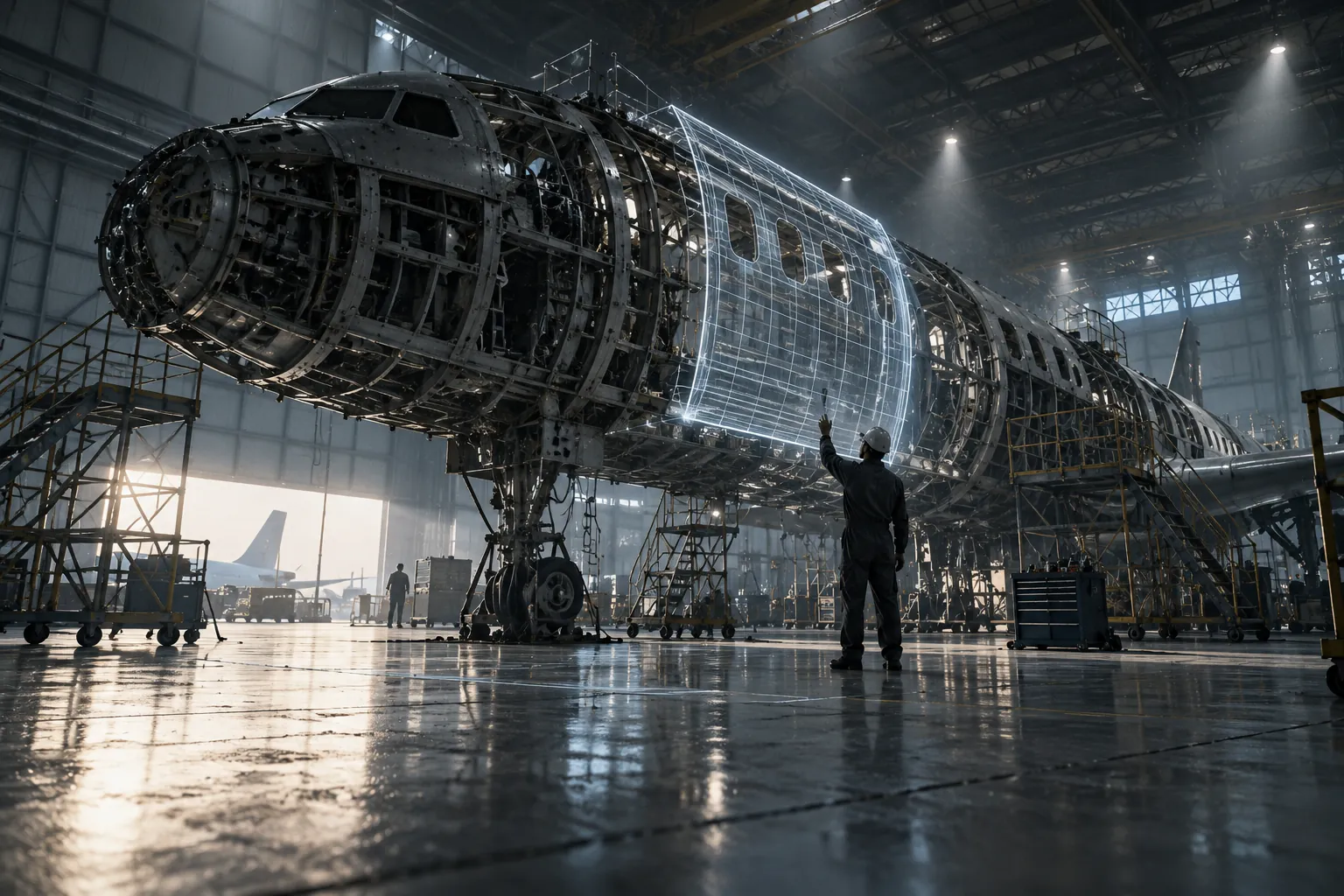
From Break-Fix to Mission Assurance
As of April 2026, the Indian Ministry of Defence has mandated a definitive pivot toward the "MRO Metaverse" to ensure high operational availability of its increasingly complex air fleet. With the rapid induction of platforms like the Tejas Mk2 and the MQ-9B SkyGuardian, traditional break-fix maintenance is no longer viable. By leveraging AR and Predictive Spatial Maintenance, the Indian Armed Forces are transforming their hangars into high-tech hubs where every technician has the power of a master engineer at their fingertips.
"The future of Indian aerospace sustainment is heads-up, hands-free, and spatially intelligent."
1. The Sustainment Crisis: Rising Costs and Skill Gaps
Aerospace field service and maintenance face an unprecedented productivity and workforce skills gap. While the global field service management market is projected to grow from $5.21 billion to $25.26 billion by 2030, the economic forecast remains uncertain. Costs have increased across almost every facet of field operations.
- Rising labour costs: Since 2021, field service labour costs have gone up 8% and are rising.
- The veteran exodus: Over 10,000 baby boomers leave the workforce each day globally, contributing to an expected 8.2 million worker shortage by 2027.
- The 'poorest performer' penalty: A company's poorest-performing employees cost 67% more than their highest performers. Knowledge gaps drive truck rolls and wrong-part orders.
2. AR-Guided Maintenance: The 'See-What-I-See' Advantage
The core of the MRO Metaverse is the transition from static, paper-based technical manuals to Assisted Reality and Augmented Reality interfaces.
- Hands-free operation: Smart glasses are particularly valuable — technicians access AR while keeping hands free and heads up, maximising work efficiency and improving safety.
- Remote support: A service technician connects with an off-site supervisor who views what the on-site technician is seeing and walks them through needed steps via video. This drops repair times and reduces truck rolls.
3. Predictive Spatial Maintenance: Beyond First-Time Fix Rate
For years, First-Time Fix Rate was the only KPI organisations used. In 2026, FTFR alone is not enough to overcome today's cost pressures.
- Diagnostic accuracy: AR devices with AI integration detect technical problems with 98% accuracy.
- Historical trend analysis: AI integration lets technicians review repair history and spot patterns instantly.
- Zero-travel troubleshooting: 75% of AR users report a greater ability to resolve problems without dispatching a senior technician.
- Predictive shift: IoT-enabled sensors drive a shift from reactive to predictive repair — addressing problems before they cause shutdowns.
4. The Economic Impact: 42% More Profitable Sustainment
Strategic investment in AR wearables is no longer a futuristic option; it is a prerequisite for survival in a high-cost environment. For large-scale defence organisations, deploying AR in field service can result in annual cost savings of up to $20 million. Companies utilising AR also see 1.6× greater annual revenue compared to non-users.
5. Sovereignty, Training, and the IDDM 2026 Mandate
In accordance with DAP 2026 IDDM guidelines, the MRO Metaverse in India is built on a Sovereign Skill Stack.
- Bridging the skill gap: AR deployment decreases the learning gap between new hires and senior-level technicians.
- Time-to-proficiency: 65% of organisations employing AR benefit from a decrease in ramp-up time for new employees.
- Rapid productivity gains: 60% of companies see YoY increases in overall productivity.
- Improved retention: 68% of companies see a decrease in annual voluntary turnover — visual, immersive training appeals to younger employees.
- Third-party efficiency: As 86% of companies outsource a portion of field service tasks, AR lets organisations boost the performance of third-party service providers.
Strategic Conclusion: From Maintenance to Mission Assurance
By April 2026, the MRO Metaverse has become the standard by which operational performance is measured. By reducing Aircraft-on-Ground time by 30% and slashing repair costs, the Indian Armed Forces are ensuring that the Simulation-First approach extends from the training room to the flight line. Businesses that have employed AR experience a 17.8% YoY increase in customer lifetime value — 3× that of organisations yet to implement it.
Request a Technical Briefing
Our team provides direct support for procurement officers, institutional buyers, and enterprise technology leads.