Industry Insights · Defence · Training
Indian Armed Forces XR Training. How Simulation-First Cuts Rehearsal Costs by 40%.
By QWR Technical Marketing
The Indian Army has declared 2026 the Year of Networking & Data Centricity. With Bharat 6G private bands and IDDM-compliant XR, tactical rehearsal has moved from wood mock-ups to tactical digital twins.
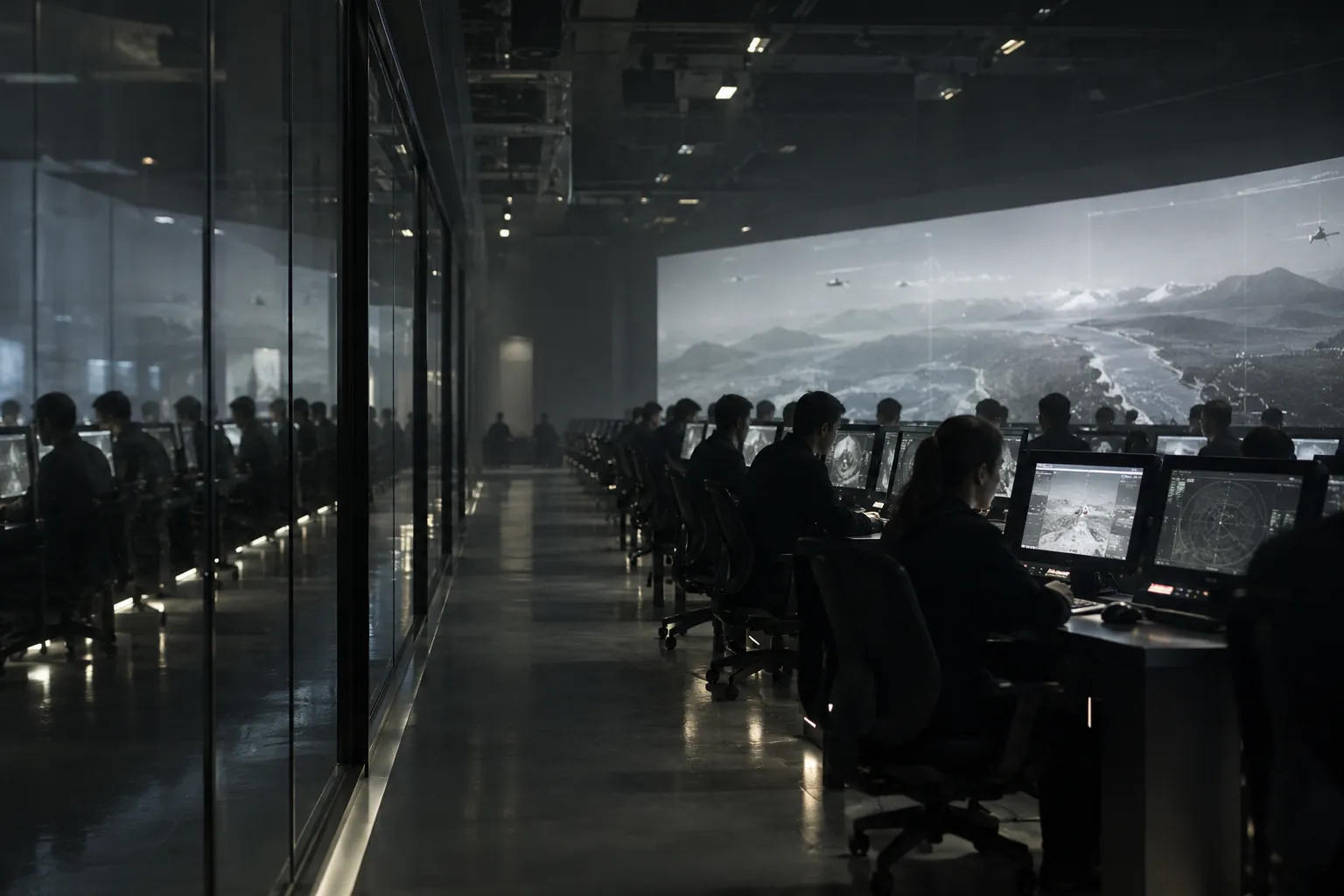
From 'Technology Absorption' to 'Operational Data Centricity'
In the strategic roadmap for April 2026, the Indian Armed Forces have officially transitioned from "Technology Absorption" to "Operational Data Centricity." Following the Union Budget 2026–27, which allocated a record ₹2.19 Lakh Crore for capital outlay, the mandate has shifted. We are no longer just buying hardware; we are investing in Sovereign Readiness.
By shifting the first 80% of tactical mission rehearsal into IDDM-compliant XR environments, India's defence ecosystem is achieving a 40% reduction in rehearsal costs and a significant acceleration in the sensor-to-shooter timeline for frontline units.
"We are no longer just 'preparing' for war; we are simulating victory until it becomes a statistical inevitability."
1. The 'Networking & Data Centricity' Mandate
The Indian Army has declared 2026 as the Year of Networking & Data Centricity. This isn't just a slogan; it is a structural overhaul of how we train.
- Network-Centric Warfare: Training is moving away from isolated drills. XR headsets are networked via Bharat 6G private bands, allowing a platoon to rehearse a synchronised pincer move across land and air domains in a shared virtual space.
- Data as a Strategic Asset: Every movement, trigger pull, and spatial decision in simulation is captured as data. Commanders make data-centric decisions, identifying tactical bottlenecks before a single boot touches the ground.
2. Why the 40% Saving Is a Reality
The 40% cost reduction is driven by the elimination of "physical friction" in the training pipeline. Traditional rehearsals for specialised operations typically involve building wooden mock-ups, transporting thousands of troops, and burning millions in fuel and live ammunition.
By using Tactical Digital Twins — centimetre-accurate 3D scans of operational terrain — units now rehearse a high-stakes airborne drop or urban sweep 50 times in a virtual world for the cost of a single physical jump.
3. Scaling the 'Agniveer' Pipeline
With the Agnipath scheme reaching full maturity in 2026, recruit volume has reached an all-time high. The military can no longer afford the multi-month learning curve of previous decades.
- Early performance filtering: AI-driven analytics track muzzle discipline and spatial awareness in the first 48 hours of induction.
- High-throughput training: 100 recruits can rehearse an urban sweep simultaneously in a 20×20 foot room, achieving the same muscle memory as a week on a live firing range.
4. Indigenous Sovereignty: The IDDM 2026 Edge
Under the newly released DAP 2026 (Draft), the "Buy (Indian-IDDM)" category now requires 60% Indigenous Content. This shift has effectively secured India's "Digital DNA."
- Air-gapped security: Modern XR training systems are designed to operate without external cloud dependency. Tactical data remains sharded and locally processed, ensuring spatial intelligence never leaves sovereign borders.
- Architectural control: By owning the source code and design data locally, the Indian defence ecosystem can upgrade hardware and software ab initio without external permission.
Strategic Conclusion: Victory Is a Replay
The strategic goal of the 2026 Simulation-First mandate is to ensure that when an Indian soldier steps onto a real battlefield, it doesn't feel like a surprise — it feels like a replay. By cutting the "Cost of Failure" in the virtual world, the Indian Armed Forces are ensuring that the "Cost of Victory" in the real world is as low as humanly possible.
The 2026 Defence Procurement & Readiness Checklist
- Audit for IDDM compliance: Does your hardware meet the 60% indigenous content threshold? Systems relying on foreign-designed core PCBs or optical engines may be re-categorised, causing procurement delays.
- Verify air-gap security: Ensure tactical data remains sharded and locally processed. All spatial mapping data must be hosted on sovereign servers.
- Assess simulation fidelity: Demand 1:1 Digital Twin accuracy that mirrors real-world telemetry, updated to 2026 topographical specs.
- Evaluate data-centric readiness: Confirm the system can handle high-uplink requirements for real-time, multi-site collaborative briefings per the Year of Networking protocols.
Request a Technical Briefing
Our team provides direct support for procurement officers, institutional buyers, and enterprise technology leads.