Industry Insights · Defence · Soldier Systems
The Eagle Eye Initiative. Solving the Intelligence Paradox on the 2026 Battlefield.
By QWR Technical Marketing
India's drones are flawless. The soldier holding the tablet is not. A structural look at how spatial overlays, edge NPUs, and biometric-responsive HUDs close the sensor-to-shooter loop.
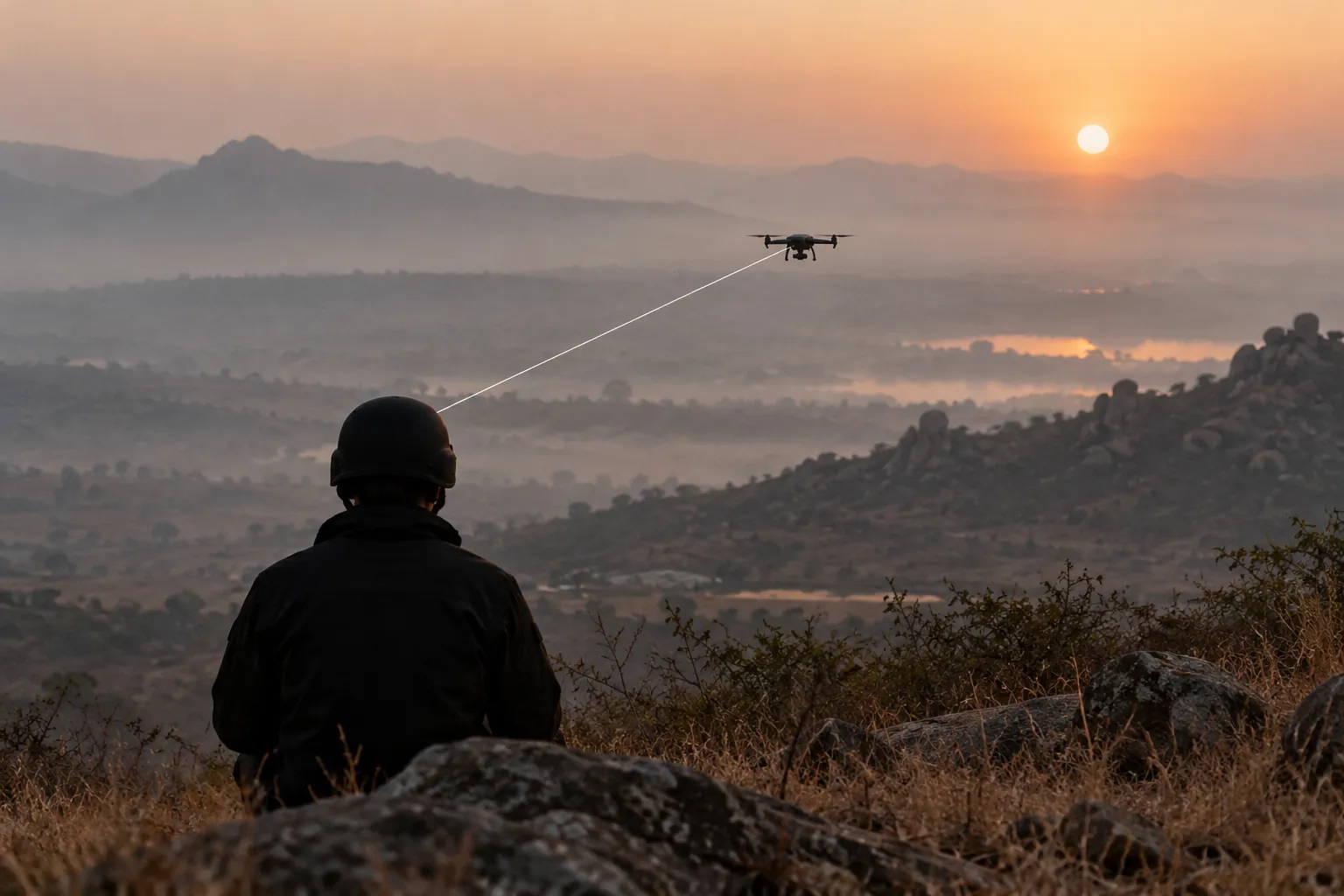
The Drone Is Smart. The Soldier Is Not.
In April 2026, the character of Indian conflict has undergone a fundamental realignment. Following the high-altitude lessons of the last 24 months, the Indian Armed Forces have achieved a Drone-First posture. But this technological leap has created a dangerous Intelligence Paradox: as our Unmanned Aerial Systems become more autonomous, the dismounted soldier risks becoming the weakest link in the data chain due to Information Asymmetry.
We are smartening the machines, but leaving the warfighter in a 20th-century information vacuum. The Eagle Eye initiative is the strategic bridge designed to fix this.
"The Indian infantryman of 2026 doesn't need more gadgets — they need Cognitive Empowerment."
1. The 'Data Wall' & The Latency of Command
The modern Indian Drone Shakti ecosystem generates terabytes of ISR data every minute. From Solar-Electric HALE drones patrolling the LAC to Nano-Swarms clearing urban corridors in the North East, the eye in the sky is flawless. The problem is what happens next.
- Cognitive overload: Data flows from the drone to an ICCC, where analysts process it before relaying back to the platoon leader via voice radio or handheld tablet.
- The 30-second death loop: In the hyper-war environment of 2026, a target identified by a drone can move or neutralise a squad before the verbal radio command reaches the soldier.
- The 'stupid' factor: Without a heads-up interface, a soldier is tethered to a tablet — losing peripheral vision and dropping reaction time.
2. Eagle Eye: Closing the Sensor-to-Shooter Loop
The Eagle Eye interface transforms the soldier from an isolated operator into a Networked Node.
Direct Retinal Uplink
Live feed from a loitering munition is projected directly onto the soldier's ballistic visor — a transparent AR overlay, not a video screen. If a drone sees a sniper on a rooftop, a red diamond appears on that rooftop in the soldier's actual field of vision. Eyes on target, finger on trigger.
Blue Force Tracking (BFT) 2.0
In grey-zone or urban CQB chaos, Eagle Eye uses Ultra-Wideband and GPS-independent positioning to highlight teammates with a green "glow" even through thick concrete walls or dense forest canopy.
Target Acquisition via Gaze
Integrating AI-driven Shatrujeet frameworks, the system uses eye-tracking. A soldier simply looks at a suspicious window, and the micro-drone nearby "locks" its gimbal onto that exact coordinate, providing an X-ray-style thermal overlay of the interior.
3. Tactical Edge Computing: The 'Brain' in the Helmet
To avoid cloud-latency stutter, Eagle Eye relies on Tactical Edge Computing. We cannot rely on a distant server in Delhi or a 5G tower that could be jammed.
- Ruggedised NPU: AI "thinking" happens on the soldier's person — typically in a unit no larger than a smartphone carried in the vest. The NPU filters non-combatants and only pushes mission-critical intelligence to the display.
- On-device sharding: Even if a headset is captured, the data is encrypted and broken into useless pieces — impossible for an adversary to reverse-engineer the battalion's tactical map.
- Spatial audio integration: If an acoustic sensor on a drone detects a muffled footstep 200m to the flank, Eagle Eye generates a directional 3D "ping." The soldier hears it as if coming from the source of the threat.
4. Sovereignty & The IDDM Mandate
- Air-gapped privacy: Eagle Eye operates without external network dependency. In GNSS-denied environments, the system uses Visual Inertial Odometry to navigate — the soldier's map is built locally as they move.
- Bharat 6G resilience: While 5G was about speed, 6G in 2026 is about Resilience. It allows ultra-low latency (<10ms) between a squad and their drone swarm, even in an electronic warfare storm.
5. The Cognitive Exoskeleton: Combating the 'Fog of Data'
In high-stress environments, we often mistake "more information" for "better intelligence." If a soldier is flooded with alerts, they experience Cognitive Freeze. Eagle Eye acts as a Cognitive Exoskeleton — it doesn't just add tech; it filters reality.
'Subtractive' UI: The Power of the Cognitive Filter
Unlike civilian AR which seeks to add content, Eagle Eye is subtractive by design. The AI ingests 100% of drone data but pushes only the relevant 3% to the visor.
- Sector-specific relevance: The system suppresses alerts about a target 1km away already tracked by long-range assets, focusing attention on immediate threats in the 200-metre engagement zone.
- Prioritised lethality: A soldier with a standard rifle isn't alerted to an armoured vehicle 2km away (that's the anti-tank team's problem); they're alerted to the insurgent with an RPG hiding 100m to their flank.
Biometric-Responsive Interfaces ('Stress-Sync')
Non-invasive sensors in the helmet monitor heart rate, pupil dilation, and galvanic skin response.
- Dynamic information density: If cortisol and heart rate spike (high combat stress), the system simplifies the HUD — stripping non-essential data, leaving only the Threat Red-Box.
- Focus-assist: When fatigue is detected, the AI increases visual contrast on potential targets to compensate for reduced human reaction times.
Haptic Directionality: Bypassing Visual Saturation
The human visual system is easily saturated. Integrated haptic actuators in the vest provide a subtle tap on the shoulder corresponding to the direction of detected movement — silent, non-visual communication, crucial for Night-OPs where light discipline is paramount.
Conclusion: From 'Boots on Ground' to 'Nodes on Grid'
Eagle Eye isn't just a vision tool; it is a Decision-Support System. It solves the Intelligence Paradox by ensuring the Brain on the ground is just as fast and informed as the Metal Mind in the sky. In the Year of Networking, the most lethal asset isn't the smartest drone — it is the soldier who can finally see through its eyes.
Request a Technical Briefing
Our team provides direct support for procurement officers, institutional buyers, and enterprise technology leads.